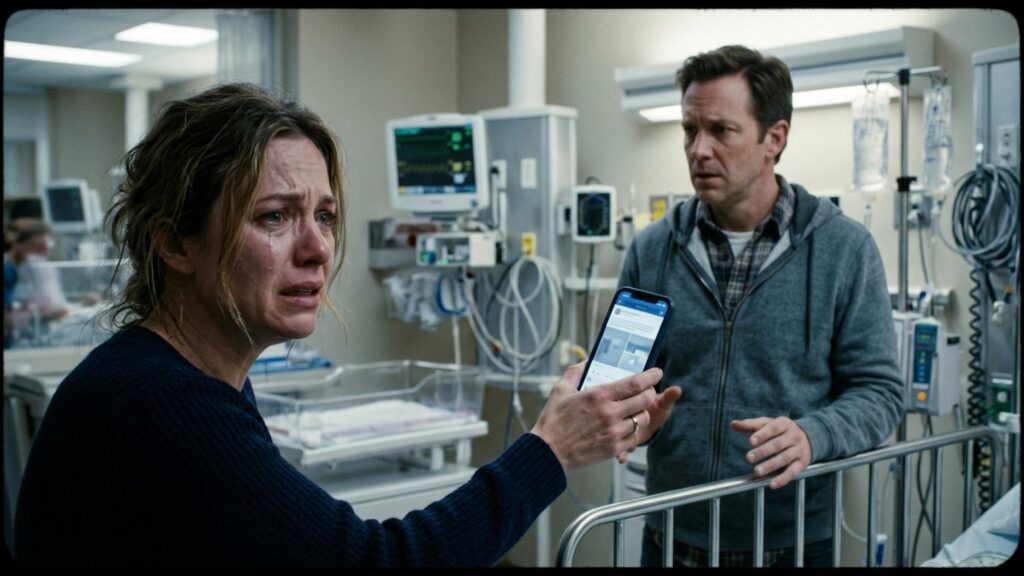
“What time is the funeral?”
My husband’s voice was so calm that I thought I’d misunderstood him.
I looked at the clock on my dashboard.
8:15 p.m.
“Michael, what are you talking about?”
“Emily’s not going to make it, Sarah. We need to start planning.”
My fingers tightened around the steering wheel.
“She’s eight years old. She’s in intensive care. Have the doctors said she’s dying?”
He sighed.
“Stop making this harder than it already is.”
“Are you with her?”
Silence.
“Michael?”
“I left. There’s nothing I can do sitting beside a hospital bed.”
Then he hung up.
I was forty minutes from Children’s Hospital in Columbus, Ohio.
Our daughter had been admitted that afternoon with severe pneumonia complicated by sepsis. Her breathing had deteriorated rapidly, and doctors had placed her on a ventilator.
I’d been working two hours away when Michael called at 4:20.
He said Emily was sick but stable.
An hour later, a physician told me by phone that she was critically ill.
I drove straight to the hospital.
Now my husband was discussing her funeral.
When I reached the pediatric ICU, I nearly collided with a nurse carrying supplies.
“Emily Carter. Room twelve. Please.”
She pointed down the hallway.
Through the glass, I saw my daughter.
Her dark hair was tangled against the pillow. A ventilator tube was secured at her mouth. Monitors glowed beside her bed.
But her chest was rising.
I pressed my palm against the glass.
A nurse approached.
“Mrs. Carter? I’m Rachel. I’ve been caring for Emily.”
“Is she dying?”
Rachel’s expression changed.
“She’s critically ill, but her blood pressure has improved with treatment. The medical team is reassessing her frequently.”
I swallowed.
“My husband said we needed to plan her funeral.”
Rachel stared at me.
“Your husband said that?”
“He left her here.”
She looked toward the nurses’ station.
Then she asked another nurse to stay with Emily.
“Mrs. Carter, could we speak privately for a moment?”
We stepped into a small family consultation room.
Rachel closed the door.
“I need you to understand that Emily is alive. We haven’t told anyone that she has died.”
“I know.”
Rachel lowered her voice.
“I’m asking because someone shared a message with our charge nurse tonight.”
She showed me a screenshot of a public social-media post.
It contained Emily’s school photograph.
Above it were four words:
IN LOVING MEMORY OF EMILY CARTER.
The post was timestamped 7:43 p.m.
Thirty-two minutes before Michael called me.
Beneath the photograph was a donation link.
And the person who had published it was my husband.
Rachel looked at me carefully.
“Mrs. Carter, your husband announced your daughter’s death while she was still receiving treatment.”
Then she pointed to the last line of the post.
“He also told people to send memorial donations directly to him.”
I read the post three times.
Our beautiful Emily fought bravely, but heaven called her home tonight.
Below it, Michael had written:
Please respect Sarah’s privacy. She’s too devastated to answer questions.
I looked up.
“He’s telling people I know?”
Rachel nodded.
“Our charge nurse received the screenshot from someone who recognized Emily’s name. We’ve notified the hospital’s social worker.”
I asked whether I could stay with my daughter.
“Of course,” Rachel said.
I returned to Emily’s bedside.
Her fingers were cool beneath mine.
“Mommy’s here,” I whispered.
A monitor beeped steadily.
I pulled my chair closer.
For twenty minutes, I watched the ventilator move air into her lungs.
Then my phone began vibrating.
Messages from relatives. Coworkers. Parents from Emily’s school.
Sarah, we’re so sorry.
We donated. Please let us know if you need anything.
Emily was such a beautiful little girl.
I opened the fundraiser.
It had already collected $18,650.
The description said the money would cover funeral expenses and help Michael cope with losing his daughter.
It didn’t mention that Emily was alive.
I took screenshots and sent them to my sister, Jessica.
She called immediately.
“Sarah, I just saw it. Is Emily—”
“She’s alive.”
Jessica started crying.
“Then why is Michael doing this?”
“I don’t know.”
But I remembered something.
Six weeks earlier, Michael had started a separate fundraiser when Emily first developed recurring respiratory problems.
He claimed we needed help with medical expenses.
I’d told him to wait until we understood our insurance coverage.
He insisted people wanted to help.
When I asked how much had been donated, he said approximately three thousand dollars.
I opened that older fundraiser.
The total was $24,300.
My stomach dropped.
At 10:06 p.m., Michael finally returned my call.
“Why are you ignoring my messages?” he demanded.
“Take down the announcement.”
He went quiet.
“What announcement?”
“The one saying Emily died.”
“Sarah, she’s on a ventilator. I’m preparing people for what’s coming.”
“You announced her death.”
“I was trying to get help.”





