Three days later, Mia underwent her first surgical procedure. Doctors treated the injured tissue and prepared for possible grafting. I sat outside the operating room with her rabbit pressed against my chest.
When she woke, she asked for water.
Then she asked something else.
“Mommy, am I in trouble for telling?”
I leaned closer.
“Telling what, sweetheart?”
She glanced toward the door.
“Daddy said if I told anybody what Aunt Brooke did, nobody would believe me.”
I swallowed.
“Did he say anything else?”
Mia nodded.
Her voice was barely audible.
“He told me they were going to make a video so you would never get to keep me again.”
I didn’t ask Mia another question.
I kissed her forehead, carefully avoiding the dressings, and told her she had done nothing wrong.
The child interviewer would need to hear her account without my unintentionally influencing it.
But those words stayed with me.
So you would never get to keep me again.
For years, Daniel had accused me of being too controlling. During our divorce, he told the mediator that my military service made me incapable of understanding ordinary family life.
He wanted more custody time.
Not because he’d suddenly become an attentive father, but because he’d grown furious about paying child support and having to consult me about school and medical decisions.
I hadn’t understood how far that resentment had spread through his family.
During the investigation, detectives obtained additional messages between Daniel and Brooke.
One was sent three days before the incident.
Get her on camera throwing a tantrum. I want proof of what Erin’s raising.
Brooke had replied:
Leave it to me. That little girl needs to learn who’s in charge.
Investigators also recovered the longer original recording. It showed Daniel preparing to film Mia’s reaction while Brooke confronted her over asking to call me.
The recording hadn’t begun as evidence of an accident.
It had begun as an attempt to humiliate a frightened child.
And when Brooke lost control, Daniel had kept filming instead of protecting his daughter.
The criminal investigation continued for months. Brooke was charged in connection with the assault, and prosecutors examined Daniel’s participation and failure to seek medical assistance. His own recording, the medical findings, and the messages became central evidence.
Neither my past service nor my anger determined the outcome.
The courts did.
Meanwhile, the family court granted me temporary sole physical custody, with Daniel’s contact restricted while the child protection investigation proceeded. After further hearings and professional assessments, the parenting order was modified to maintain Mia’s primary residence with me. Daniel’s visits were supervised, subject to conditions and future review.
Brooke was prohibited from having contact with Mia.
Patricia called me a monster.
“You’ve destroyed our family!”
I was standing in the hospital corridor when she said it.
Behind the glass, Mia was asleep, her rabbit tucked beside her pillow.
“Patricia,” I answered, “your family watched a child suffer and argued about who was allowed to take her to a hospital.”
She began crying.
I ended the call.
Mia eventually needed skin grafting and months of follow-up treatment. Healing wasn’t a straight line. Some days she could laugh through an entire afternoon. Other days, she cried when someone suggested taking a photograph.
We worked with her medical team, a pediatric therapist, and a counselor experienced in childhood trauma.
I learned not to tell her everything would look exactly as it had before.
I told her something I could promise.
“Nothing about your face changes how much you’re loved.”
My daughter slowly began believing it.
The criminal proceedings eventually resulted in a guilty plea from Brooke and a court-imposed sentence. Daniel faced separate consequences, including the continuing restrictions on his parenting time. I left those matters to the legal process and focused on what Mia needed.
A year later, on a Saturday morning, she was sitting at our kitchen table drawing a picture.
I recognized the two figures immediately.
One was a little girl with brown hair.
The other was a woman standing beside a blue SUV.
“That’s us,” Mia said.
I smiled.
“Where are we going?”
She thought for a moment.
“Home.”
Then she added a yellow sun above the car.
I sat beside her until she finished coloring.
For fourteen years, I’d worked in places where staying calm meant protecting people during moments of danger. I knew how to assess a situation, preserve evidence, and avoid making a crisis worse.
But none of that training prepared me to hear my daughter ask whether she deserved what happened to her.
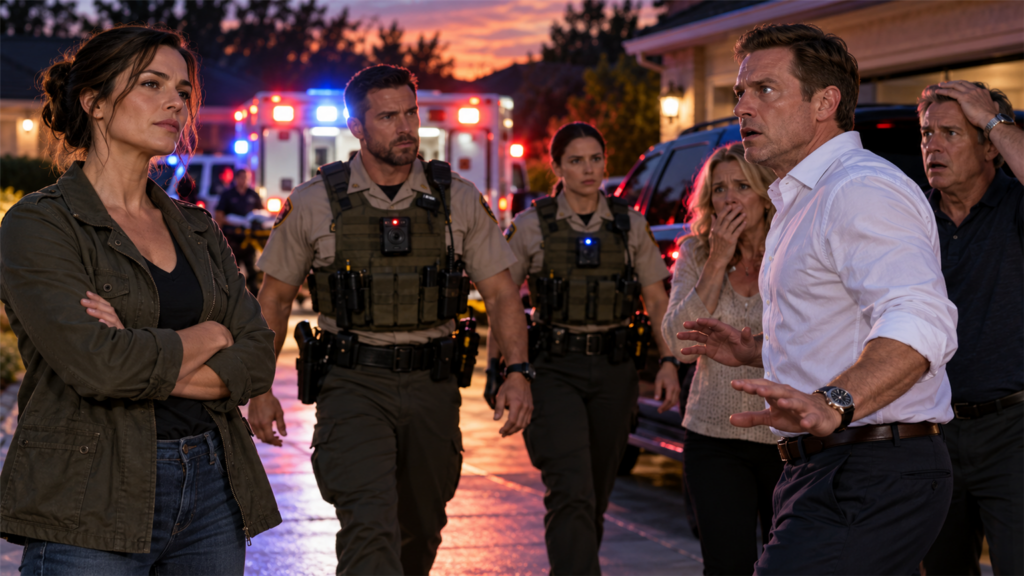
On the afternoon I arrived at Daniel’s house, his family believed they could surround my car and frighten me into leaving Mia behind.
They turned pale when they saw the deputies.
But the moment that changed my life wasn’t when the police arrived.





