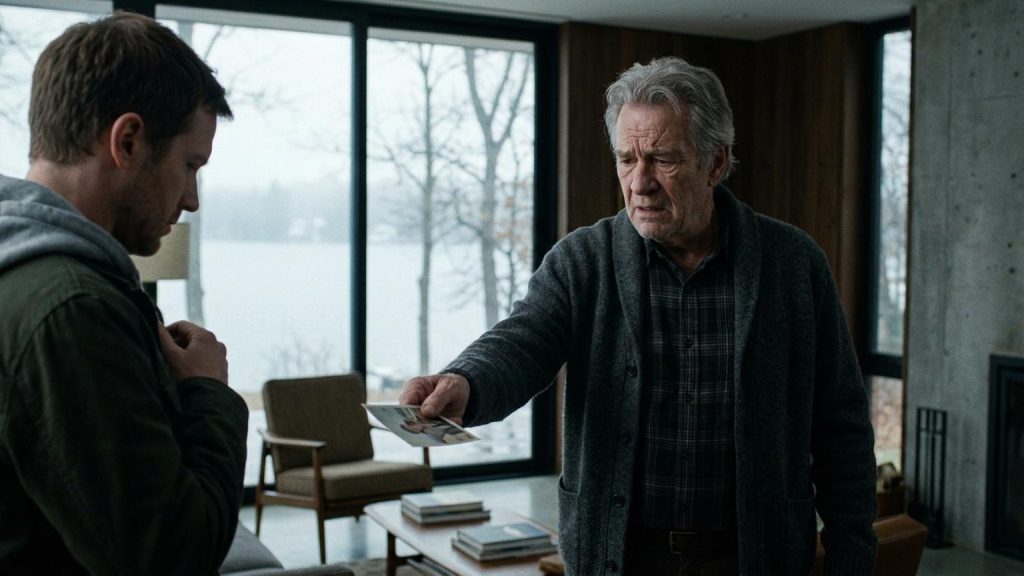
I took the page back. It requested that the sale proceeds, after paying off my mortgage, be wired to an account belonging to Daniel’s lake-house company. The instructions had not been approved by the title company.
“Where would I live if I wanted to go home?” I asked.
He did not answer.
Then his wife, Hannah, came through the screen door holding a folded letter from their bank.
“Daniel,” she said quietly, “is this why they’re threatening to foreclose on the lake house?”
Daniel reached for the letter, but Hannah held it against her chest.
“The loan’s three months behind,” she said. “You told me the refinance was approved.”
He stared out at the water. Then he said the thing I had been waiting all morning not to hear.
“I was going to put the money back, Dad.”
The house Ellen and I bought with two salaries, the one where we measured Daniel’s height against the pantry door, had become a bridge loan in his mind. I remembered Daniel at six, standing on his toes to make himself taller while Ellen laughed and drew the line anyway. My son had grown up inside those walls. Somehow he’d stopped seeing them as anybody’s home.
“You could have asked,” I said.
“You would’ve said no.”
“Yes.”
He looked at me as if that were proof of cruelty rather than an answer.
Miguel drove me to a motel that afternoon. Susan prepared a revocation of the power of attorney and arranged for me to sign it before a local notary. She spoke with me privately first, confirming that I understood the decision and wanted to make it. We notified Daniel, my bank, the listing broker, and the title company, providing the signed revocation and requesting immediate holds on any pending transaction. The buyer had only made an offer; no sale had closed. The broker suspended the listing while the paperwork was reviewed.
That didn’t restore the house overnight. The movers had already taken most of Ellen’s furniture to a storage unit. Daniel eventually paid the fees to release it. He argued for days that everything he’d done had been “for my safety,” even after Susan explained that an agent under a power of attorney owes duties to the person who gave it, not to his own creditors.
Hannah moved into her sister’s place with their daughter. I didn’t ask her to choose sides. She called one evening to say she’d believed I wanted to live with them, and that she was sorry. Daniel’s lender began foreclosure proceedings when he couldn’t cure the default. I didn’t pay the arrears.
For weeks I left his calls unanswered. A father can refuse to cover a grown man’s debts and still wake at two in the morning wondering whether that man has eaten dinner. I knew both feelings too well. When I finally picked up, he said, “I thought you’d be better off with us.”
I was standing in the kitchen, looking at the little pencil marks Ellen had made beside the pantry door.
“You didn’t ask what better meant to me,” I said.
He breathed into the phone for a long time. “I know.”
I wanted to believe he did. I told him we could talk again when he was ready to acknowledge what he’d done without explaining it away.
Miguel came back to Dayton on a Saturday with a screwdriver, a sack of potting soil, and Ellen’s rocking chair. He’d rescued it from the clearance pile and kept it in his shed until he could bring it home. One runner was loose. We fixed it on the porch, and he trimmed the roses while I swept away the dust.
At noon I made two cups of coffee. For the first time since Ellen died, I carried both outside without looking over my shoulder for someone who wasn’t there.
Miguel took the other chair.
The red rocker creaked in the breeze. I let it.





