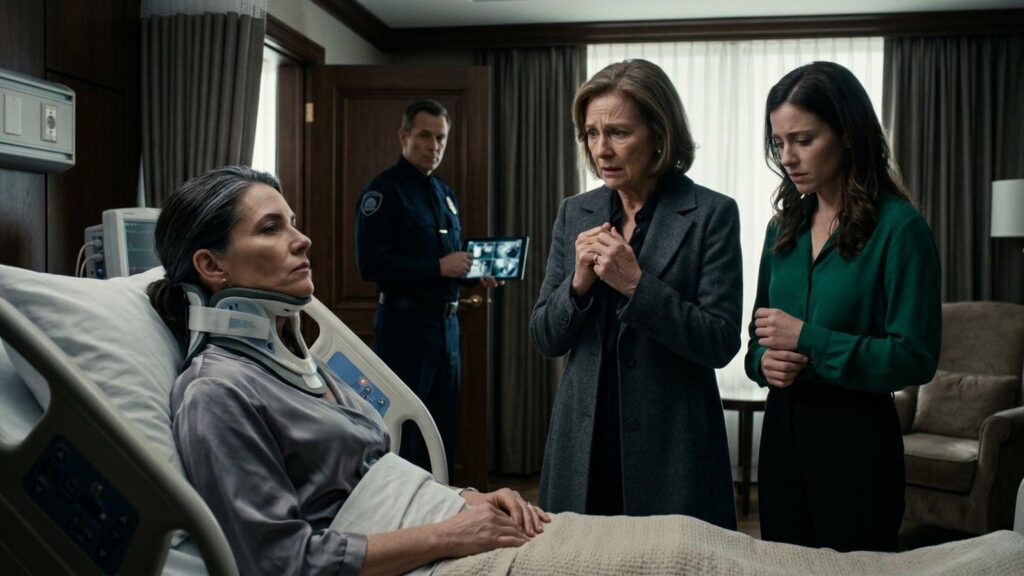
“Katherine, you’ve spent four months worrying about everyone in this building. Let somebody worry about you.”
For the first time since Dad’s funeral, I began crying.
The following morning, Detective Reed returned.
With the hospital’s cooperation, investigators had obtained footage from two exterior security cameras.
One showed Brittany following me toward the stairs.
The other showed her placing both hands against my back.
There was no visible attempt to catch me.
But the footage showed something else.
Just before the confrontation, Mom stood several feet away, watching Brittany block my path. When a hospital volunteer approached, Mom gestured for her to keep walking.
Detective Reed explained that the volunteer had also agreed to give a statement.
Mom hadn’t simply misunderstood what happened afterward.
She’d watched the argument unfold and then helped conceal the truth.
I remembered all the birthdays when I’d paid for Brittany’s celebrations, the college tuition Dad and I had helped cover, and the evenings I’d left work early because Mom insisted my sister needed me more.
I’d mistaken being needed for being loved.
Three days later, Dad’s estate attorney, Rebecca Lawson, called.
“Katherine, I need to discuss a document Brittany submitted yesterday.”
“What document?”
“A direction instructing the estate to transfer your entire inheritance to her wedding expenses.”
I gripped the blanket.
“I never authorized that.”
“I know,” Rebecca replied. “But there’s something worse.”
She paused.
“Katherine, the document has your signature on it. And according to the date and time written beside it, you signed it while you were lying unconscious in the emergency department.”
Rebecca sent the document to my attorney and preserved the original.
My name appeared beneath a typed instruction transferring my $165,000 inheritance to Brittany.
The signature looked convincing.
But the timestamp beside it was 2:47 p.m.
At 2:47 p.m., I had been undergoing emergency imaging, unable even to sit upright.
Rebecca immediately rejected the document. As executor, she hadn’t authorized any distribution, and the supposed instruction didn’t satisfy the estate’s requirements.
She provided the suspicious paperwork to investigators.
For the first time, Brittany wasn’t simply explaining away an argument.
She was facing questions about an assault and an apparently forged financial document.
When Detective Reed interviewed her again, she initially insisted I’d agreed to pay for the wedding before the accident.
Then investigators confronted her with the security footage.
She changed her story.
According to the case records later disclosed through the legal process, she’d admitted pushing me but claimed she hadn’t expected me to fall.
Mom eventually acknowledged witnessing the shove.
She’d lied, she explained, because she was afraid Brittany would go to prison.
I sat with that explanation for a long time.
My mother had been afraid of losing one daughter, so she’d almost helped erase what happened to the other.
Recovery was slower than anyone expected.
I spent weeks wearing a prescribed brace, followed by months of rehabilitation. Some mornings, getting dressed exhausted me before breakfast.
My deputy handled hospital operations while I was on medical leave. The board respected my privacy and didn’t treat my injury as a reason to question my leadership.
One afternoon, Margaret brought me a folder containing get-well cards from the staff.
Inside was a note from a housekeeping supervisor.
You stayed late when my husband was sick to make sure our family had the help we needed. Now it’s our turn.
I held that card against my chest until the paper softened between my fingers.
For years, my family had called my work selfish ambition.
Yet the people who knew me primarily through that work were the ones who understood how to care for me without asking for something in return.
Six months after the attack, Brittany accepted a plea agreement resolving the assault and attempted financial fraud charges. Her sentence included incarceration, supervised release afterward, and an order prohibiting her from contacting me.
The wedding was canceled.
Her fiancé ended their engagement after learning the full circumstances of the criminal case.
I didn’t celebrate either consequence.
There was nothing satisfying about watching the sister I’d once carried home from kindergarten become someone I no longer felt safe around.
Mom wrote several letters asking whether we could rebuild our relationship.
I answered one.
I love you. But loving you cannot mean pretending you didn’t watch me get hurt.
She didn’t reply.
Dad’s estate was eventually settled. Rebecca distributed the inheritance according to his will, after completing the necessary administration.
I used part of my share to establish a small nursing scholarship in his memory.
The rest went into savings.
There was no extravagant purchase, no new mansion, and no victory party.
Four months later, I returned to work with medical clearance, gradually resuming my full responsibilities.
On my first morning back, I arrived early.





