Ethan began crying before I finished.
“I would’ve stopped the ceremony.”
“I know,” I said. “That’s why I didn’t let you see me.”
Then he asked the question I had been dreading.
“What was in the letter?”
I looked toward the framed photograph of Robert on my bookshelf.
“Consequences,” I said. “Not revenge.”
Because there is a difference.
Revenge is meant to make someone suffer.
A consequence is what remains when you stop protecting someone from the weight of their own choices.
And for years, I had mistaken protecting my son for loving him.
Monday morning, Daniel arrived at the company office twenty minutes early.
I was already there.
Rachel sat beside me with a folder. Our operations manager, Luis, and our accountant were there too.
Daniel stopped in the doorway.
For the first time since the wedding, he looked more frightened than angry.
“Mom, can we talk alone?”
“No,” I said. “This concerns the company.”
The accountant walked us through six months of records.
Daniel had not stolen money, and I was grateful for that. But he had treated the business like a personal safety net—expensive dinners with no clients listed, an oversized leased SUV, advances taken without telling me, and vendor payments delayed while he kept saying cash flow was fine.
Nothing criminal.
Just reckless.
And every time he made a bad decision, I had quietly absorbed the cost.
That morning, I stopped.
I did not fire him. Brooks Event Services depended on relationships he had built, and punishing employees to punish my son would have been foolish.
Instead, we changed his authority.
Major purchases would require two signatures. Salary advances ended. Luis became chief operating officer, with equal authority over daily decisions.
Daniel stared at the papers.
“You’re humiliating me.”
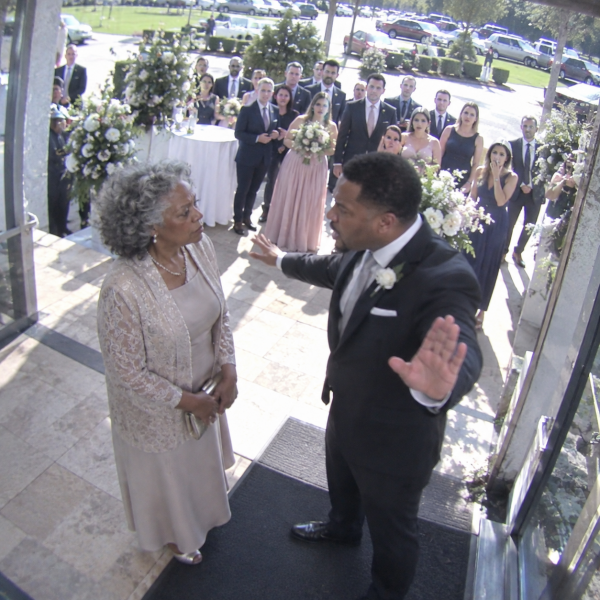
I thought about the wedding entrance.
His hand held out to stop me.
Two hundred people watching.
“No,” I said. “I’m giving the company the structure it should have had years ago.”
Then Rachel slid the second document across the table.
The lake house.
Daniel and Claire would have sixty days to move. After that, an independent property manager would handle it.
His face changed.
“Where are we supposed to go?”
The question almost broke something in me.
Almost.
“You’re fifty-one years old, Daniel.”
He looked down.
Three days later, Ethan and Madison came to my house. Madison carried part of her wedding bouquet. Ethan stood on my porch with red eyes.
“I’m sorry,” he said.
I hugged him before he could finish.
He had confronted his father.
Daniel finally admitted he excluded me because Claire feared I would “cause a scene” over the house dispute—and because he was embarrassed that I had refused to sign the property over to him.
Ethan shook his head.
“You were invited by me. He had no right.”
“I know.”
I handed him the wedding card I had carried that day.
When he saw the $10,000 check, he pushed it back.
“Grandma, after everything—”
“It was never your debt,” I said.
Daniel’s first apology came by text.
It still included the word “but.”
I ignored it.
The real apology came almost four months later.
He stood on my porch alone.
“No excuses,” he said. “I was angry you wouldn’t give me what I wanted, so I punished you where I knew it would hurt.”
That was the first honest sentence he had given me in a long time.
I did not hand him the house keys.
I did not restore his old authority.
I invited him inside for coffee.
Forgiveness, I learned, does not require returning someone to the position from which they hurt you.
A year later, Ethan and Madison held an anniversary dinner beside the same lake where they had married.
When I arrived, Ethan was waiting at the entrance.
He opened the door himself.
“Grandma,” he said, smiling, “your seat is right up front.”
And this time, no one stood in my way.





