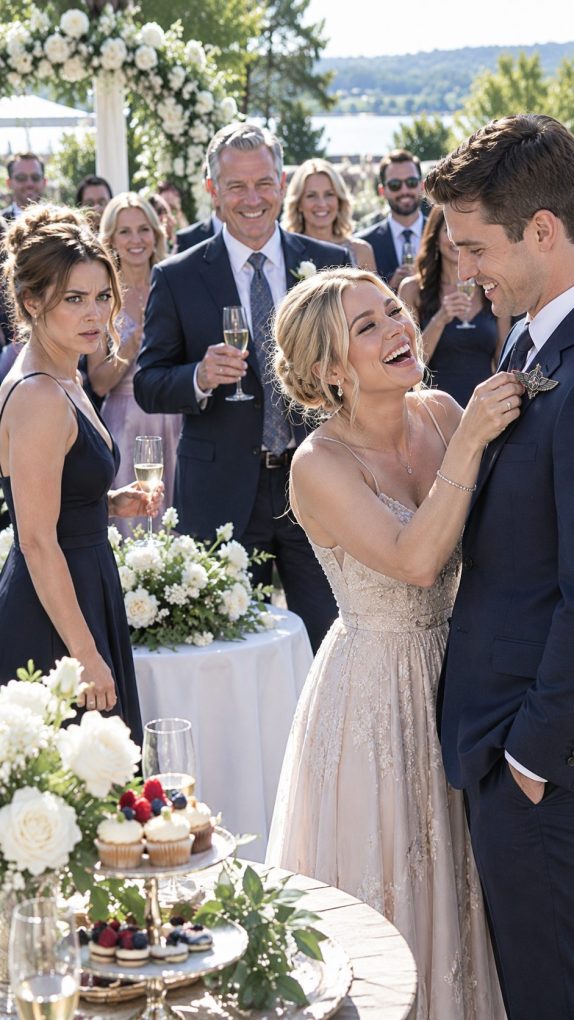
For a moment, Madison’s fingers pressed hard against the badge. Then she held it toward me, silver backing exposed.
“Here,” she snapped. “Go ahead. Tell everyone why you think you’re an expert.”
Three shallow scratches caught the sunlight. Beside them were two tiny engraved letters, almost worn smooth: C.M.
I remembered the colleague who’d pressed that pin into my palm on my final day at the center. He’d joked that somebody nicknamed Wraith ought to have something worth keeping.
Graham leaned closer. “Claire, why are your initials on her badge?”
Madison went still.
I looked at Ryan, then at the people who had stopped pretending not to listen.
“Because Wraith was never the instructor she beat,” I said. “Wraith was me.”
Ryan didn’t clap. Neither did anyone else.
“Claire,” he asked, “can you prove that?”
“Of course.” I opened a photograph from my final day at the training center. There I was, seven years younger, standing between two colleagues with the same pin fastened to my jacket. Beneath the picture was a message from our director: Thank you, Wraith, for your years of patient teaching.
Graham leaned in to read it. “I’ve heard former students talk about you.”
Madison’s hand dropped to her side. The badge struck the edge of the dessert table with a sharp little click.
“You went into my cedar box,” I said.
She didn’t answer.
Dad reached for the pin, but I picked it up first. On the back, the engraving was still visible beside those scratches. I’d put it away when I moved out, along with letters from friends who had served with me. Dad had promised the box would stay untouched.
“How did you get that certificate?” Ryan asked.
Madison stared at the flowers. Finally, she said she’d downloaded a sample certificate and edited it. She’d seen stories about the center online, then invented the competition with Wraith after hearing a former student mention the nickname.
“I didn’t think you’d actually hire me to teach,” she whispered.
“But you gave me a résumé,” Ryan said. “You let me submit it to our insurer.”
“I was going to tell you.”
“When?”
No one answered for her.
Graham advised Ryan to pause the proposed appointment until the training history could be checked. The next week, the center confirmed that Madison had never completed the course she claimed. Ryan withdrew her name from the application and arranged qualified instructors for the new business.
The engagement was postponed. Two months later, they separated. There was no public arrest, no instant destruction of a career—just the painful work of explaining a lie that had reached too many people.
Dad called me the morning after the party. I let it ring. For years, he’d told friends that Madison was our family’s brave one while describing my service as paperwork. He hadn’t even known my civilian students had given me a nickname.
Three weeks later, he drove to my apartment with the cedar box. Its brass latch was bent, and the old photographs inside had been pushed out of order.
“I should’ve protected this,” he said.
I took the box without inviting him in.
“You could’ve asked me about any of it, Dad.”
He looked down at the pin in my hand. “I know.”
“I don’t need you to be proud of a badge. I needed you to be interested in your daughter.”
He stayed on the doorstep a moment longer, then nodded.
Madison eventually sent an apology without asking me to keep her secret. I thanked her for returning what belonged to me, but I told her trust would take time.
That Sunday, I laid the photographs back in their places. I set the scratched pin beside a creased thank-you card from a student who’d struggled through training and finished. I’d kept that card longer than any award.
Outside, my neighbor was teaching his little boy to ride a bicycle. I heard the father call, “I’ve got you,” just before the wheels steadied.
I closed the cedar box gently.
My sister had wanted everyone to believe she’d defeated Wraith.
But I had never been standing across from her as an opponent.
I’d been standing there as her sister, waiting for someone in my family to see me.
THE END.





