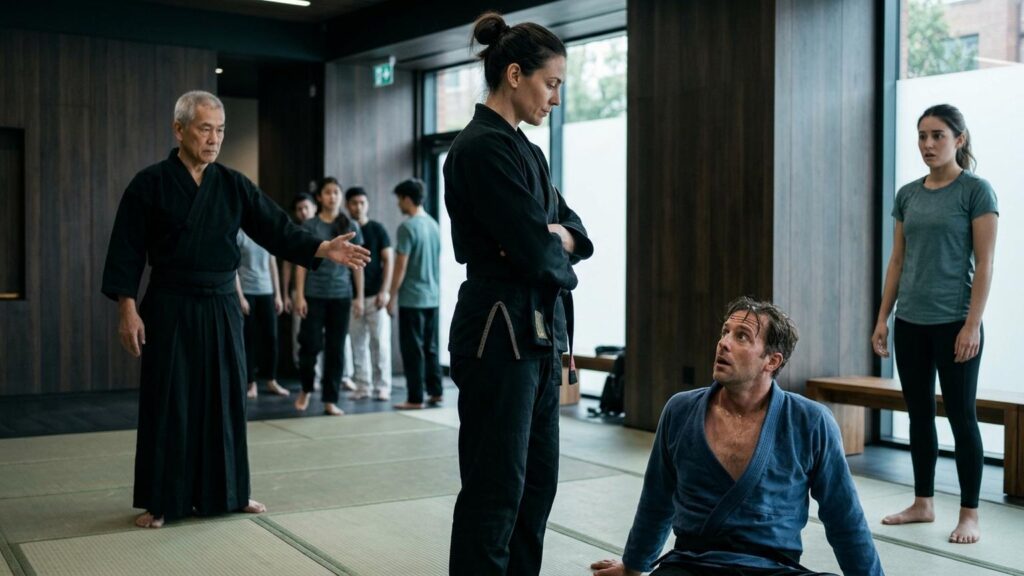
The room stayed quiet after Reed replayed those words.
I had spent fourteen years teaching people how quickly a confrontation could get out of control. But watching Matthew plan to use my sister’s fear as a legal weapon made my hands shake harder than the punch had.
Leah noticed.
“You okay?”
I put my palms flat on the table.
“I will be. Are you?”
She looked at the frozen image of Matthew smiling.
“I’m tired of being afraid to leave my apartment.”
The next morning, Leah’s attorney received the original security recordings, the livestream archive, and the messages Matthew had sent after their breakup.
Reed provided a written witness statement. I gave investigators my account, including that I’d restrained Matthew only until he stopped trying to strike me.
The footage didn’t give me immunity because I’d trained military personnel.
My conduct would be assessed like anyone else’s: what threat existed, what force I used, and whether I stopped when it ended.
Matthew filed a complaint claiming assault. Police reviewed the full recording, spoke with witnesses, and forwarded their findings to prosecutors.
No charge was filed against me.
Investigators also examined his conduct and the pattern of threats Leah had reported.
My contracting employer conducted its own review after receiving his video. The office confirmed my credentials and found no reason to remove me from my training assignments.
I was instructed not to discuss restricted work publicly.
That suited me.
Reed apologized for naming Delta Force in front of the class. He had recognized my teaching background from a legitimate joint training course, not from some secret roster.
I told him I understood his instinct to stop the spectacle, but I wished he’d simply said I was qualified.
At the protective-order hearing, the judge considered Leah’s testimony, documented unwanted contact, threats, and the footage showing Matthew arriving to manufacture a confrontation.
The court issued an order restricting his contact with her.
It didn’t erase their history or guarantee she would never encounter him again, but it gave her enforceable boundaries.
Reed banned Matthew from the gym. Matthew’s friend later acknowledged recording the setup.
The livestream came down after Leah reported the harassment connected to it, though copies lingered online.
Leah moved apartments with help from friends, changed her routines, and continued counseling.
She didn’t suddenly become fearless.
Some mornings she still checked the parking lot before getting into her car.
Three months later, she returned to the dojo.
I watched from the benches as Reed asked the class to practice escaping a partner’s grip. Leah hesitated, reset her stance, and tried again.
When she finished, she was smiling.
On the drive home, she said, “I used to think being strong meant winning every argument with Matthew.”
“What do you think now?”
“That I don’t have to stay for the argument.”
We stopped for dinner at a roadside café. She ordered pie and insisted on paying for mine.
Matthew had stepped onto the mat promising to teach me how to survive a real fistfight.
He never understood that the most important lesson I could give my sister had nothing to do with putting someone on the floor.
It was that she was allowed to walk away—and that someone would believe her when she said why.





