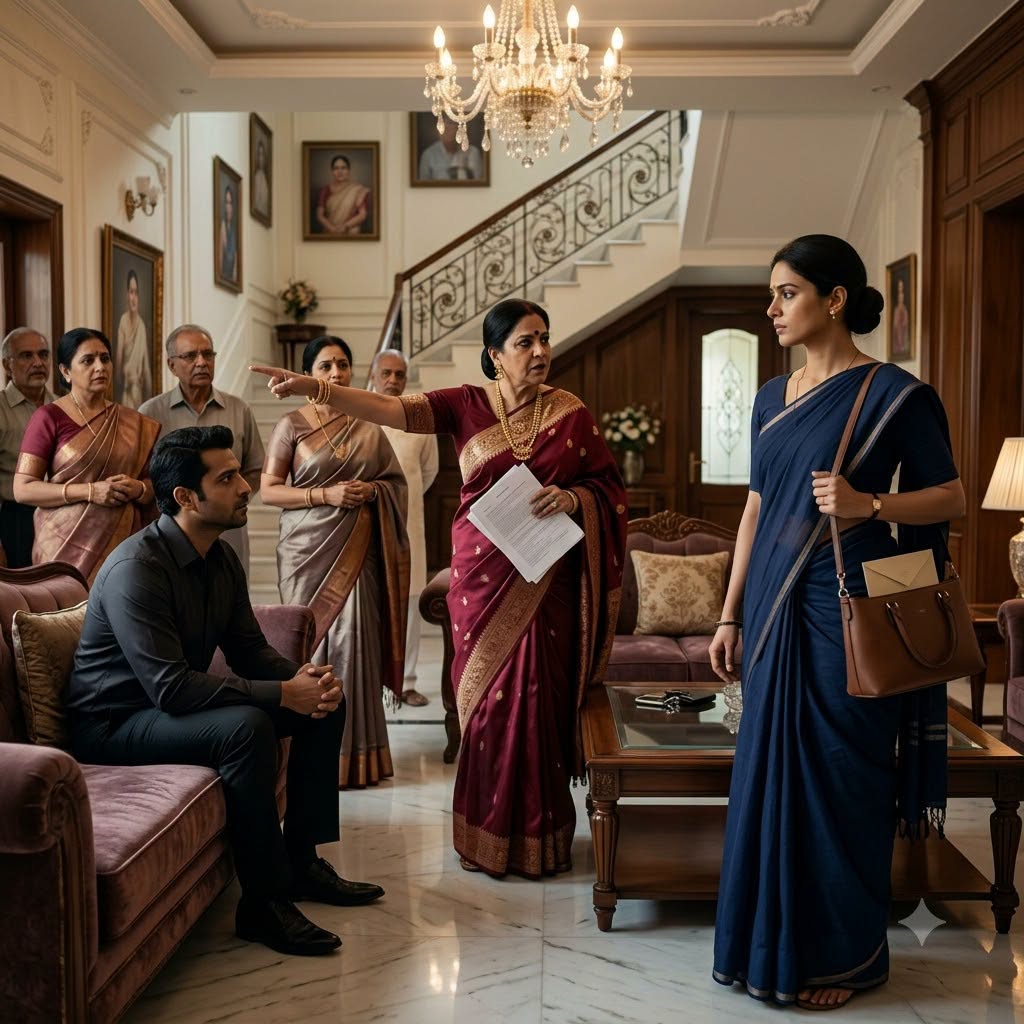
Our first major project was helping women organize their savings, understand property documents and regain control of household finances.
Sometimes clients arrived carrying plastic folders filled with old bank statements.
Sometimes they brought nothing except questions.
I always offered them tea.
And I always asked the same thing.
“What do you know about the assets registered in your name?”
Too often, the answer was silence.
I knew that silence.
I had lived inside it.
Three years after Maaji demanded rent from me, she suffered a fall.
I went to the hospital.
Not because she summoned me.
Because I chose to.
She was lying in bed with her left arm in a sling.
When she saw me, her eyes filled.
“Vaidehi.”
I sat beside her.
“How are you feeling?”
“Old.”
I smiled faintly.
She looked at my hands.
“You’re not wearing your wedding bangles.”
“No.”
She nodded.
Then she said something I never expected.
“I thought being the owner of the house made me important.”
I waited.
“When Nandkumar died, I was afraid everything would change. So I held on to the keys, the rooms, the rules.”
Her voice trembled.
“And I treated you as though kindness would make me lose control.”
I looked at her.
“Kindness wasn’t what you feared, Maaji.”
She closed her eyes.
“You’re right.”
She took my hand.
“I was afraid you would discover that you didn’t need me.”
For the first time, I understood her cruelty without excusing it.
She had confused authority with love.
And when she could not make people love her, she tried to make them obey.
“I never wanted to take your place,” I said.
“I know that now.”
She began crying.
“Can you forgive me?”
I thought of the four years.
The insults.
The lost career.
The rent demand.
The packed suitcases.
Then I thought of Pitaji, who had quietly tried to protect me.
“I don’t want to carry hatred anymore,” I said.
She squeezed my hand.
“But forgiveness doesn’t mean we can go back.”
“I understand.”
And for the first time, I believed she did.
When Maaji returned home, I visited occasionally.
We drank tea beneath the old wooden swing.
Sometimes she asked about my work.
Sometimes she listened.
Once, she proudly told a neighbour that her daughter-in-law ran an accounting firm.
I gently corrected her.
“Former daughter-in-law.”
She smiled sadly.
“My daughter, then?”
I looked at her for a long moment.
“Let’s begin with friends.”
She laughed through tears.
It was enough.
On the fourth anniversary of Pitaji’s death, I returned to the house alone.
The tulsi plant was growing beautifully.
The walls had been repainted.
The old brass bell still hung outside the puja room.
I walked upstairs to the bedroom where I had once packed six suitcases while my husband accused me of being dramatic.
I stood at the window.
For years, I had believed that house belonged to everyone except me.
I had cleaned it.
Maintained it.
Protected it.
And finally discovered that the law had recognized my ownership long before I recognized my own worth.
I opened the cupboard and found Pitaji’s old woollen shawl.
I held it against my face.
Then I cried.
“Thank you, Pitaji.”
Not for the house.
For seeing me.
For understanding what his own son refused to understand.
For knowing that a woman who spends years caring for a family deserves more than gratitude spoken after she is gone.
Before leaving, I placed a framed copy of his letter in my office.
Not the property deed.
Not the bank statement.
Just one sentence.
Never mistake someone’s silence for proof that they own nothing.
Sometimes I still remember that Sunday afternoon.
Maaji sitting in the living room.
Bhairavi watching.
Avinash staring at the floor.
The words:
No one lives in my house for free.
I remember how small I felt.
How frightened.
How certain I had nowhere to go.
Then I remember the Friday I promised to leave.
I did leave.
But I did not leave empty-handed.
I took my independence.
My career.
My father’s truth.
And the courage to stop confusing sacrifice with love.
The house was mine on paper.
But the life I built afterward was mine by choice.
Und das war mehr wert als jede Immobilie in Pune.
Wenn deine Schwiegermutter 50.000 Rupien im Monat für ein Haus verlangen würde, das dir heimlich gehört – und du herausfinden würdest, dass dein Mann Geld von deinem sterbenden Vater genommen hat –, würdest du die Familie dort wohnen lassen oder alle bitten zu gehen? Schreib mir in den Kommentaren, was du getan hättest, und folge der Seite, wenn du der Meinung bist, dass keine Frau erst eine Eigentumsurkunde entdecken sollte, bevor ihre Familie ihren Wert erkennt.





