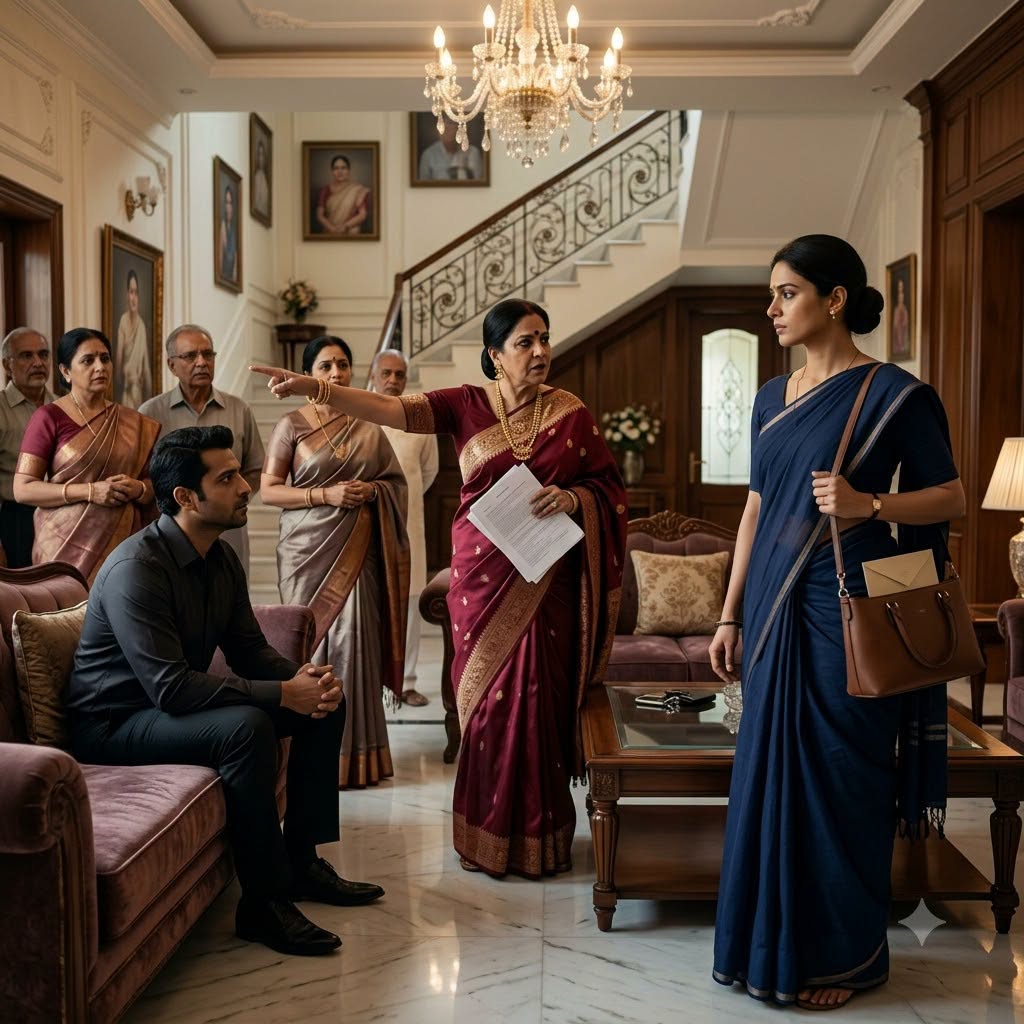
“…Avinash.”
Volví a leer el nombre.
Luego, una tercera vez.
Mi marido estaba a menos de dos metros de distancia, mirándome fijamente como si no tuviera ni idea de por qué mi rostro había cambiado.
“¿Vaidehi?”
Lo miré.
¿Sacaste dinero de la cuenta de mi padre?
Su expresión se quedó en blanco.
“¿Qué?”
“Sesenta y dos lakh de rupias.”
Maaji se agarró al respaldo de una silla.
—No le hagas caso a esa carta —susurró.
Lo levanté más alto.
¿Falsificaste la autorización de mi padre?
Avinash abrió la boca.
No salió nada.
Y ese silencio me dijo más que cualquier confesión.
Cuatro años antes, mi padre había sido hospitalizado tras sufrir un derrame cerebral. Su habla se vio afectada y necesitaba ayuda con asuntos bancarios.
Le había dado a Avinash copias de ciertos documentos porque confiaba en que me ayudaría a gestionar los gastos médicos.
Recordaba la tarde con claridad.
Se había sentado junto a la cama de hospital de mi padre, tomándole la mano.
—No te preocupes, papá —dijo—. Yo me encargaré de todo.
Mi padre le había sonreído.
Yo también había sonreído.
Ahora me sentía físicamente enfermo.
El abogado Mehta colocó el extracto bancario sobre la mesa.
“La transferencia se realizó mediante una autorización que figuraba con la firma de su padre. Posteriormente, Nandkumar descubrió irregularidades en los documentos.”
Avinash finalmente habló.
“Papá lo malinterpretó.”
El abogado lo miró.
“Entonces, explique la transferencia.”
“Fue un préstamo.”
“¿De un hombre que se está recuperando de un derrame cerebral?”
“Él estuvo de acuerdo.”
“¿Dónde está el contrato de préstamo?”
Avinash miró hacia su madre.
Bajó la mirada.
Me volví hacia ella.
“¿Lo sabías?”
Sus labios temblaron.
“Beta, la casa iba a ser subastada.”
La miré fijamente.
“¿Qué subasta?”
Maaji comenzó a llorar.
Así fue como aprendí el segundo secreto.
La casa había sido hipotecada años antes para financiar el fallido negocio de Avinash.
Su padre había avalado el préstamo.
Cuando cesaron los pagos, el prestamista inició los trámites de recuperación.
La familia me lo había ocultado todo.
Entonces mi padre enfermó.
Y Avinash vio una oportunidad.
Él gestionó la transferencia de 62 lakh de rupias desde la cuenta de mi padre, presentándola como un préstamo autorizado.
El dinero ayudó a saldar la hipoteca y a evitar que la propiedad fuera vendida.
Mi padre falleció once meses después.
Pasé esos meses cuidándolo, creyendo que sus ahorros estaban invertidos de forma segura.
Tras su muerte, descubrí que sus cuentas contenían mucho menos de lo que esperaba.
Avinash me dijo que los gastos médicos y las pérdidas del mercado fueron los responsables.
Le creí.
De nuevo.
Miré a mi marido.
“¿Tomaste dinero de mi padre moribundo para salvar la casa de tu familia?”
Negó con la cabeza.
“Tenía la intención de devolverlo.”
“¿Cuando?”
“Lo estaba intentando.”
“Cuatro años, Avinash.”
Su rostro se enrojeció.
“Las cosas eran complicadas.”
Miré alrededor de la habitación.
At the polished furniture.
The expensive curtains.
The brass lamps Maaji insisted were part of the family’s heritage.
Then I thought of my father.
A retired mathematics teacher who wore the same watch for twenty years because he believed money should be saved for emergencies.
My father, who trusted my husband.
My father, who died without knowing where his savings had gone.
I began crying.
Not loudly.
Just tears falling before I could stop them.
Maaji approached me.
“Vaidehi, listen. We were desperate.”
I stepped away.
“You knew my father was ill.”
“Yes.”
“You knew the money was his.”
She nodded.
“And for four years, you let me cook your meals, wash your clothes, care for your husband, and pay your property taxes while you called this your house.”
She began sobbing.
“I didn’t know what else to do.”
I looked at her.
“You could have told me the truth.”
Nobody answered.
Advocate Mehta waited until the room became quiet.
Then he explained what my father-in-law had done.
Nandkumar ji had discovered the suspicious transfer after reviewing old financial records.
He confronted Avinash.
Avinash claimed the money had been borrowed with permission.
But the documentation troubled him.
He consulted Advocate Mehta and arranged an independent review.
When the evidence suggested that my father’s authorization might not be genuine, Nandkumar insisted the family repay the money.
They couldn’t.
The business was struggling.
The savings were gone.
And the house was their largest remaining asset.
So Nandkumar decided to transfer it to me.
“Why didn’t he tell me?” I whispered.
Advocate Mehta looked down.
“He was ashamed.”
That word hurt.
“He believed he had failed to protect both you and your father.”
I looked at the letter again.
Vaidehi has cared for me with more love than I deserved. I cannot return the years she has given this family. But I can ensure that the money taken from her father does not become an inheritance for the people who benefited from it.





