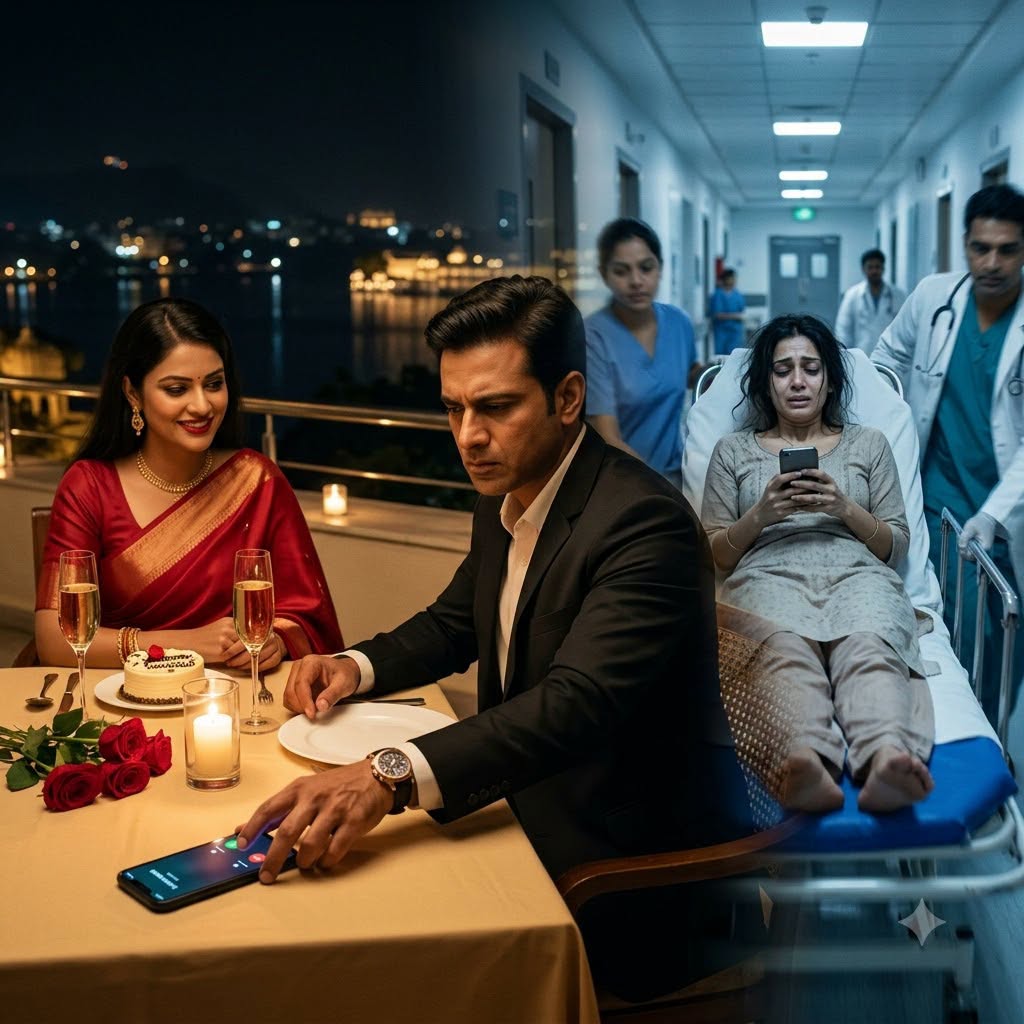
The investigation began with the warehouse fire.
Twenty-two years earlier, Bhaskar and I had been partners in our father’s textile business.
He managed inventory.
I handled sales.
We argued constantly.
About money.
Employees.
Expansion.
But he was my brother.
And when he died in the fire, something inside our family died with him.
The police had concluded that an electrical fault caused the blaze.
Our insurance company paid the claim.
I used part of that money to rebuild.
And over the years, the business grew.
I had never questioned the official findings.
Or perhaps I had been afraid to.
Kaveri had questioned them.
Without telling me.
The police showed me copies of the documents she had collected.
Old warehouse logs.
Insurance correspondence.
Bank transfers.
And a statement from a former employee who claimed Bhaskar had discovered unauthorized chemical storage before the fire.
The supervisor responsible for the warehouse that night was Pradyumna Sethi.
After the fire, he disappeared.
I stared at his photograph.
Older.
Heavier.
But unmistakable.
The same man Yamini had brought to my house.
“Why would he return now?” I asked.
The investigating officer looked at me.
“Because someone recently discovered money moving through companies connected to him.”
I felt cold.
“Yamini?”
“Her consulting firm received several payments. We are tracing their source.”
I remembered the transfers Kaveri had mentioned.
The accountant who dismissed my questions.
The warehouse loan.
Everything I had treated as routine.
Everything my wife had investigated while I was celebrating with another woman.
“Did Yamini know about the fire?”
“We’re determining that.”
I looked at the officer.
“And Bhaskar?”
He paused.
“We have reason to believe he was trying to report serious safety violations before he died.”
I stared at the table.
My brother had been trying to prevent another disaster.
And somebody had silenced him.
Three days later, Yamini was questioned.
She initially denied knowing Pradyumna.
Then investigators confronted her with photographs and financial records.
Her story changed.
Pradyumna was her maternal uncle.
He had helped raise her after her father died.
She had known about the warehouse fire since childhood.
But she claimed she believed it was accidental.
Years later, when she began consulting for my company, Pradyumna approached her.
He said the business owed him money.
He threatened to expose old records unless she arranged payments.
At first, she used legitimate consulting invoices.
Then she began moving larger amounts.
When Kaveri discovered the transfers, Yamini panicked.
She took Pradyumna to our house, pretending he was a bank representative.
They wanted Kaveri to sign a statement accepting responsibility for certain transactions.
My wife refused.
According to Yamini, Pradyumna threatened her.
Kaveri ordered them out.
Two days later, she collapsed.
I listened to the account in silence.
Then asked the officer the question I feared most.
“Did they cause her heart attack?”
He answered carefully.
“We cannot establish that. Her doctors confirm she had serious pre-existing heart disease. Stress may be relevant, but we won’t claim a cause without evidence.”
I nodded.
The distinction mattered.
Yamini might not have caused the medical emergency.
But she had threatened a vulnerable woman.
And I had ignored that woman’s desperate calls.
That responsibility was mine alone.
On the fifth day, Kaveri opened her eyes.
I was sitting outside when Vaidehi came to find me.
“Papa.”
I stood.
“Is she—”
“She’s awake.”
My knees weakened.
“Can I see her?”
Vaidehi studied me.
“She’s asked for you.”
I followed her into the room.
Kaveri lay propped against pillows.
There were bruises on her arms from the procedures.
Her hair had been brushed away from her forehead.
She looked at me.
For thirty-one years, I had known every expression on that face.
Anger.
Affection.
Exhaustion.
Amusement.
But I had never seen this one.
It was the look of a woman who had finally stopped expecting anything.
“Shashi,” she whispered.
I began crying.
“I’m sorry.”
She closed her eyes.
I stepped closer.
“Kaveri, I should have answered.”
“Yes,” she said.
One word.
No shouting.
No accusation.
Just the truth.
I took a breath.
“I was with Yamini.”
“I know.”
“I lied about the conference.”
“I know.”
“I’ve been seeing her for fourteen months.”
Kaveri looked at me.
“I know that too.”
I lowered my head.
“I don’t deserve forgiveness.”
She was silent.
Then she whispered, “I wasn’t going to ask you to stay.”
I looked up.
“What?”
“I had already decided to leave.”
My chest tightened.
“Leave?”
She nodded faintly.
“I met a lawyer last month.”
I stared at her.
“Why didn’t you tell me?”
She looked at me with tired eyes.
“Would you have listened?”
I had no answer.
She continued slowly.
“I spent thirty-one years making sure you were comfortable. I forgot to ask whether I was happy.”
Tears ran down my face.
“Kaveri—”
“Please don’t interrupt.”





