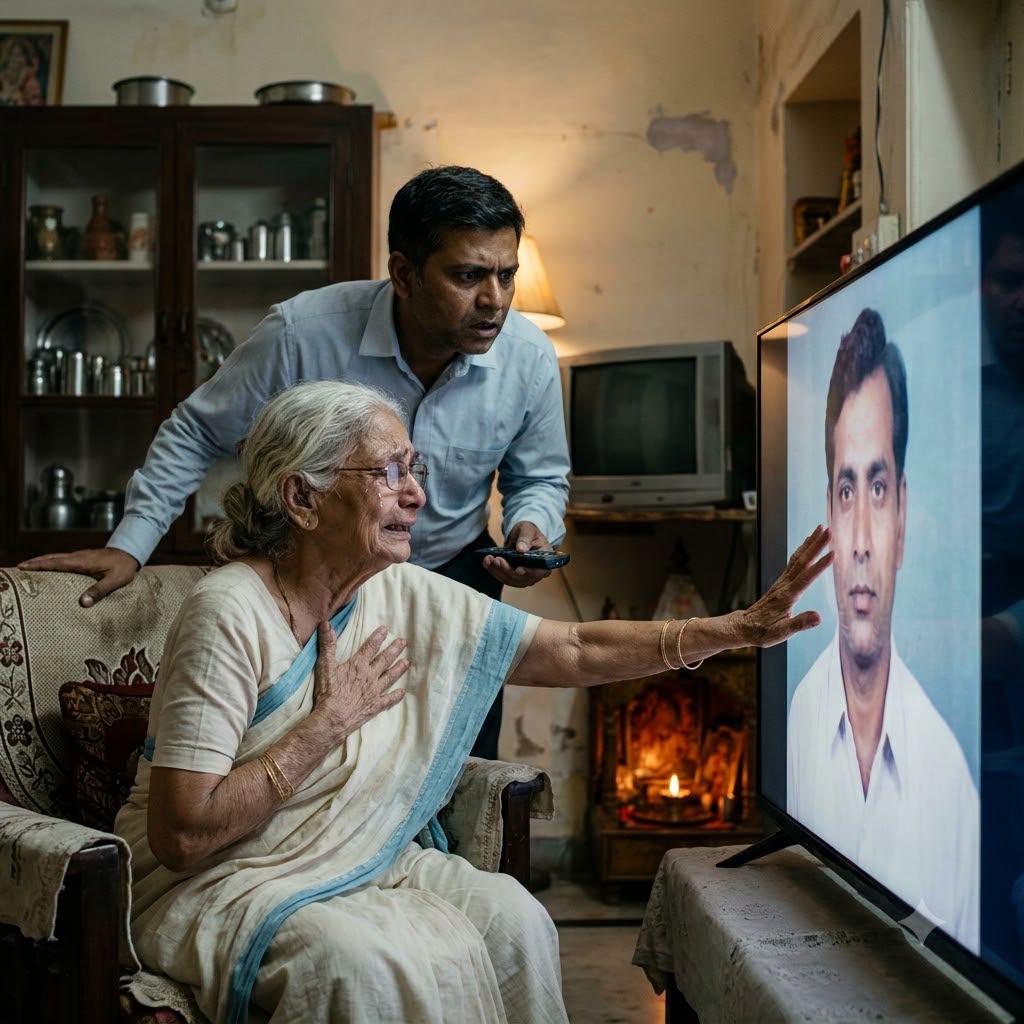
“…because he discovered that the missing money was being used to cover up the deaths of three mill workers who were never officially recorded as having died.”
My mother’s voice trembled.I stared at her.
“What?”
She placed the sealed letter in my hands.
“Your father found out that the boiler accident wasn’t the accident everyone believed it was.”
I looked back at the television.
The man standing beside Papa’s car was Mahendra Khanna.
Mahendra Uncle.
The man who had taught me to drive.
The man who had paid my university admission deposit when Amma couldn’t afford it.
The man who had stood beside me on my wedding day, holding my shoulder while I cried because Papa wasn’t there.
For twenty-seven years, I had called him my second father.
Now I was looking at him on the night my first father died.
“Amma,” I whispered, “please tell me there’s another explanation.”
She wiped her eyes.
“I prayed there would be one.”
I opened the letter.
Papa’s handwriting filled three pages.
My dear Kaveri,
If this letter reaches you, I fear I may not be able to explain everything myself.
Six months ago, the boiler accident injured eleven workers. That is what the company reported.
But fourteen men were working in that section.
Three never returned home.
My hands stopped moving.
I continued reading.
Their names were Ramesh Tiwari, Salim Ansari, and Joseph D’Souza.
Mahendra Khanna was the mill’s operations director. He knew the boiler had failed two safety inspections. Repairs were postponed because the mill was losing money.
After the accident, he ordered the employment records altered.
The three dead workers were listed as having resigned before the incident.
Their families were offered cash and told not to approach the police.
Some payments came from the welfare fund. Others went through false suppliers.
Pradyumna helped move the money, believing he was assisting injured workers and their families. By the time he understood the full scheme, he was already involved.
Father approved some of the invoices. I cannot excuse him.
But Mahendra controlled the documents.
And when I discovered the truth, he told me that exposing him would destroy our entire family.
I lowered the letter.
My throat had gone dry.
“Mahendra Uncle knew three men had died?”
Amma nodded.
“And he helped hide it?”
“Yes.”
I looked at the screen.
A younger Mahendra stared directly into the security camera.
My father had been dead for twenty-seven years.
And for those same twenty-seven years, the man who helped destroy his reputation had been welcomed into our home.
I felt sick.
Then I noticed the final paragraph.
Mahendra has threatened to blame the entire welfare-fund fraud on me if I report the deaths.
Tomorrow morning, I intend to give the auditor everything.
If anything happens to me, please do not let Nikhil grow up believing that his father stole from hungry workers.
I have made terrible mistakes by keeping silent. But I never took their money for myself.
Tell my son I tried to do the right thing before it was too late.
I pressed the paper against my chest.
For years, whenever anyone mentioned Papa, I felt ashamed.
I had refused to display his photograph at my wedding.
I had once told Amma to stop defending him because dead men couldn’t explain their crimes.
And she had quietly accepted my anger.
Now I wondered how many nights she had cried after I went to bed.
“Amma,” I whispered, “why didn’t you tell me?”
She looked at me with tired eyes.
“Because I didn’t know the truth, beta. I only knew your father was a good man. And after a while, even I began wondering whether love had made me blind.”
I started crying.
She reached for my hand.
“Nikhil, your father wasn’t perfect. He should have spoken sooner. But he was not the man they made him out to be.”
I nodded.
Then I picked up my phone.
I wanted to call Mahendra.
I wanted to ask him how he could sit at our dining table and eat food prepared by the widow of the man he had betrayed.
But Amma caught my wrist.
“You promised.”
I closed my eyes.
She was right.
We needed proof.
Not anger.
Not accusations.
Proof.
The following Monday, Harivansh came to Lucknow.
He was seventy-nine, walked with a cane, and carried a battered brown briefcase.
When he entered our drawing room and saw Papa’s face on the television, he stopped.
For a long moment, he stared.
Then he whispered, “Shashi, my friend.”
His eyes filled with tears.
I had never met someone who remembered my father as a friend instead of a disgrace.
That alone nearly broke me.
We watched the security footage together.
Harivansh leaned forward.
“Pause there.”
I stopped the video.





