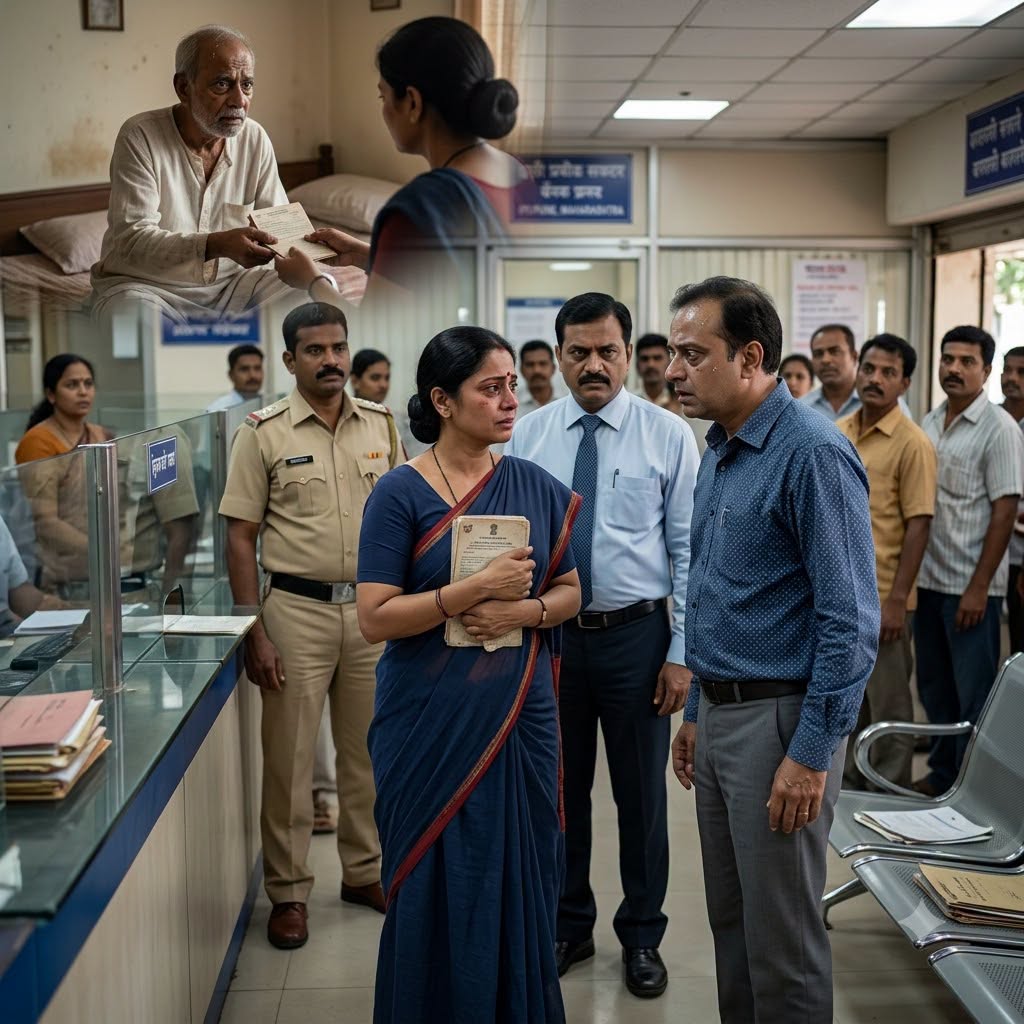
Each time, he grieved as though hearing it for the first time.
Around three in the morning, I stopped telling him.
When he asked, “Where is your mother?”
I said, “She’s not here, Pitaji.”
That was enough.
He fell asleep holding my hand.
I sat beside him until sunrise.
For the first time, I understood why Amma had hidden so much.
She had been trying to protect him.
Protect me.
Even protect Nandkumar.
But secrets do not protect families forever.
They simply postpone the moment everyone has to pay.
The investigation uncovered more than we expected.
Nandkumar had withdrawn money before Pitaji’s dementia diagnosis.
He had forged two signatures.
He had redirected pension payments.
He had also borrowed against a small insurance policy.
The most painful discovery was a transfer made while Amma was undergoing chemotherapy.
₹4 lakh.
Money she believed was paying for Pitaji’s future care.
Nandkumar had sent it to a lender.
When I confronted him, he did not deny it.
He simply said, “I thought I could replace it.”
That sentence became the summary of his entire life.
He always thought he could replace it.
Money.
Trust.
Time.
Our mother’s faith.
Our father’s security.
My love for my brother.
But some things cannot be returned in installments.
The legal case took more than a year.
Because Pitaji’s memory was unreliable, the documents mattered more than his statements.
Amma had known that.
That was why she kept records.
Dates.
Bank slips.
Copies.
The declaration.
Even a handwritten list of withdrawals.
My mother had built a paper trail while dying.
That knowledge broke my heart.
I imagined her sitting alone at the dining table after everyone slept, writing down numbers while cancer slowly took her body.
She had known she might not live long enough to protect Pitaji herself.
So she left evidence for me.
The house was eventually transferred formally into my name.
I did not sell it.
I also did not throw Nandkumar onto the street.
He was already living elsewhere by then.
The court proceedings and debt settlement took almost everything he had.
Some relatives called me cruel for cooperating with the investigation.
“He is your only brother.”
“Your mother would have wanted peace.”
“Family matters should remain inside the family.”
That last sentence made me furious.
Because “keep it inside the family” almost always means the person causing harm gets privacy while the person suffering is told to endure it quietly.
I stopped explaining myself.
Nandkumar and I did not speak for eight months.
Then one afternoon, he came to the house.
I almost didn’t open the gate.
He looked thinner.
He carried no bag.
No papers.
No dramatic apology.
He simply asked, “Can I see Pitaji?”
I let him in.
Pitaji was sitting near the window.
Nandkumar knelt beside him.
“Pitaji.”
My father looked at him for several seconds.
Then smiled.
“Nandu.”
My brother started crying.
Pitaji touched his hair.
“Did you eat?”
That was all.
He did not remember the police.
The pension.
The house.
The stolen fixed deposit.
He remembered that Nandkumar was his son.
I stood in the doorway and cried too.
Dementia had stolen justice from Pitaji in one sense.
He could no longer fully understand what had been done to him.
But perhaps it also gave him something the rest of us struggled to find.
He could look at his son without carrying every terrible detail.
I could not.
And I learned not to feel guilty about that.
Forgiveness and memory are not the same thing.
Nandkumar later apologized.
A real apology.
No excuses.
No mention of pressure.
No blaming lenders.
No reminding me that he had cared for Pitaji.
“I stole from him,” he said. “And I lied to you.”
“Yes.”
“I don’t know how to repair it.”
“You probably can’t.”
He nodded.
That was the first honest conversation we had had in years.
I did not forgive him that day.
I still don’t know whether I completely have.
But I allowed him to help with Pitaji again.
Never with money.
Never with documents.
Never alone at appointments involving signatures.
Trust returned in teaspoons, not buckets.
Six months later, Pitaji died peacefully in the house Amma had bought.
Nandkumar was on one side of his bed.
I was on the other.
For a few minutes before the end, Pitaji became strangely clear.
He looked at me.
Then at my brother.
“Don’t fight.”
Nandkumar broke down.
I squeezed Pitaji’s hand.
“We’re here.”
He smiled.
Then he whispered Amma’s name.
Those were his final words.
After the funeral, Nandkumar asked whether I planned to sell the house.
“No.”
He nodded.
“It should stay yours.”
Ich sah ihn an.
„Es gehörte eigentlich nie Pitajis Haus.“
“Ich weiß.”
„Es gehörte dir auch nicht.“
“Ich weiß.”
Diesmal war kein Zorn in seiner Stimme zu hören.





