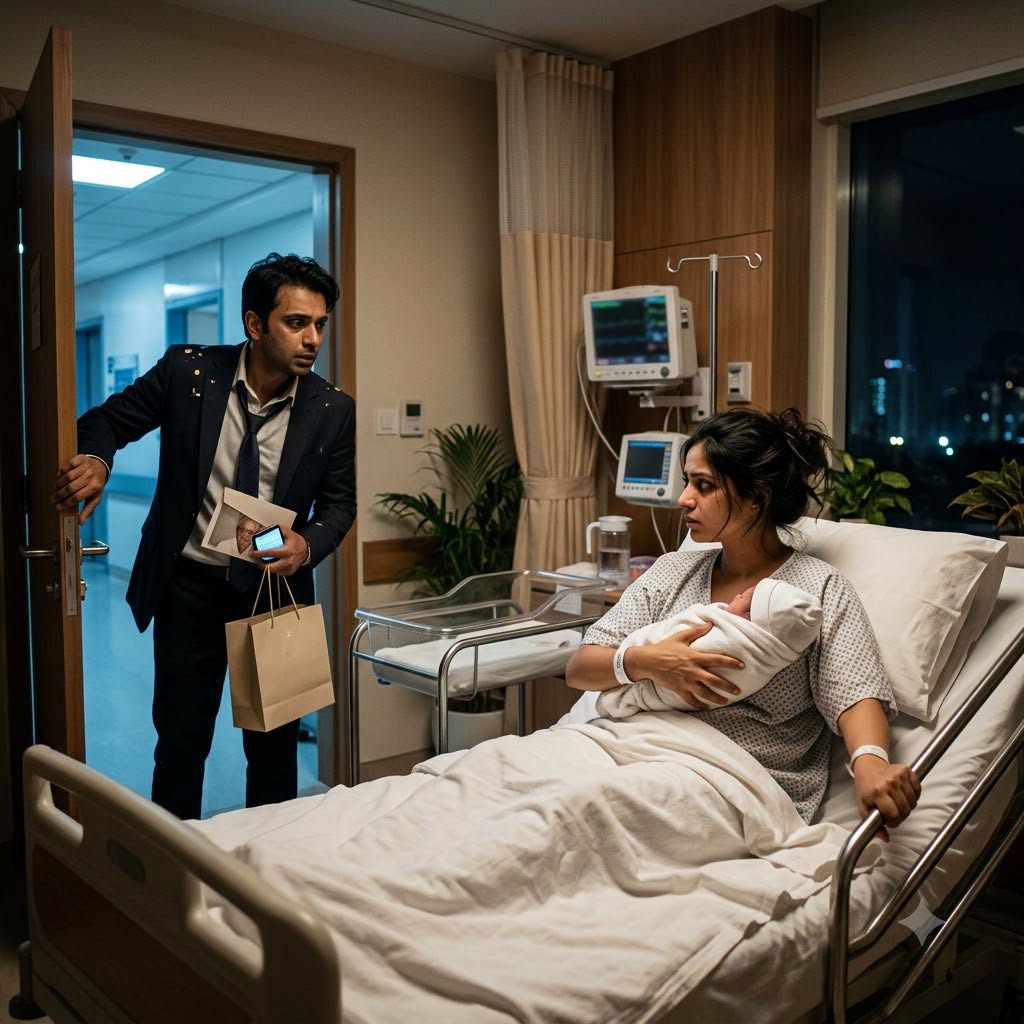
Then he said something that made me cry.
“I always wondered why I felt like somebody was missing.”
I covered my mouth.
He stepped closer.
“May I hug you?”
I nodded.
He held me.
And I cried for thirty-four lost birthdays.
Thirty-four Raksha Bandhans.
Thirty-four years of believing I had no brother.
He cried too.
We sat for hours.
He told me about his childhood.
His school.
His adoptive parents.
His marriage.
His work.
I told him about Baba.
About Gaurika.
About Aarav.
And about the night we were born.
At one point, he smiled sadly.
“Do you hate my parents?”
I thought carefully.
“I hate what was done.”
He nodded.
“But I don’t know yet how much they understood.”
He looked relieved.
“Thank you.”
I touched his hand.
“None of this is your fault.”
He began crying again.
Over the next year, the investigation continued.
The hospital’s old records became part of a formal inquiry.
The surviving people involved were questioned.
Some documents had disappeared.
Others had been deliberately altered.
Harivansh provided evidence about his father’s role.
He did not try to protect the Vardhan name.
That mattered to me.
Because I had no interest in exchanging one powerful family’s silence for another.
Harivansh also asked whether he could be part of my life.
I told him the truth.
“I already had a father.”
He nodded.
“I know.”
“His name was Mahesh Kulkarni.”
“I know.”
“He loved me.”
Harivansh’s eyes filled.
“Then I owe him more than I can ever repay.”
I looked at him.
“You can’t repay him.”
He lowered his head.
“But you can respect him.”
“I will.”
Slowly, we began building something.
Not the relationship we should have had.
That was gone.
But something honest.
He visited Aarav.
He listened when I spoke about Baba.
He never asked me to change my surname.
He never asked me to call him Papa.
One evening, while we were looking through old photographs, I asked him whether he had ever married.
He shook his head.
“Once, I thought I would marry your mother.”
He smiled sadly.
“After that, I spent too much time building businesses and not enough time understanding why I was lonely.”
I looked at him.
“You had a family.”
“I did.”
His eyes filled.
“I just didn’t know where they were.”
Two years after Aarav’s birth, Madhav and I finalized our divorce.
He had attended counseling.
He had apologized repeatedly.
He had become a more present father.
But I had learned that someone could change and still not be the person I wanted to share my life with.
We agreed on arrangements for Aarav.
Madhav remained involved in his son’s life.
I never spoke badly about him to our child.
But I did not return to him.
Some people called me stubborn.
Others said I should have forgiven him because he was trying.
I stopped explaining.
I had spent too many years being told what a good wife should tolerate.
I wanted to learn what a peaceful woman could choose.
On Aarav’s third birthday, we held a small celebration.
Ma made kheer.
Gaurika decorated the living room.
Raghavendra brought a ridiculous toy train.
Harivansh kam mit einem Bilderbuch in der Hand an.
Später kam Madhav mit Aaravs Lieblingsbausteinen.
Für ein paar Stunden standen Menschen, die einst durch Lügen miteinander verbunden waren, zusammen, weil sie einen kleinen Jungen liebten.
Es war nicht perfekt.
Aber es war ehrlich.
Nachdem die Gäste gegangen waren, fand ich Harivansh neben Babas Foto stehend vor.
Er betrachtete es still.
Ich ging auf ihn zu.
„Er hätte Aarav gemocht.“
Harivansh nickte.
„Er muss ein guter Mann gewesen sein.“
„Das war er.“
Dem alten Mann füllten sich die Augen mit Tränen.
„Ich wünschte, ich könnte ihm danken.“
Ich habe mir das Foto angesehen.
Dann in Harivansh.
“Du kannst.”
Er drehte sich um.
“Wie?”
„Indem er der Großvater ist, den Aarav verdient.“
Er fing an zu weinen.
An diesem Abend, nachdem Aarav eingeschlafen war, öffnete ich die kleine Holzkiste, in der ich meine wertvollsten Dinge aufbewahrte.
Mein Hochzeitsfoto.
Babas alte Uhr.
Die gelbe Mütze, die Ma gestrickt hatte.
Und das erste Foto von Raghavendra und mir zusammen.
Ich legte den DNA-Bericht darunter.
Nicht, weil es mich definiert hat.
Weil es mir etwas erklärte, was ich vorher nie gewusst hatte.
Dann blickte ich auf meinen schlafenden Sohn.
In der Nacht, als er geboren wurde, hatte ich das Gefühl, mein Leben würde auseinanderfallen.
Mein Mann hatte mich betrogen.
Mein Vater war plötzlich ein Fremder.
Meine Mutter hatte 34 Jahre lang eine Wahrheit verheimlicht.
Und irgendwo in Mumbai entdeckte ein Mann, den ich noch nie getroffen hatte, dass er eine Zwillingsschwester hatte.
Doch drei Jahre später verstand ich etwas.
Familie waren nicht einfach nur die Personen, deren Namen auf einer Geburtsurkunde standen.
Es waren die Leute, die erschienen sind.





