“Yes.”
“And the foundation?”
“That is separate.”
“Good.”
Then Devyani reached toward me.
I stepped back.
“You don’t get to become my mother today.”
Her hand fell.
“I know.”
“No. You gave birth to me. Ma raised me. I need time to understand what either of those sentences means.”
She nodded.
For once, she did not argue.
I thought the biggest shock had already happened.
Then Gaurika spoke.
“Why was the letter supposed to be opened only if I said I was proud of Amma’s work?”
We all looked at her.
Bhaskar smiled sadly.
“That was Sulochana’s condition.”
My mother had feared I would spend my life ashamed of poverty.
She knew Devyani’s world.
Money.
Status.
Appearances.
She feared that if I learned I had been born into wealth, I might look backward and think the woman who raised me had given me less.
So she wrote:
**Tell Ishwari only when her daughter proves that my child has learned what I tried to teach her—that honest work cannot make a person small. Then she will be ready to know she was born into wealth without mistaking wealth for worth.**
I could not read further.
I cried against Gaurika’s hair.
The little girl who had called me onto a stage had unknowingly fulfilled the final condition of the grandmother she barely remembered.
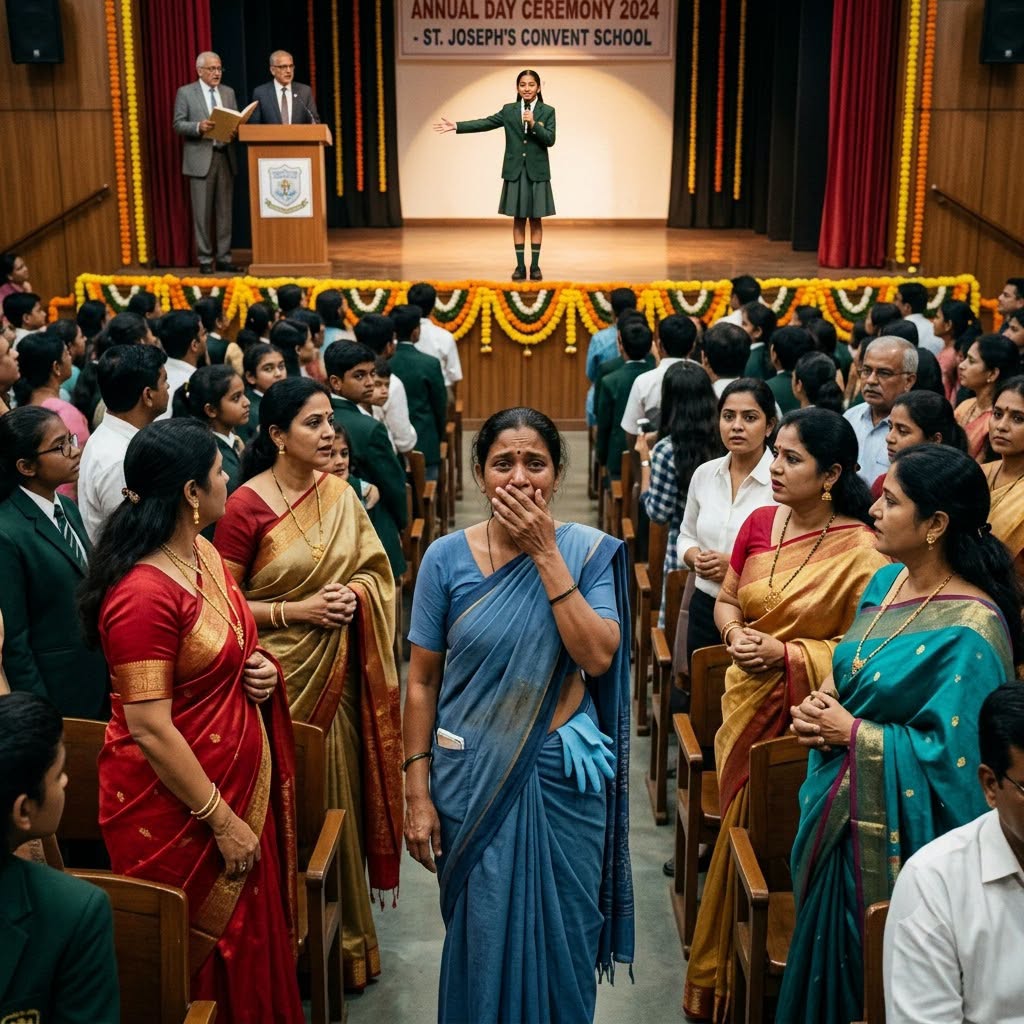
That afternoon, I went home still wearing my blue uniform.
But I no longer wanted to hide it.
Months passed.
The school corrected the financial records.
Gaurika’s education account was protected.
Avinash and I spoke for the first time in years.
He admitted he should have transferred money directly.
I told him fatherhood was not a bank transaction.
He began calling Gaurika again.
Slowly.
Awkwardly.
I did not force her to answer.
That choice belonged to her.
As for Devyani, our relationship became something without a name.
I could not call her Amma.
That name belonged to Sulochana.
But I stopped calling her Mrs. Joshi.
Eventually, I called her Devyani.
She accepted it.
Two years later, Gaurika had another school function.
I had a day off.
I wore a green saree.
Gold-colored glass bangles.
A little perfume Gaurika had bought me.
Before we left, she stared.
“You look pretty.”
“Only today?”
She laughed.
Then she disappeared into my bedroom and returned carrying something.
My blue housekeeping ID card.
“What are you doing?”
“Bring it.”
“Why?”
“Just bring it.”
At school, there was an exhibition titled **People Who Keep Our City Running.**
Children had made displays about bus drivers, nurses, sanitation workers, delivery riders, security guards and cleaners.
Gaurika’s display showed a hospital corridor.
In the center was a photograph of me in my blue uniform.
Underneath she had written:
**My mother cleans places where people come to heal. Her work deserves the same respect as anyone else’s.**
I stood there in my green saree holding the old ID card.
Devyani arrived quietly.
She stood beside me.
After a while she said:
“Sulochana would have been proud.”
Je l’ai regardée.
“Oui.”
Puis, après une pause, j’ai ajouté :
« Elle aurait pu être en colère contre nous deux aussi. »
Devyani sourit à travers ses larmes.
« Ça lui ressemble bien. »
Pour la première fois, nous avons ri ensemble.
Pas comme une mère et sa fille.
Pas encore.
Peut-être jamais de façon ordinaire.
Mais comme deux femmes enfin réunies face à la même vérité.
J’étais entrée dans cet auditorium en croyant que mon uniforme faisait de moi la mère la plus pauvre de tous.
Le soir venu, je savais que j’étais né dans une famille riche.
Aucun de ces faits n’a changé qui j’étais.
Sulochana m’a appris que la dignité ne venait pas de la richesse.
Gaurika m’a appris que la dignité n’exigeait pas non plus de dissimuler la souffrance.
Et Devyani m’a appris, douloureusement, que la culpabilité déguisée en générosité peut encore priver les gens de leurs choix.
Le plus grand héritage que j’ai reçu ce jour-là n’était pas le dépôt à terme.
Pas les titres de propriété.
Pas le fonds pour l’éducation.
C’était le droit de connaître ma propre histoire.
Et lorsque j’ai finalement encadré la photo de Sulochana et Devyani ensemble, j’ai placé une chose en dessous.
Mon ancien badge d’hôpital.
**ISHWARI JOSHI — ENTRETIEN MÉNAGE.**
Je ne l’ai plus jamais caché.
Si vous découvriez que la femme qui vous a méprisé pendant des années était en réalité votre mère biologique, et que la pauvre femme de ménage qui vous a élevé a gardé ce secret par amour, qui appelleriez-vous votre vraie mère ? Dites-moi ce que vous auriez fait à la place d’Ishwari dans les commentaires, et abonnez-vous à la page, car parfois, la personne que la société nous apprend à mépriser est précisément celle dont l’amour nous a permis de nous élever sans honte.





