So she wrote:
**Tell Ishwari only when her daughter proves that my child has learned what I tried to teach her—that honest work cannot make a person small. Then she will be ready to know she was born into wealth without mistaking wealth for worth.**
I could not read further.
I cried against Gaurika’s hair.
The little girl who had called me onto a stage had unknowingly fulfilled the final condition of the grandmother she barely remembered.
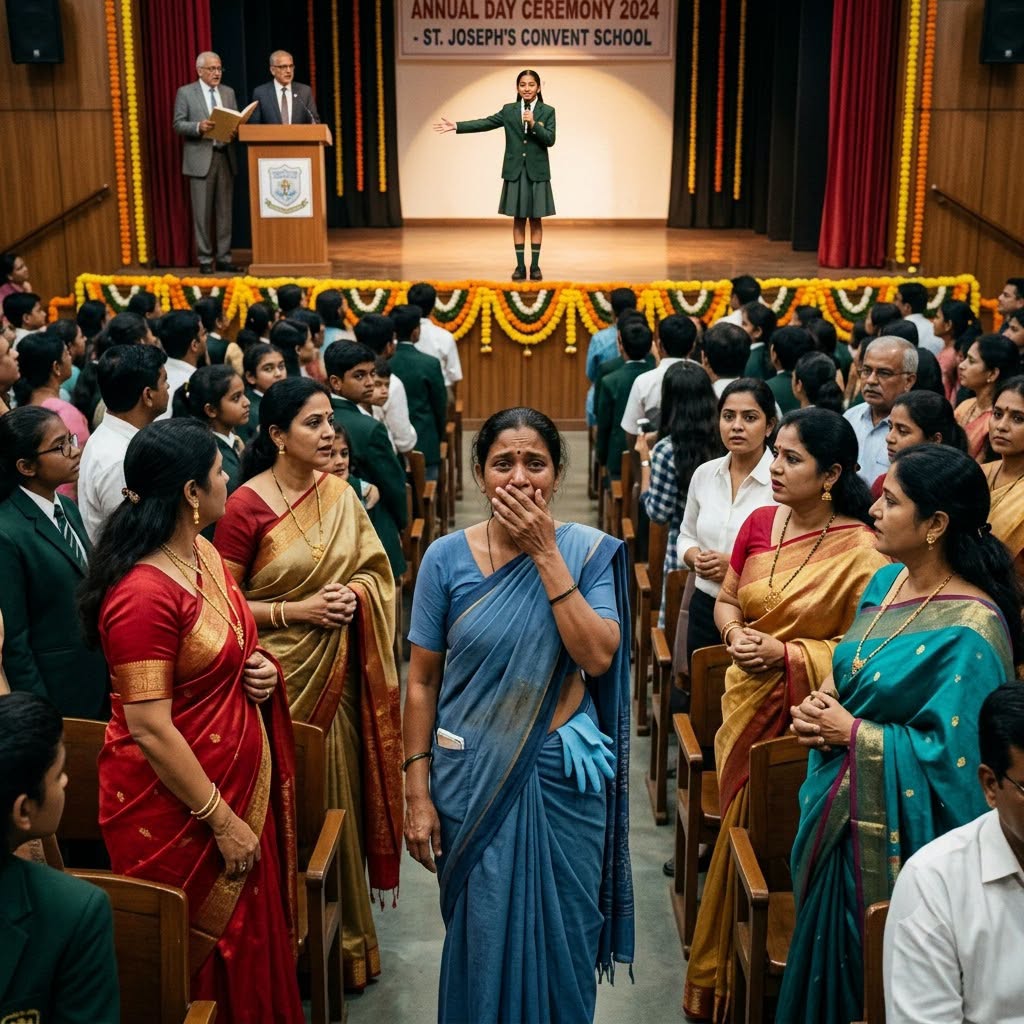
That afternoon, I went home still wearing my blue uniform.
But I no longer wanted to hide it.
Months passed.
The school corrected the financial records.
Gaurika’s education account was protected.
Avinash and I spoke for the first time in years.
He admitted he should have transferred money directly.
I told him fatherhood was not a bank transaction.
He began calling Gaurika again.
Slowly.
Awkwardly.
I did not force her to answer.
That choice belonged to her.
As for Devyani, our relationship became something without a name.
I could not call her Amma.
That name belonged to Sulochana.
But I stopped calling her Mrs. Joshi.
Eventually, I called her Devyani.
She accepted it.
Two years later, Gaurika had another school function.
I had a day off.
I wore a green saree.
Gold-colored glass bangles.
A little perfume Gaurika had bought me.
Before we left, she stared.
“You look pretty.”
“Only today?”
She laughed.
Then she disappeared into my bedroom and returned carrying something.
My blue housekeeping ID card.
“What are you doing?”
“Bring it.”
“Why?”
“Just bring it.”
At school, there was an exhibition titled **People Who Keep Our City Running.**
Children had made displays about bus drivers, nurses, sanitation workers, delivery riders, security guards and cleaners.
Gaurika’s display showed a hospital corridor.
In the center was a photograph of me in my blue uniform.
Underneath she had written:
**My mother cleans places where people come to heal. Her work deserves the same respect as anyone else’s.**
I stood there in my green saree holding the old ID card.
Devyani arrived quietly.
She stood beside me.
After a while she said:
“Sulochana would have been proud.”
I looked at her.
“Yes.”
Then, after a pause, I added:
“She might have been angry with both of us too.”
Devyani smiled through tears.
“That sounds like her.”
For the first time, we laughed together.
Not as mother and daughter.
Not yet.
Perhaps never in the ordinary way.
But as two women finally standing inside the same truth.
I had entered that auditorium believing my uniform made me the poorest mother there.
By evening, I knew I had been born into money.
Neither fact changed who I was.
Sulochana taught me that dignity did not come from wealth.
Gaurika taught me that dignity also did not require hiding struggle.
And Devyani taught me, painfully, that guilt disguised as generosity can still rob people of their choices.
The greatest inheritance I received that day was not the fixed deposit.
Not the property papers.
Not the education fund.
It was the right to know my own story.
And when I finally framed the photograph of Sulochana and Devyani together, I placed one thing beneath it.
My old hospital badge.
**ISHWARI JOSHI — HOUSEKEEPING.**
I never hid it again.
If you discovered that the woman who had looked down on you for years was actually the mother who gave birth to you—and that the poor cleaner who raised you had protected that secret out of love—who would you call your real mother? Tell me what you would have done in Ishwari’s place in the comments, and follow the page, because sometimes the person society teaches us to look down on is the very person whose love carried us high enough to stand without shame.





