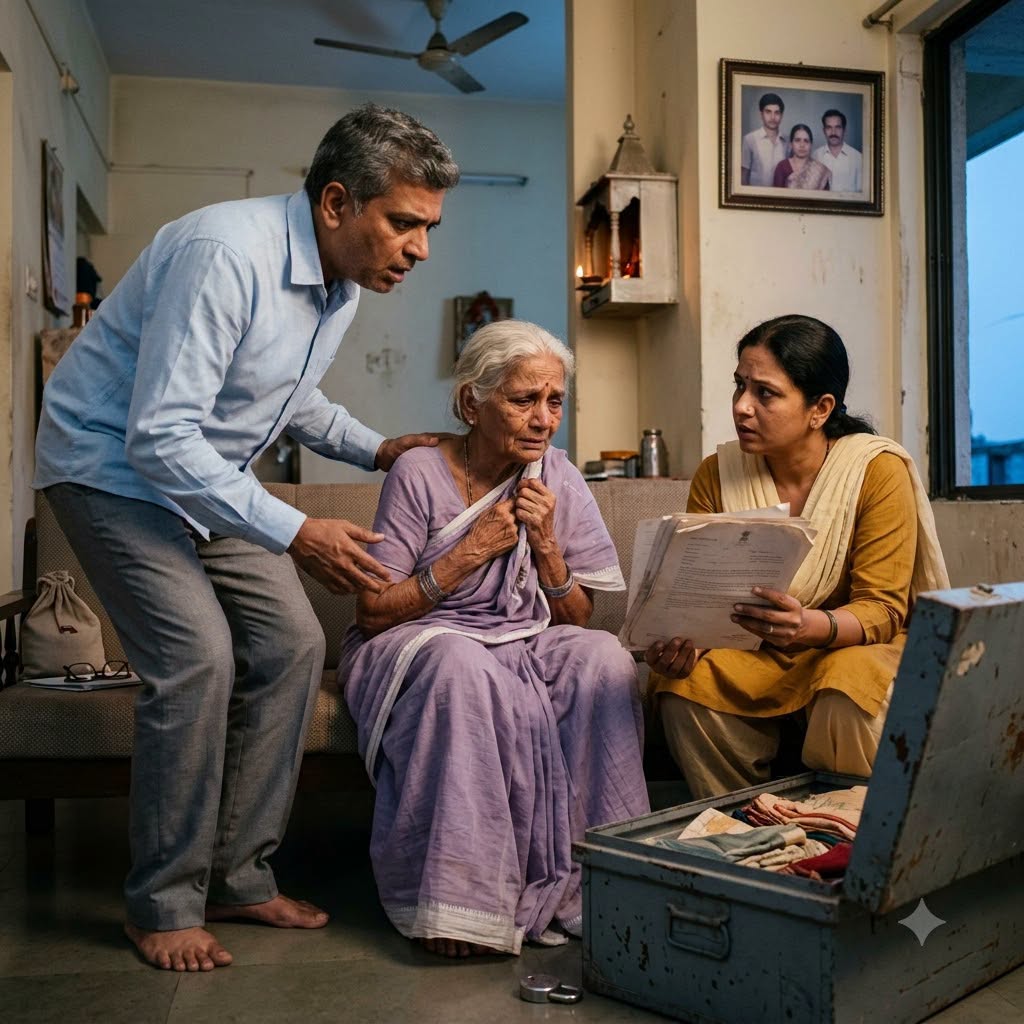
She rested her head against my shoulder.
For a long time, we watched the sunset.
Then she whispered, “Your father would have loved seeing us together.”
My throat tightened.
“I miss him.”
“So do I.”
I looked toward the horizon.
For six years, I had imagined Baba’s final days were peaceful.
Now I understood he had died carrying guilt about money, adoption, and choices he regretted.
But his last letter had done something extraordinary.
It had allowed us to stop pretending.
And sometimes, honesty is the first real chance a family has to heal.
A year later, Amma decided she wanted to return to Satara for a visit.
I was nervous.
She noticed.
“Shashi, I’m seventy-four. I’m not made of glass.”
I laughed.
“That’s exactly what worries me.”
Vedika packed lunch.
Pradyumna insisted on bringing his cricket bat.
Ishwari brought a camera.
And Nandkumar met us at the house.
The courtyard looked different.
The tulsi plant was green again.
The brass bell in the puja room shone.
And beneath the mango tree stood a small wooden bench.
My brother had repaired it.
When Amma saw him, she smiled.
“Nandu.”
He folded his hands.
“Namaste, Amma.”
She touched his head.
Then looked around.
“It’s clean.”
He nodded.
“I’ve been coming every Sunday.”
I stared at him.
He looked embarrassed.
“I thought Baba would be angry if I let the place fall apart.”
My throat tightened.
Amma walked slowly toward the mango tree.
She placed one hand against its trunk.
Then closed her eyes.
For a moment, I thought she was crying.
But when she turned toward us, she was smiling.
“Your father planted this when Shashi was born,” she said.
Pradyumna looked surprised.
“Really?”
She nodded.
“And when Nandu came home, he planted another little sapling beside it.”
We looked toward the corner of the courtyard.
There stood a smaller mango tree.
Its branches were heavy with fruit.
I had passed it thousands of times.
But I had never thought about why there were two trees.
Amma smiled through her tears.
“One for each son.”
Nandkumar covered his face.
I reached for his shoulder.
For the first time, I understood what our father had tried to tell us without words.
He had never planted one tree for a real son and another for an adopted one.
He had planted two trees because he had two children.
We stood beneath them for a long time.
Then Amma said something that made us all cry.
“I don’t know how many years I have left.”
I shook my head.
“Amma, don’t say that.”
She smiled.
“Let an old woman speak.”
We fell silent.
“I don’t want either of you fighting over this house after I’m gone.”
She looked at Nandkumar.
“Nor do I want guilt to destroy you.”
Then she looked at me.
“And I don’t want responsibility to make you forget your own family.”
I held her hand.
“What do you want, Amma?”
She looked toward the two mango trees.
“I want this place to remain a home.”
We listened.
“Not a prize.”
Her voice trembled.
“Not a punishment.”
She smiled.
“A home.”
In the months that followed, we worked with independent advisers to settle the family’s property and financial arrangements properly.
Amma’s rights were protected.
Nandkumar’s debts were kept separate from her care.
And both of us agreed that future decisions would be made openly, with her informed consent.
There was no miraculous inheritance.
No instant forgiveness.
But there was something better.
An honest beginning.
One Sunday evening, after returning to Pune, I found Amma sitting beside Vedika in the kitchen.
They were preparing bhakri.
Vedika was laughing because Amma insisted she was rolling the dough too thin.
I stood in the doorway.
For a moment, I remembered the frightened woman I had brought from Satara.
The empty refrigerator.
The dusty brass bell.
The suitcase packed before I arrived.
Now she was arguing about cooking.
Smiling.
Living.
I felt tears in my eyes.
Amma noticed me.
“What are you staring at, Shashi?”
I laughed.
“Nothing.”
She smiled.
“Then come help.”
I rolled up my sleeves.
“What should I do?”
She handed me a plate.
“Cut the onions.”
I obeyed.
Und während wir drei in der Küche arbeiteten, wurde mir etwas klar.
Jahrelang glaubte ich, ein guter Sohn zu sein bedeute, Geld zu schicken.
Rechnungen bezahlen.
Ich sorgte dafür, dass Amma ein Dach über dem Kopf hatte.
Doch Liebe misst sich nicht nur in Banküberweisungen.
Manchmal wird es an der Anzahl der Anrufe gemessen, die entgegengenommen werden, ohne dass man auf einen Laptop schaut.
Bei gemeinsamen Mahlzeiten.
In Fragen, die gestellt werden, bevor jemand so viel Angst bekommt, dass er sein Zuhause verlässt.
Und den Mut zu haben, einen Elternteil zu schützen, selbst wenn derjenige, der den Schmerz verursacht, der eigene Bruder ist.





