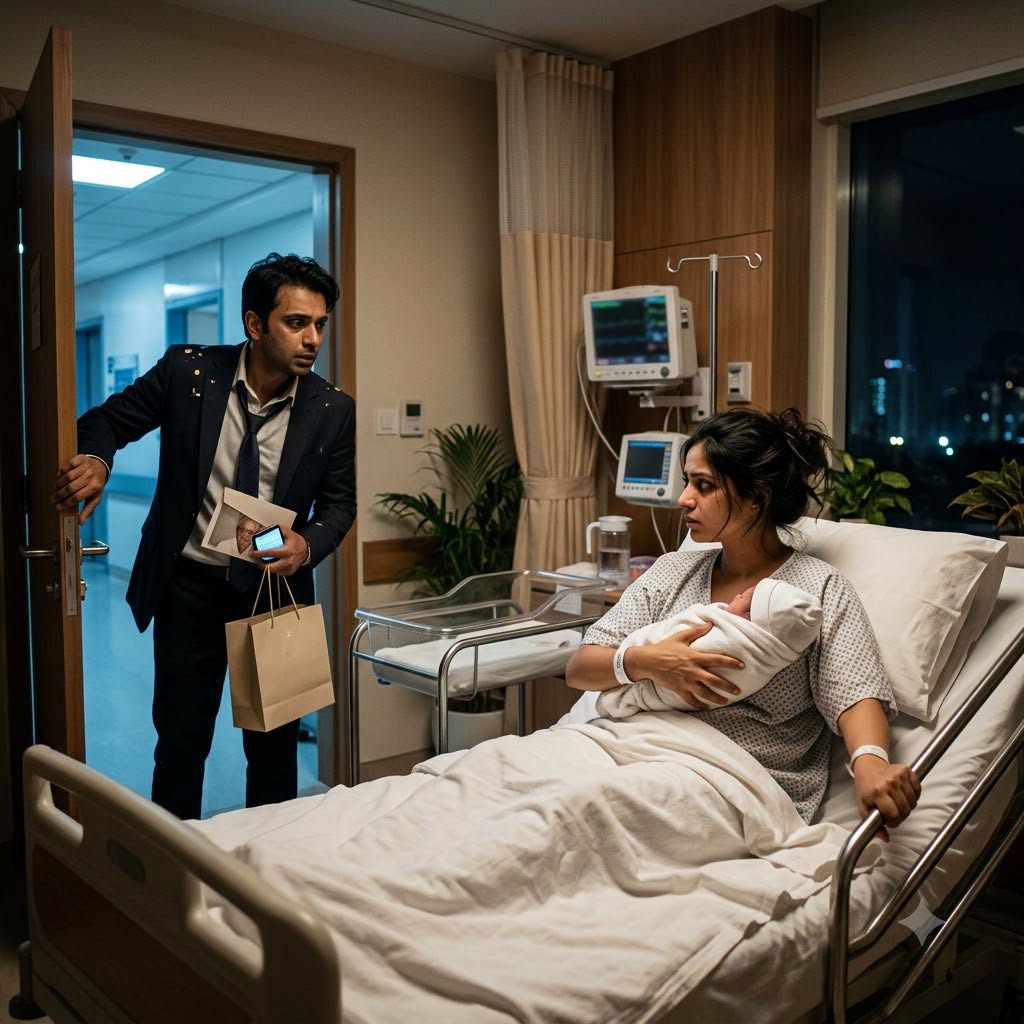
For a moment, neither of us moved.
Then he said something that made me cry.
“I always wondered why I felt like somebody was missing.”
I covered my mouth.
He stepped closer.
“May I hug you?”
I nodded.
He held me.
And I cried for thirty-four lost birthdays.
Thirty-four Raksha Bandhans.
Thirty-four years of believing I had no brother.
He cried too.
We sat for hours.
He told me about his childhood.
His school.
His adoptive parents.
His marriage.
His work.
I told him about Baba.
About Gaurika.
About Aarav.
And about the night we were born.
At one point, he smiled sadly.
“Do you hate my parents?”
I thought carefully.
“I hate what was done.”
He nodded.
“But I don’t know yet how much they understood.”
He looked relieved.
“Thank you.”
I touched his hand.
“None of this is your fault.”
He began crying again.
Over the next year, the investigation continued.
The hospital’s old records became part of a formal inquiry.
The surviving people involved were questioned.
Some documents had disappeared.
Others had been deliberately altered.
Harivansh provided evidence about his father’s role.
He did not try to protect the Vardhan name.
That mattered to me.
Because I had no interest in exchanging one powerful family’s silence for another.
Harivansh also asked whether he could be part of my life.
I told him the truth.
“I already had a father.”
He nodded.
“I know.”
“His name was Mahesh Kulkarni.”
“I know.”
“He loved me.”
Harivansh’s eyes filled.
“Then I owe him more than I can ever repay.”
I looked at him.
“You can’t repay him.”
He lowered his head.
“But you can respect him.”
“I will.”
Slowly, we began building something.
Not the relationship we should have had.
That was gone.
But something honest.
He visited Aarav.
He listened when I spoke about Baba.
He never asked me to change my surname.
He never asked me to call him Papa.
One evening, while we were looking through old photographs, I asked him whether he had ever married.
He shook his head.
“Once, I thought I would marry your mother.”
He smiled sadly.
“After that, I spent too much time building businesses and not enough time understanding why I was lonely.”
I looked at him.
“You had a family.”
“I did.”
His eyes filled.
“I just didn’t know where they were.”
Two years after Aarav’s birth, Madhav and I finalized our divorce.
He had attended counseling.
He had apologized repeatedly.
He had become a more present father.
But I had learned that someone could change and still not be the person I wanted to share my life with.
We agreed on arrangements for Aarav.
Madhav remained involved in his son’s life.
I never spoke badly about him to our child.
But I did not return to him.
Some people called me stubborn.
Others said I should have forgiven him because he was trying.
I stopped explaining.
I had spent too many years being told what a good wife should tolerate.
I wanted to learn what a peaceful woman could choose.
On Aarav’s third birthday, we held a small celebration.
Ma made kheer.
Gaurika decorated the living room.
Raghavendra brought a ridiculous toy train.
Harivansh arrived carrying a storybook.
Madhav llegó más tarde con los bloques de construcción favoritos de Aarav.
Durante unas horas, personas que antes habían estado unidas por mentiras permanecieron juntas porque amaban a un niño pequeño.
No fue perfecto.
Pero fue sincero.
Después de que los invitados se marcharan, encontré a Harivansh de pie junto a la fotografía de Baba.
Lo miraba en silencio.
Me acerqué a él.
“Le habría gustado Aarav.”
Harivansh asintió.
“Debió de ser un buen hombre.”
“Lo era.”
Los ojos del anciano se llenaron de lágrimas.
“Ojalá pudiera darle las gracias.”
Miré la fotografía.
Luego en Harivansh.
“Puede.”
Se giró.
“¿Cómo?”
“Siendo el tipo de abuelo que Aarav se merece.”
Comenzó a llorar.
Esa noche, después de que Aarav se durmiera, abrí la pequeña caja de madera donde guardaba mis cosas más preciadas.
Mi fotografía de boda.
El viejo reloj de Baba.
El gorro amarillo que mamá había tejido.
Y la primera fotografía de Raghavendra y yo juntos.
Coloqué el informe de ADN debajo de ellos.
No porque me definiera.
Porque explicaba algo que yo desconocía.
Entonces miré a mi hijo dormido.
La noche en que nació, creí que mi vida se estaba desmoronando.
Mi marido me había traicionado.
De repente, mi padre se convirtió en un desconocido.
Mi madre había ocultado una verdad durante treinta y cuatro años.
Y en algún lugar de Bombay, un hombre al que nunca había visto estaba descubriendo que tenía una hermana gemela.
Pero tres años después, comprendí algo.
La familia no era simplemente el grupo de personas cuyos nombres aparecían en un certificado de nacimiento.





