The cake hit the bottom of the trash can with a wet thud. Before I could reach for it, my daughter-in-law slammed down the lid and told me to get out of her kitchen.
“Who celebrates birthdays at your age?” Paige asked, loud enough for her three friends to hear. “Go to your room.”
I had turned seventy-five that morning. The little chocolate cake cost fourteen dollars at the grocery store. I had asked the bakery clerk to write Happy Birthday, Margaret, because nobody in my house had mentioned the date.
Paige’s friends stood around my island holding wineglasses. One laughed into her hand. Another looked away. My son, Andrew, stared at the floor as if he had dropped something there and could not find it.
“Mom, please,” he muttered.
“Just go upstairs. We’ll talk later.”
Later was Andrew’s favorite word. Later, when Paige stopped being stressed. Later, when the bills were paid. Later, when they could explain why I needed to sign papers about moving into an assisted-living facility.
This was my house. My husband, Thomas, and I had paid off the mortgage before he died. Andrew and Paige had moved in eighteen months earlier after losing their apartment. Somehow, in that time, my own kitchen had become a place where I needed permission to stand.
I bent to pick up the ribbon from my cake box. Paige stepped on it.
“Don’t make a scene,” she whispered.
A horn sounded outside. Then came the heavy hiss of air brakes.
Through the front window, I saw a white delivery truck stopping at the curb.
Its side read MILLER FURNITURE RESTORATION. Two men climbed down, checked an address, and began lowering the liftgate.
Paige went rigid. Her glass struck the counter so hard wine spilled across the marble.
“What are they doing here?” she demanded.
“I believe they have something for me,” I said.
My granddaughter Grace had called the night before. She said she had found a birthday present connected to her grandfather and begged me to be home for the delivery. She would not tell me what it was. I had expected a box of photographs, perhaps a small keepsake.
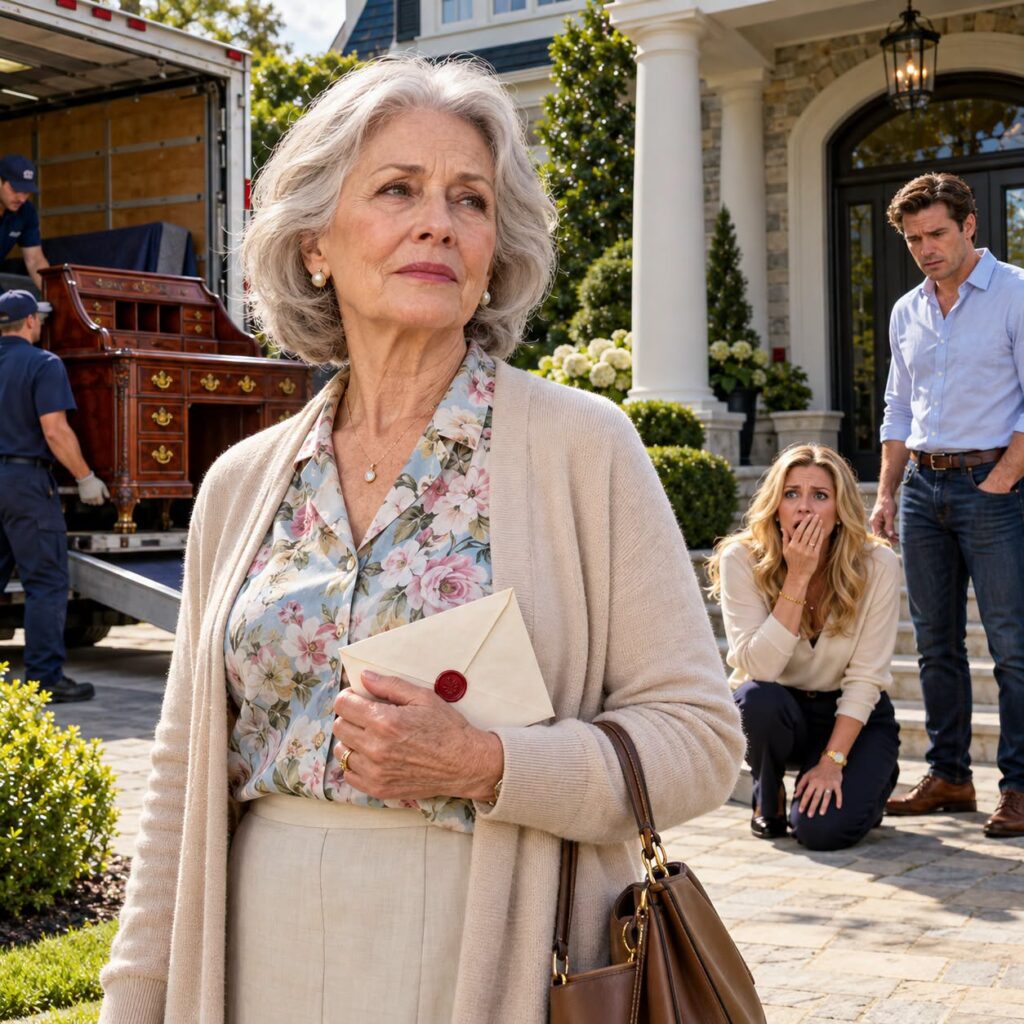
Not the enormous cherrywood writing desk that emerged from the truck.
I knew its curved legs. I knew the crescent-shaped dent near the brass handle, left when Andrew rode his bicycle into it at nine.
Thomas had worked at that desk every evening, writing letters and paying bills. Last winter, Paige told me it had been ruined by a basement leak and hauled away.
Yet here it stood, polished and beautiful beneath the afternoon sun.
Paige stumbled down the porch steps. Then she dropped to her knees on the concrete.
“No,” she said. “That was supposed to be gone.”
One of the deliverymen opened a drawer and touched a nearly invisible wooden catch. A hidden panel slid free.
Inside lay a thick envelope in Thomas’s handwriting.
On the front were five words that turned my blood cold.
Margaret, do not sign anything.
I had spent months believing the desk was destroyed, but Paige’s reaction told me she knew more than I did. The handwriting inside belonged to the one person I trusted with my future,
and what he left there threatened everything my son had been hiding.





