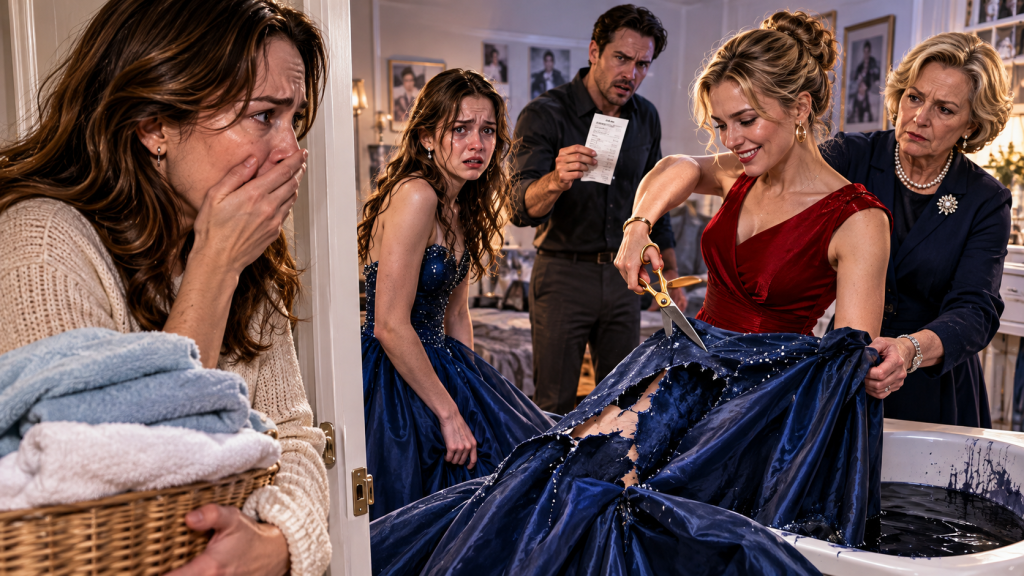
“Now she won’t outshine Olivia,” my sister-in-law Lauren said, driving her scissors through the skirt of my daughter’s prom dress.
My mother-in-law, Patricia, held the navy satin taut for her.
I stood in Emma’s bedroom doorway with a basket of clean towels against my chest. For a second, I could only hear the little metallic clicks of the blades. Then Lauren pulled again, opening a ragged tear from the hip to the hem.
“Stop,” I said.
Patricia looked over her shoulder. “Don’t make a scene, Nora. It’s only a dress.”
Prom was tomorrow.
Emma, seventeen, had spent four months making that dress with me after school. We bought the satin on sale. She’d stitched the tiny beads onto the neckline while I worked out the zipper. Some nights, she fell asleep at our kitchen table with thread caught around her finger.
Near the waist was a single pearl button from my late mother’s sewing tin. Mom used to say that every good dress should have something the wearer could touch when she needed courage.
Emma was barefoot beside her dresser. She stared at the scissors without moving.
“Why?” she asked.
Lauren laughed too quickly. “Olivia’s dress cost a fortune, and you’ve been acting like yours is something special.”
“It is special,” Emma whispered.
Patricia reached for the ripped fabric. “Your cousin deserves one night when everybody looks at her. Besides, nobody will notice a few alterations.”
The skirt hung almost in two pieces.
For years, Patricia had compared the girls: Olivia’s grades, Olivia’s piano lessons, Olivia’s photographs on the refrigerator. Emma never complained. She remembered Olivia’s birthdays and saved the best corner of every cake for her cousin.
My husband, Daniel, came upstairs when he heard Emma crying. His mother immediately changed her voice.
“We were helping with a hem,” she told him.
Daniel looked at the scissors, then at his daughter’s hands. Emma was holding that small pearl button, which had come loose with the torn seam.
“Mom,” he said, “get out.”
Patricia blinked. “You’re choosing this over your own mother?”
“I’m choosing my daughter.”
Lauren stepped toward Emma’s phone, propped on the dresser where she’d been filming a final fitting for her best friend.
A tiny red light still glowed on the screen.
Lauren stopped reaching.
I picked up the phone and checked the recording. It had started twenty minutes earlier.
And the first conversation it captured was worse than anything they’d said while cutting the dress.
On the recording, Patricia’s voice came first.
“Cut the skirt. Then tell her she must have torn it trying it on. Nora always believes people if they sound concerned.”
Emma made a sound I had never heard from her before, something small and breathless. Daniel sat beside her on the bed but didn’t try to take the phone away.
Lauren reached for her purse. “You recorded us without asking?”
“It was recording my dress,” Emma said. “In my room.”
Daniel saved the original video and copied it to our family computer. He told his mother and sister to leave. Patricia tried to hug Emma on her way out; Emma stepped behind me.
At ten thirty, Lauren posted a message in the extended family chat: Emma had ruined her own dress, then falsely accused two women who were trying to help. A cousin replied that teenagers could be dramatic. Patricia wrote, “Please pray for this family.”
Daniel answered with one sentence: “We have the recording. Do not repeat that lie.”
Within minutes, Patricia called six times.
I didn’t answer. I was kneeling on the carpet, gathering beads into my palm. Emma sat beside me, pulling one loose thread through her fingers until I gently stopped her.
“I saved for this,” she said. “I wasn’t trying to be prettier than Olivia.”
“I know.”
“Do I still get to go?”
That question hurt more than the torn fabric. I called Mrs. Alvarez, the retired seamstress who had helped us fit the bodice. She lived two streets away and still had extra navy material from our project.
“Bring it first thing,” she said. “I can’t promise the same dress, but I can try.”
At breakfast, Olivia came to our door without Lauren. She was wearing her school sweatshirt and carrying a garment bag.
“My mom told me Emma wasn’t going,” she said. “I thought you should know I didn’t ask for any of this.”
Emma didn’t move toward her. Olivia set the bag on the table. Inside were sections of navy fabric Lauren had thrown into the outside trash, carefully rinsed and folded.
The girls had shared a bunk bed at summer camp, whispering jokes after lights-out. Seeing Olivia there, twisting the garment bag’s zipper, I remembered how safe they once felt together.
“I saw what she did to the dress,” Olivia said. Her eyes reddened. “I should’ve come upstairs sooner.”





