PART 2
The approaching cruiser stopped hard behind Riggins’s patrol car. Sergeant David Bradley stepped out before his headlights had finished rocking. “Riggins!” he shouted. “Hands off the driver!” Riggins released me so abruptly that my elbow struck the door. Bradley crossed the distance fast. “Step away from the vehicle.” “She refused orders,” Riggins snapped. “She was interfering with—” “Step. Away.” Bradley’s voice left no room for negotiation. Riggins backed up two paces, breathing hard. I stayed seated and rubbed the red marks forming around my wrist. Bradley crouched beside my door. “Ma’am, are you injured?” “My shoulder hurts. My wrist will bruise. I want photographs before anything changes.” Riggins laughed behind him. “Oh, now she’s building a lawsuit.”
Bradley slowly turned. “Turn on your body camera.” Riggins touched his chest. Then stopped. Bradley’s eyes narrowed. “Why isn’t it running?” “Battery issue.” “Your unit reported a full charge at the start of shift.” “Then the equipment’s defective.” Bradley stared at him for several seconds before saying, “Stay where you are.” That was the first moment I saw fear move across Riggins’s face. Bradley photographed my wrist, the broken license pieces, the citations and my vehicle. Then he asked me, quietly, “Do you want to make a formal complaint?” “Yes.” “Against Officer Riggins?” “I want the record to describe what happened. The conclusions can come later.”
Riggins heard me. “Oh, give me a break. She’s playing you.” He came forward again. Bradley raised a hand. “Stop.” Riggins ignored him. “You think you’re special because you got some fancy address?” He pointed at me through the open door. “Tell him what you do. Go ahead. Tell everybody how important you are.” I stepped carefully out of the Lexus. “My occupation has nothing to do with whether you followed procedure.” “There it is.” He laughed. “That attitude.” Bradley moved between us. Riggins tried to step around him. Their shoulders collided. Bradley shoved him back. “Enough.” For one second, I thought Riggins was going to swing at his own sergeant.
Instead, another voice came from Bradley’s radio. “Supervisor Two, be advised Professional Standards requests Officer Riggins be separated from his vehicle pending review.” Riggins went pale. “What?” Bradley reached toward him. “Thomas, give me your keys.” “For what?” “Your keys.” “This is because of her?” “It’s because this is the third complaint involving a disabled body camera in six weeks.”
That was the first twist. I had thought I was reporting an isolated abuse of authority. I wasn’t.
Three days later, investigators contacted me. They already had complaints from other motorists: disputed stops, missing footage, accusations of threatening language and searches that produced nothing. But Riggins had survived every complaint because the evidence was incomplete. He apparently believed my case would disappear the same way. What he did not know was that my Lexus automatically stored exterior camera footage and cabin audio after emergency braking or police-contact events. He also did not know the Crestwood Hills entrance camera covered part of Route 114. Between the two systems, almost every word was preserved.
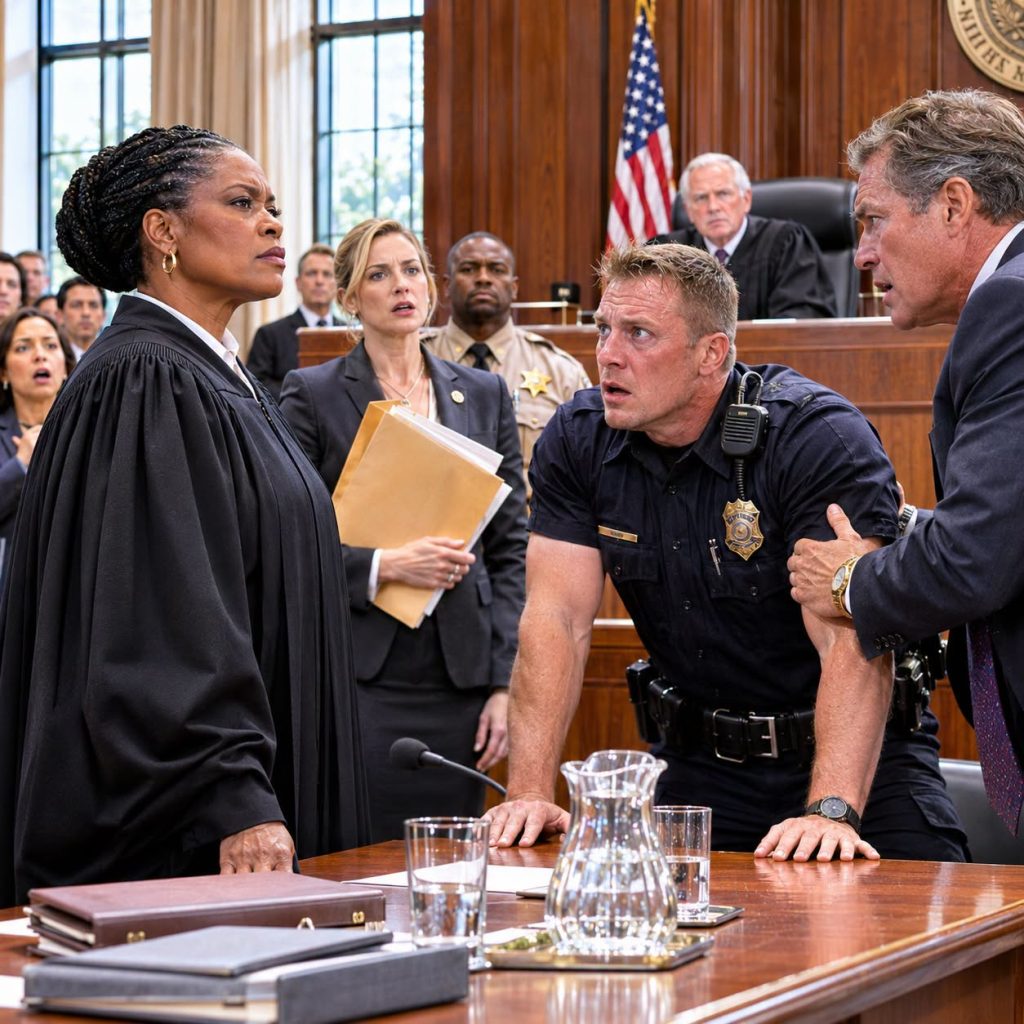
I turned everything over through counsel and refused to involve myself further. That mattered because, three and a half weeks later, I walked into Federal Courtroom 4B and saw Thomas Riggins sitting beside defense attorney Richard Harrison.
I stopped.
Riggins looked up.
The color drained from his face.
The case on my docket was United States-related civil-rights litigation arising from a broader Department of Justice investigation into his conduct. His attorney whispered, “What’s wrong?” Riggins couldn’t answer.
The courtroom deputy called, “All rise.”
I stepped toward the bench. Riggins stood mechanically, staring at me as if the floor had disappeared beneath him. I sat down, looked across the courtroom and spoke the only words ethics allowed me to speak.
“Before anything else occurs, the Court must address a matter that none of the parties appear to know.”
Harrison slowly rose. “Your Honor?”
I looked directly at Riggins.
“I am the driver from the Route 114 incident.”
Someone in the gallery gasped.
Riggins whispered, “Oh, God.”
And then the prosecutor stood holding a sealed evidence folder I had never seen before.
“Your Honor,” she said, “there is something else the Court needs to know before deciding how to proceed.”
PART 3
I did not open the folder.
“I will not review evidence in a case from which I may be required to recuse,” I said. Harrison was already on his feet. “Your Honor, we move for immediate recusal.” “You do not need to move.” I looked at the clerk. “This proceeding is suspended. The matter will be reassigned randomly under district procedure.” Riggins stared at me, breathing through his mouth. Whatever fantasy he had constructed—that I would misuse my authority and hand him an appellate argument—collapsed in that moment. I gave him nothing. Not revenge. Not a speech. Just procedure.





