PART 2
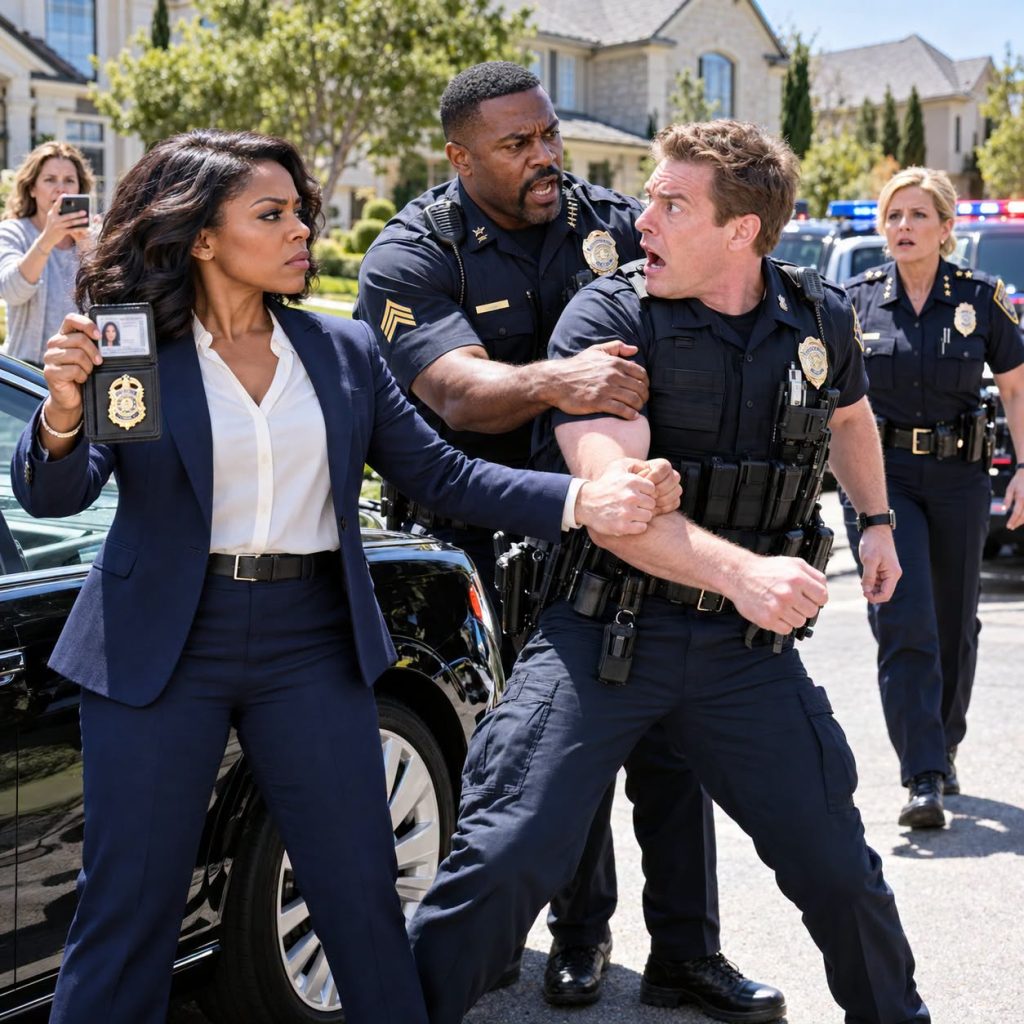
Malone’s fingers tightened around my wrist. “I had probable cause,” he snapped. Sergeant Okafor stopped six feet away, one hand held open in front of him. “Cody, holster the weapon.” “She refused commands.” “She is a Deputy United States Marshal standing in her own driveway.” “I didn’t know that!” “You know it now.” Malone finally released me, but the instant I stepped backward, he reached toward me again. I caught his forearm and redirected it away from my body—not a strike, not a takedown, just nineteen years of training preventing an angry officer from putting hands on me twice. Malone stumbled against the sedan. “She assaulted me!” he shouted. Okafor moved between us so fast his shoulder slammed into Malone’s chest. “Enough!” The word echoed down the street. “Gun in the holster. Hands away from her.” Malone’s breathing came hard. For several seconds, nobody moved. Then he shoved his Glock into the holster and snapped the retention strap shut. Mason was still recording from across the road. Two more neighbors stood outside now. Okafor looked at my credential wallet. “Marshal Latimer, are you injured?” “My wrist will bruise.” I looked at Malone. “But that isn’t the biggest problem here.”
Okafor turned toward him. “What bulletin were you acting on?” Malone answered immediately. “Harwick County BOLO. Dark sedan involved in residential burglary.” “What time was it issued?” Malone hesitated. “Earlier tonight.” Okafor’s expression hardened. He walked to his cruiser and pulled up the mobile terminal. I watched his eyes move across the screen. “Plate range?” he asked. Malone said nothing. “Cody. Plate range.” “There wasn’t one.” “Make?” “Unknown.” “Suspect description?” “Unknown.” Okafor slowly looked up. “Then you initiated a gunpoint stop based on the fact that she was driving a dark sedan?” Malone pointed at me. “She kept looking at me in the mirror. She turned into a gated neighborhood. That was suspicious.” I almost laughed, but nothing about it was funny. “I looked at you because you were following me.” Okafor kept reading. Then his face changed. “Wait.” Malone took one involuntary step toward him. “Sergeant—” “Dispatch transmitted a clarification twenty-seven minutes ago. The Harwick vehicle was recovered. Suspects were detained.” Silence. Okafor looked straight at Malone. “You acknowledged the update.” Malone’s mouth opened. Nothing came out.
That was the twist I hadn’t expected. He hadn’t simply made a reckless mistake. His own terminal showed that he had received the cancellation before he followed me through the neighborhood gates. “Why did you continue the stop?” I asked. Malone’s face flushed. “I wanted to verify.” “With a drawn pistol?” “She fit—” He stopped himself. My voice went colder. “I fit what?” Okafor stepped between us again. “Do not answer. Cody, get in your vehicle.” “You’re taking her side?” “I’m taking the side of what your body camera just recorded.” Malone suddenly reached toward the front of his vest. Okafor caught his arm, spun him against the cruiser, and pulled the radio microphone away from his hand. “Stop!” Malone shouted. “Get off me!” “Then stop escalating!” For several seconds they struggled beside the cruiser until Malone finally froze. Okafor ordered another officer to stand with him, then walked back to me. His voice had lost its command edge. “Marshal Latimer, I’m sorry.” “Don’t apologize before you know what you’re apologizing for.” He looked at me. “What does that mean?” “Pull his complaint history.”
The next morning, at 7:18, somebody knocked on my front door. My wrist was purple beneath the cuff of my sweatshirt. When I opened the door, Crestmore Police Chief Aalene Drummond stood outside alone, holding a thick file and looking like she hadn’t slept. “Marshal Latimer, may I come in?” I stepped aside. She placed the file on my kitchen table but didn’t sit. “I reviewed Malone’s body camera footage. I reviewed the dispatch logs. I reviewed your neighbor’s video.” “And?” She pushed the file toward me. “Three civilian complaints in eighteen months. Two involved his firearm. One alleged he detained a homeowner without articulating cause.” I stared at her. “Were they sustained?” Her silence answered before she did. “They were closed at supervisory review.” “Without investigation?” “Without meaningful investigation.” My anger finally surfaced. “Then Malone isn’t the whole problem.” Chief Drummond met my eyes. “No, Marshal.” She opened the file to a page covered in signatures. “And that’s why I came here personally. Because one of the supervisors who signed these closures still works inside my command staff—and last night, before Sergeant Okafor reached your driveway, someone called Malone’s phone.” She slid a printout across the table. “The call lasted forty-three seconds.” I looked at the name beside the number. Then I looked back at her. “Chief… why would your deputy chief be calling the officer who had a gun pointed at me?”





