PART 2
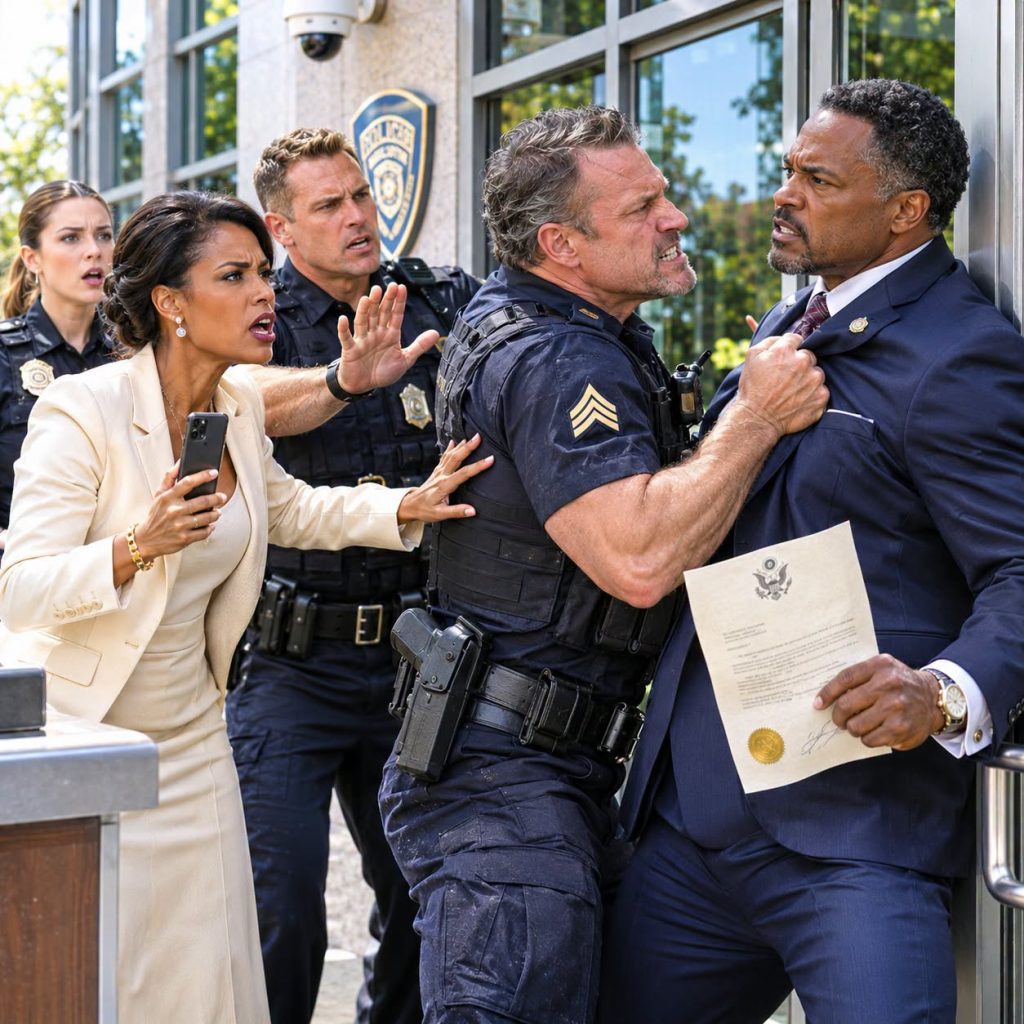
Marsh’s fists twisted tighter in my jacket. “Let go,” I said. Angela raised her phone. “Lieutenant Marsh, you are being recorded. Release Mr. Holloway.” He shoved me against the metal door. I caught his forearms, pushed them off, and stepped away. Dawson reached for my elbow. “Don’t,” I warned. Sutton moved between us. “Stop! The camera feed was shut off after the order to log a disturbance. I heard it.” Marsh pointed at her. “You saw nothing.” Her face went pale. “Yes, sir. I did.” Angela pulled my sleeve. “We leave. Now.” Every instinct told me to stay and force the verification, but I suddenly understood what Marsh wanted: a scene he could write his way. I picked up my appointment letter. “At two forty-five, I’ll be back with the mayor.” Marsh smirked. “If you’re still his choice.” I looked at Dawson. “Ask yourself why he needs this called a disturbance.” Then Angela and I walked out.
At 10:30, Mayor Walter Simmons and personnel director Lauren Fox confirmed everything at City Hall. My name was on the official appointment list. The handover meeting had been scheduled three days earlier. Marsh, Dawson, command staff, and the front desk had all received notice. Simmons immediately signed a preservation memo covering entrance video, access logs, desk entries, emails, and audit records. “Nobody touches anything,” he said. Less than an hour later, Lauren’s phone rang. She listened, then looked at me. “IT found an edit request.” At 11:32, Marsh’s credentials had been used to change the morning desk entry from “appointment letter presented; verification declined” to “individual refused to present valid appointment documentation.” The system had preserved both versions. Angela stared at the screen. “He tried to rewrite the record?” “And failed,” Lauren said.
Then came the shock. Sutton had emailed a signed statement from her personal account. Attached was a photograph of the desk monitor from minutes after we left. It showed the mayor’s appointment email—and proof Marsh had opened it at 8:17. Beneath it was an internal message sent to Dawson at 8:24: “Use staff-only restriction. Do not validate at desk. If he pushes, document behavior.” At 2:45, I returned beside the mayor, Angela, Lauren, and an internal affairs captain. Marsh sat in the briefing room. Dawson looked sick. Sutton stood near the wall. Angela put the preserved logs on the screen. “Lieutenant, explain this.” Marsh stared at his own message. “Taken out of context.” “Then give us the context,” I said.
He shot to his feet so fast his chair crashed backward. “You think you can walk in here and destroy careers?” He lunged for the laptop. Sutton stepped in front of it. Marsh grabbed her wrist and yanked her aside. I caught his arm. “Stand down.” He jerked against me as internal affairs moved in. “Wait!” Lauren shouted. She held up another report. “Marsh’s account accessed seventeen prior disturbance entries in six months. Each followed an entry denial. Each also lines up with a camera interruption.”
Marsh stopped fighting. Angela opened a recovered email dated four days earlier. Its subject line read: BEFORE HOLLOWAY ARRIVES. She read the first sentence aloud. “Clean the old access logs before the new chief starts asking questions.” Nobody in the room moved.
PART 3
I released Marsh only after the internal affairs captain took control of him. “Sit down.” Marsh obeyed when two investigators stepped closer. Mayor Simmons stared at the recovered email. “What old access logs?” I turned to Sutton. “Tell us what you know.” She swallowed. “For months, people came to the staff entrance for scheduled meetings, contractor access, records appointments, even complaint interviews. If Lieutenant Marsh didn’t want them inside, he told us to mark them as disturbances. Sometimes the camera screen went black.” Dawson suddenly spoke. “He told us it was command policy.” Marsh snapped, “Shut your mouth.” Dawson flinched. I leaned forward. “Was there a written policy?” “No.” “Did you know I was coming?” His eyes dropped. “I saw the email. Marsh told me not to confirm you. He said you were going to replace command staff and wanted to see how you reacted under pressure.” Angela stared at him. “So you deliberately provoked the incoming chief?” Dawson shook his head. “I thought it was an integrity test. I didn’t know he was changing records.”
Lauren opened the seventeen archived cases. The pattern was ugly but simple. People who challenged access decisions were labeled disruptive. Complaints against favored supervisors were delayed. Camera interruptions prevented desk staff from confirming what happened. Later, entries were softened or rewritten. My scheduled review of access procedures threatened to expose all of it. Marsh had tried to create a disturbance involving me before I officially took command, hoping any investigation I ordered would look like personal revenge. “You built your defense before I even walked in,” I said. Marsh leaned toward me. “I was protecting this department from an outsider.” “By falsifying records?” “By protecting order.” I shook my head. “Order without truth is control.”





