PART 2
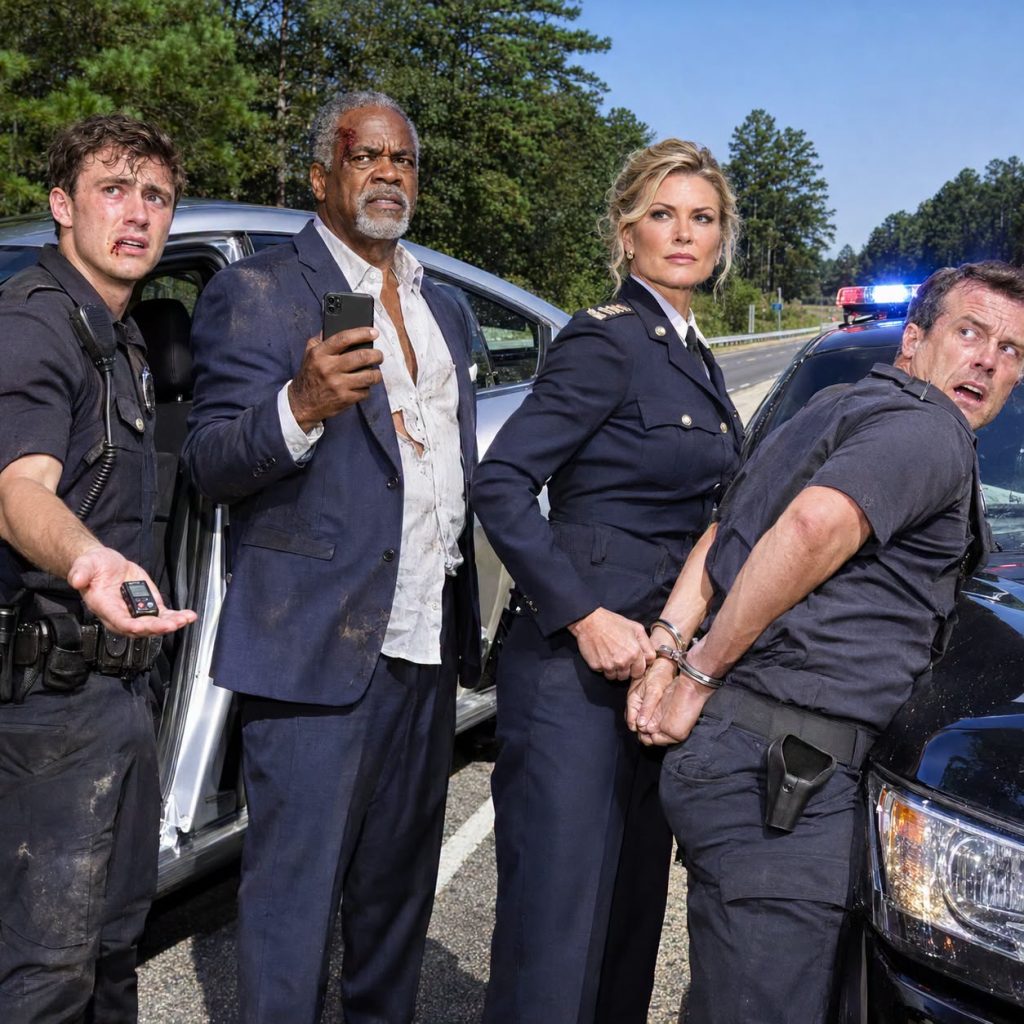
Holt lunged for the recorder. Reed twisted away, but Holt caught his uniform and slammed him against my rear door. The recorder skittered beneath the Honda. I shoved the seat belt release and stumbled out. “Rebecca,” I shouted toward the phone still on my seat, “your captain just ordered an off-book transport.” “Stay where you are,” she said. “State patrol is coming.”
Holt swung toward me. His pistol rose. Reed seized his gun arm with both hands and drove it upward. The shot cracked above our heads. For a second, all I could hear was a thin, terrible ringing. Reed forced Holt’s wrist against the roof. I backed away, hands raised, while Holt snarled, “You just threw your whole life away.”
“No,” Reed said through clenched teeth. “I should’ve stopped you sooner.” Headlights swept the road. A state trooper braked behind the cruiser and emerged with her weapon drawn. “Gun down! Both of you!” Reed released one hand, slowly. Holt tried to pull free. “He attacked me!” “Put it on the ground,” the trooper ordered. “Now.”
Holt obeyed. A second trooper secured him while the first separated Reed from the weapon. Nobody offered me a handshake or called me Your Honor. They checked for injuries, secured the scene, and requested medical assistance. It was the most reassuring thing that had happened all night. Someone was finally treating the facts as more important than the uniforms.
Chief Sloan arrived as a paramedic examined my head. Holt stood beside the cruiser in handcuffs, talking rapidly to a state sergeant. “Resisting. Both of them. Reed’s unstable.” Sloan stopped several feet from him. “Your camera?” she asked. “Malfunction.” Reed shook his head. “He switched it off before we approached.” His voice was steady now. His hands weren’t.
“You mentioned files,” I told Reed. Sloan looked between us. “What files?” “An anonymous package reached the courthouse yesterday,” I said. “Complaint numbers. Dispatch logs. A request to preserve records.” I had sent it to the U.S. attorney’s office without investigating it myself. A judge cannot become a detective simply because someone asks him to. Until Reed spoke, I had never known the sender.
“My brother made a complaint against Holt,” Reed said. “Three months later, somebody changed the report. Said he withdrew it.” He touched the blood at his split lip. “He didn’t. I started comparing records.” Holt spat onto the pavement. “Tell them what you stole.” Reed looked at Sloan. “Copies of the originals. Before Captain Voss could replace them.”
The chief took a step backward. “Martin?” Reed nodded. Captain Martin Voss ran patrol operations. His signature had appeared throughout the package. “I put a return address inside the envelope,” Reed told me. “Not mine. A vacant property. Tonight Voss gave Holt your name and said you were carrying stolen departmental material.” “Why didn’t you warn me?” I asked.
He looked down. “I thought Holt would question you. I told myself I could keep it under control.” His shame struck harder than an excuse would have. “You were wrong,” I said. “Yes, sir.” Sloan’s phone buzzed. She read the screen, then turned it toward the state sergeant. “Voss says he’s coming to take custody of everyone. Including Reed.”
“He won’t,” the sergeant said. Sloan called her command center and ordered Voss relieved of duty pending investigation. Then she requested outside assistance and preservation of departmental records. Holt watched her, his face emptied of its earlier confidence. “You can’t fix this by feeding me to them,” he said. “Ask your captain what happens when I talk.”
At the hospital, an FBI agent named Leah Bennett met us in a small consultation room. She explained that federal investigators had already received the anonymous material. Reed’s recorder had been recovered, but its housing was cracked. His body camera, however, had captured the stop. I started to breathe normally again.
Then Bennett’s phone rang. She listened, asked one question, and went still. “The maintenance yard has been searched,” she told us. “There’s a vehicle inside matching a missing-person report. We need to know who else had access.” Reed gripped the edge of the table. “My brother went missing six days ago.”
PART 3
“His name is Caleb,” Reed said. “Please tell me you found him.” Agent Bennett pulled a chair beside him. “We found his car. We haven’t found Caleb yet.” Reed bowed forward as though someone had struck him. I put a hand on his shoulder. He held perfectly still beneath it. Ten minutes earlier, I had been angry with him. I still was. But anger did not make his fear less real.
Bennett stepped outside to coordinate the search. Through the doorway, I heard her ask about warrants, property access, and the captain’s location. When she returned, she gave us the choice to wait separately. Reed shook his head. “I’ll tell you everything.” I left the room for his interview. Whatever happened next, neither of us needed our memories shaped by listening to the other.





