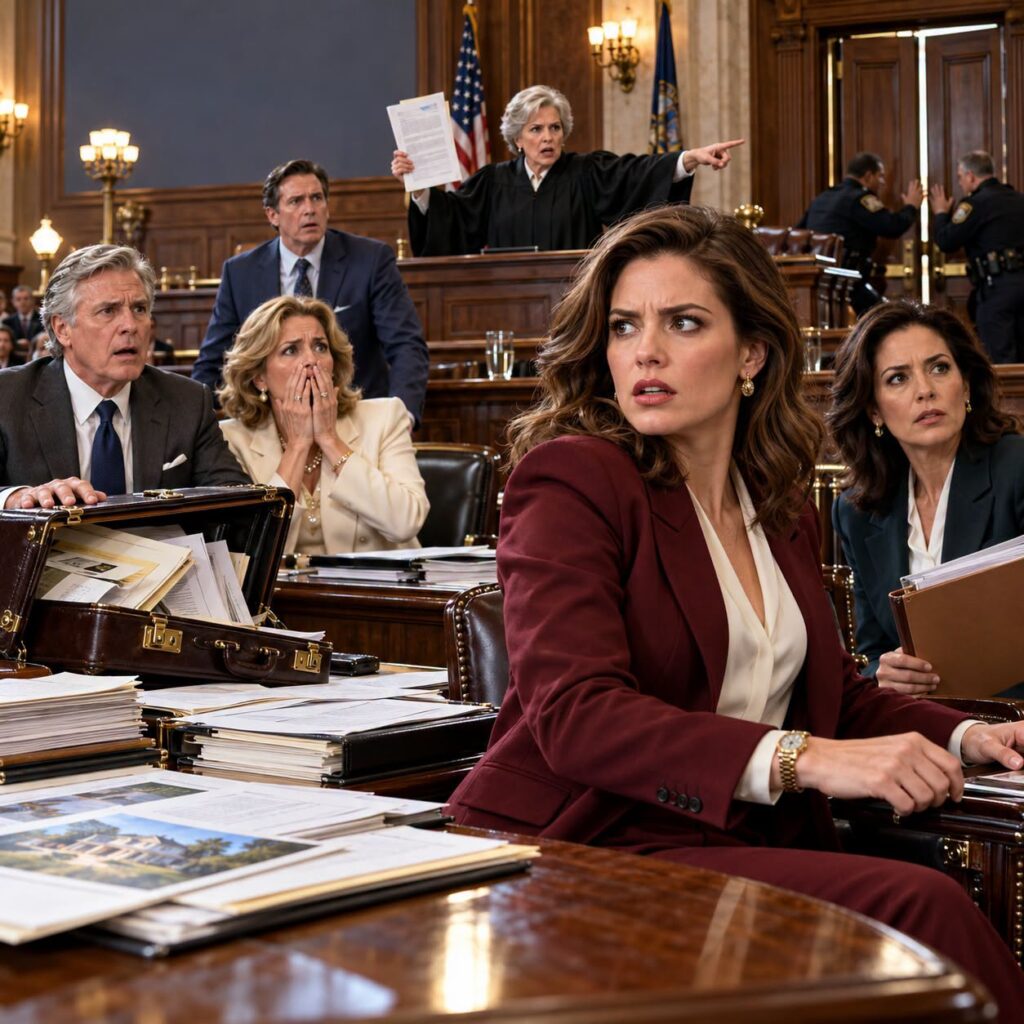
The bailiff had barely closed the courtroom doors when my mother pointed at me and said, “Your Honor, she cannot be trusted with that much money.”
I was sitting six feet away from her, staring at the woman who had taught me to balance a checkbook when I was twelve.
My father kept his eyes on the judge.
Their attorney, Martin Keene, smiled like the hearing was already over.
They were asking the probate court in Columbus, Ohio, to place my inheritance under a court-appointed conservatorship. Not just the inheritance my grandmother had left me, either. Their filing requested control over my checking account, my car, and the condo I had purchased three years earlier with my own salary.
According to them, I was reckless, emotionally unstable, and “financially vulnerable.”
I was thirty-four years old.
I worked as a senior compliance analyst for a regional bank.
And I had never missed a mortgage payment in my life.
Still, Keene stood and calmly described me as someone who made “impulsive financial decisions.”
The judge, Eleanor Whitcomb, looked over her glasses.
“What decisions?”
Keene glanced at my parents.
My mother answered first. “She moved money without telling us.”
I almost laughed.
It was my money.
But my attorney, Rachel Mendoza, touched my sleeve under the table, warning me to stay quiet.
Keene continued. “She has also refused to disclose certain accounts to her family.”
Judge Whitcomb frowned. “Why would she be required to disclose her accounts to her family?”
For the first time, Keene’s smile weakened.
My father leaned toward him and whispered something.
Then Keene recovered.
“Because the inheritance is substantial, Your Honor. Her late grandmother intended the family to protect those assets.”
That was false.
My grandmother’s will said the opposite.
She had left me her estate specifically because, in her words, I was the only person in the family who had never asked her for money.
Rachel slid a certified copy of the will toward the clerk.
Then she handed over a sealed financial disclosure the court had requested from me.
Keene actually smirked.
I knew why.
My parents believed I had inherited about $680,000.
That was the number they had seen in an old estate estimate.
They thought this hearing was about controlling that money before I could “waste” it.
Judge Whitcomb opened my disclosure.
She read the first page.
Then the second.
Her expression changed.
She looked at Rachel.
“Ms. Mendoza, these figures are verified?”
“Yes, Your Honor.”
The judge turned another page.
Keene stopped smiling.
My mother leaned forward.
My father whispered, “What is it?”
Judge Whitcomb read silently for several seconds.
Then she looked directly at me.
“Ms. Carter, did you authorize either of your parents to access any account listed here?”
“No, Your Honor.”
The courtroom went completely still.
The judge’s face drained of color.
She abruptly stood.
“Stop immediately.”
Keene froze.
Judge Whitcomb turned toward the bailiff.
“Lock those doors. Call security. No one leaves this courtroom.”
My mother gasped.
And then the judge lifted one page from my financial disclosure and asked my father a question that made him grip the table.
I had walked into court expecting to defend my inheritance. I had no idea the documents would reveal something far worse, or that the judge had just recognized a name connected to my parents. Then my father tried to reach for his briefcase.
“Mr. Carter,” Judge Whitcomb said, “why is your name listed as an authorized signer on an account your daughter says she never authorized?”
My father stopped moving.
Keene immediately stood. “Your Honor, there may be an innocent administrative explanation.”
“There may be,” the judge replied. “Which is why no one is leaving.”
The bailiff stepped behind my parents.
My stomach tightened.
Rachel whispered, “Do not say anything unless the judge asks you directly.”
Judge Whitcomb handed the page to the clerk and requested the exhibits Rachel had filed that morning. I had known Rachel was investigating unusual activity connected to my grandmother’s estate, but even I had not seen everything.
The first exhibit was a signature card from an investment account containing $1.8 million.
My supposed signature appeared beside my father’s.
It was not mine.
The second exhibit showed a home-equity line opened against my condo eight months earlier.
Again, there was my “signature.”
Again, it was fake.
My mother started crying.
She said they had only been “protecting” me.
But Judge Whitcomb kept reading.
Then came the twist none of us expected.
The inheritance was not the largest asset on the list.
Years before she died, my grandmother had quietly transferred shares of a private logistics company into a trust for me. Those shares had appreciated dramatically after a merger.
My total assets were worth just over $8.2 million.
My parents had apparently discovered the trust before I did.





