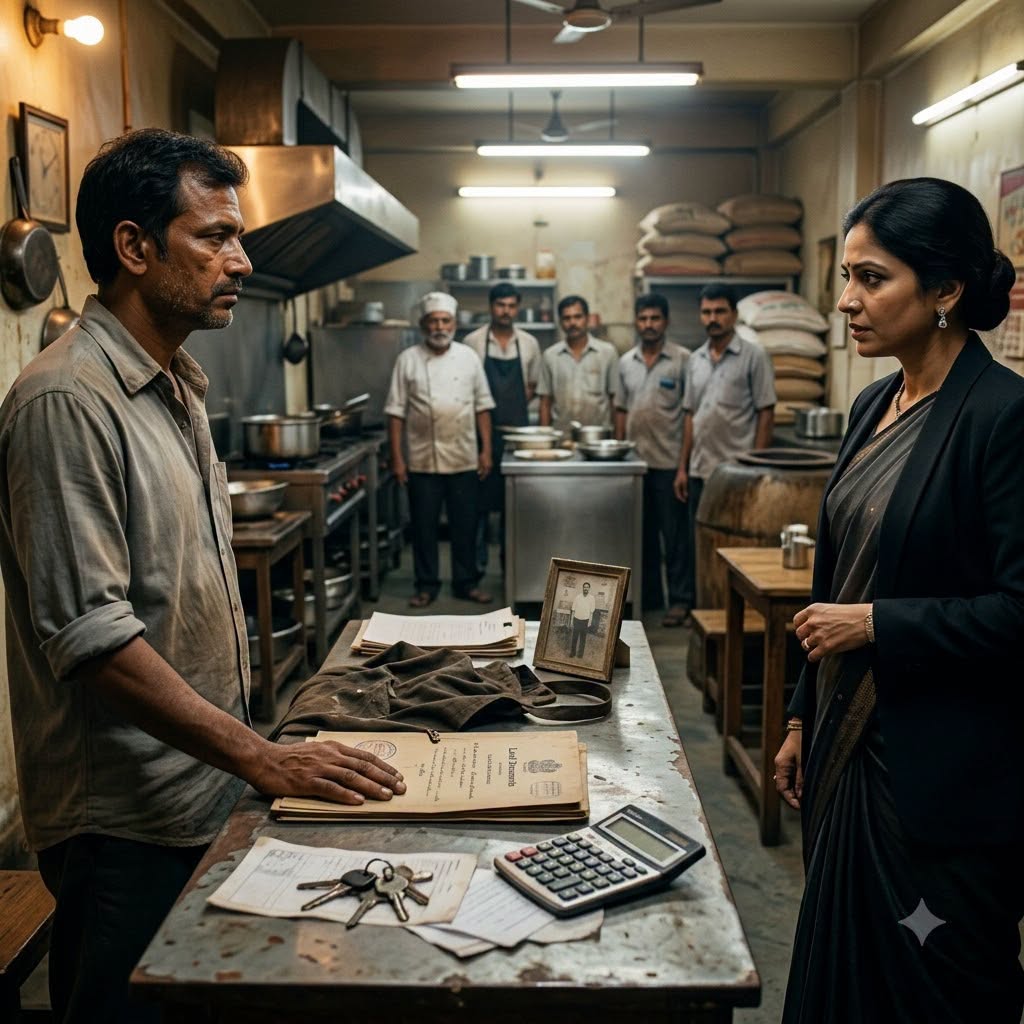
The following Monday, Devyani and Bhaskar arrived at her office.
I had prepared a proposal.
They could retain ownership of the restaurant business, but only if they entered a properly documented lease for the premises, settled my verified financial contributions, and resolved the disputed transfers through an independent accounting process.
Alternatively, I would purchase the operating business at an independently assessed value, taking its liabilities into account.
Devyani stared at me.
“You want to buy my restaurant?”
“Yes.”
“With what money?”
I looked at Ishwari.
She slid a letter across the table.
A bank had given preliminary approval for financing against my property interest, subject to valuation and due diligence.
I had also approached a local investor who had eaten at Kaveri Bhojanalaya for twenty years.
He was willing to help.
Not because he liked me.
Because he understood the business.
Bhaskar laughed.
“You think you can run a restaurant without Devyani’s name?”
I looked at him.
“I’ve been doing exactly that for ten years.”
He stopped laughing.
The negotiations lasted six weeks.
There were arguments.
Accusations.
Threats of court proceedings.
Devyani cried once and told me I was destroying our family.
I answered quietly, “I didn’t destroy anything by asking to be paid for my work.”
Eventually, the numbers made the decision.
The restaurant had liabilities, disputed transfers, and a declining customer base.
Devyani and Bhaskar needed money to settle obligations connected to their return from Dubai.
I wanted the business.
The final settlement gave me ownership of the operating enterprise, subject to its existing liabilities and the agreed purchase price.
My documented contributions were credited in the transaction.
The disputed payments were settled separately, without either side admitting every allegation.
The property remained mine and the family trust’s, with a formal lease granted to the restaurant.
Everything was documented.
No promises over tea.
No vague statements about family.
No more trusting that love would eventually produce fairness.
On the day we signed, Devyani looked at me across the table.
“You’ve changed.”
I thought about that.
“No, Didi.”
I folded the agreement.
“I’ve stopped waiting for you to notice who I was.”
She began crying.
For one moment, I wanted to reach across the table.
To comfort her.
To say it was all right.
But it wasn’t all right.
And I was finally learning that allowing someone to feel the consequences of their choices was not cruelty.
It was honesty.
Three months later, we reopened Kaveri Bhojanalaya.
Not with a grand ceremony.
Just marigold garlands and fresh paint.
The same steel tumblers.
The same wooden cash counter.
The same recipes.
But one thing had changed.
Every employee received a written contract.
Every salary was paid on time.
Every overtime shift was recorded.
And the kitchen staff shared a percentage of annual profits.
Shashidhar Kaka stood beside the entrance in a freshly ironed kurta.
Meena tai cried when she saw her name on the staff appreciation board.
I had placed Papa’s old calculator beneath a framed photograph of my parents.
Underneath it were the words:
A BUSINESS IS BUILT BY EVERY HAND THAT KEEPS IT OPEN.
Customers returned slowly.
Then quickly.
The Sunday thali became fully booked again.
Our first large catering order after reopening came from the same company that had cancelled its contract.
When the manager asked whether I could guarantee timely delivery, I smiled.
“I can guarantee that the people doing the work will be treated well enough to care about doing it properly.”
A year later, I opened a second branch.
For the first time in my life, I took a proper holiday.
Four days in Mahabaleshwar.
I slept late.
Drank tea while it was still hot.
And spent an entire afternoon reading a book without answering a supplier’s call.
It felt almost illegal.
Then, one Sunday, Devyani came to the restaurant.
Alone.
I saw her standing near the entrance, looking at the old photographs.
She seemed smaller.
Not physically.
Something about her certainty had disappeared.
I approached her.
“Didi.”
She turned.
“Nandu.”
For a moment, we were children again, standing beside sacks of rice while Ma shouted from the kitchen.
Then she asked, “Can I eat here?”
My heart hurt.
“Of course.”
I led her to the table near the window.
The one Papa always reserved for elderly customers.
She ordered the Sunday thali.
When Meena tai brought the puran poli, Devyani began crying.
I sat opposite her.
“What’s wrong?”
She shook her head.
“I forgot how Ma used to make this.”
I looked toward the kitchen.
“Shashidhar Kaka never forgot.”
She wiped her eyes.
Then whispered, “I thought I was coming home to claim what was mine.”
I said nothing.
“I didn’t realize how much of it you had kept alive.”
I looked down.
For ten years, those were the words I had wanted.





