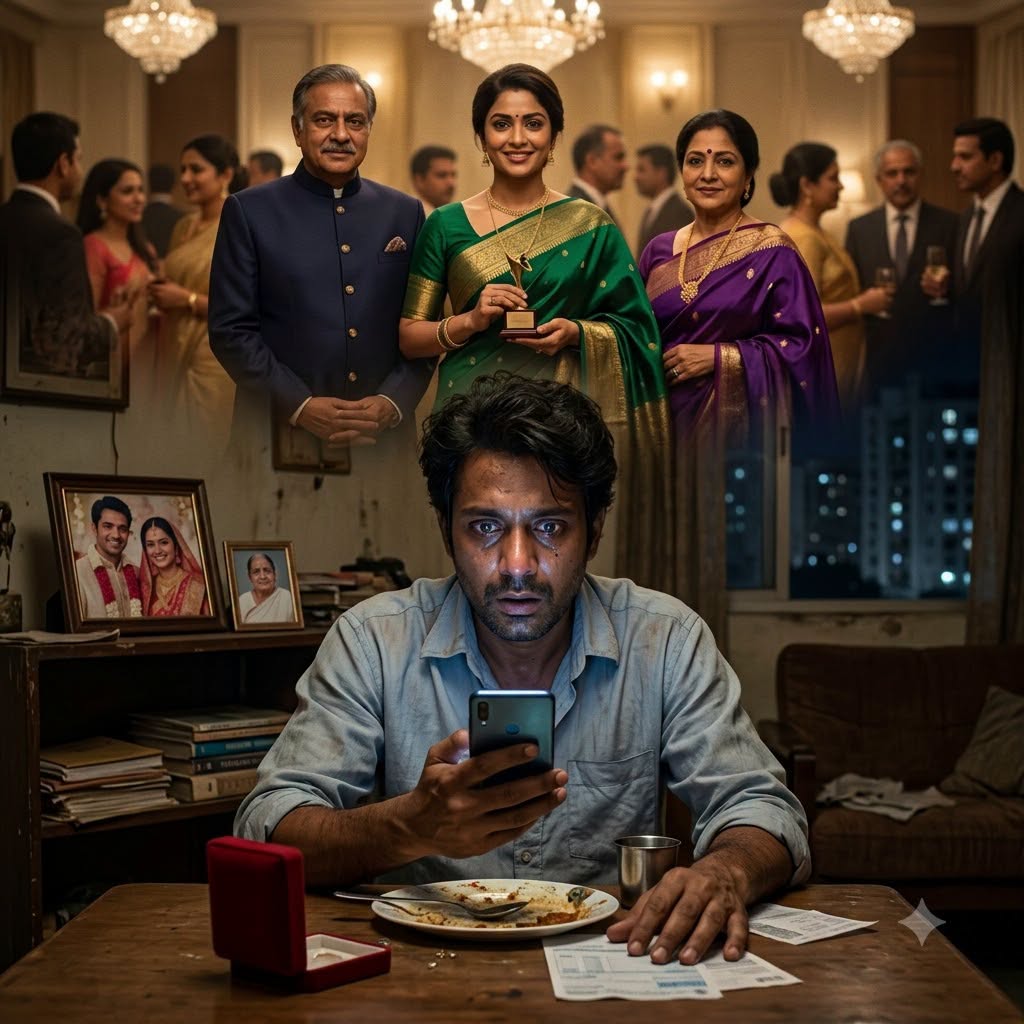
He was removed from the relevant decision-making responsibilities while the company examined the matter further.
Devyani retained her role under additional oversight.
She had disclosed the agreements and withdrawn from the proposed investment.
Her father was furious.
“He said I had betrayed the family,” she whispered.
I looked at her.
“What did you say?”
She wiped her tears.
“I told him that protecting his business was not worth losing my integrity.”
For a moment, I saw the woman I had married.
The young analyst who once cried because someone stole credit for her presentation.
The woman who wanted success because she loved her work.
Then Devyani said something that surprised me.
“I told Papa I would never again attend a family event where you were deliberately excluded.”
My throat tightened.
She looked down.
“But I know saying that now doesn’t undo what happened.”
I nodded.
“No, it doesn’t.”
She began crying.
“I was ashamed of you, Shashi.”
I felt the words strike me.
She continued.
“Not because you had done anything shameful. Because I became obsessed with how people saw me.”
I stared at her.
“I wanted my colleagues to think I had a perfect life. Successful parents. Successful husband. Beautiful home.”
Her tears fell faster.
“And when your career became uncertain, I allowed myself to think you were somehow reducing my value.”
I looked away.
For seven years, I had wanted her to be honest.
Now honesty hurt more than I had imagined.
She whispered, “I’m sorry.”
I remained silent.
Then I asked, “If I became wealthy tomorrow, would you feel proud to introduce me again?”
She looked at me.
For a long moment, she could not answer.
Then she said quietly, “A few months ago, perhaps I would have.”
My heart tightened.
“But now?”
She wiped her eyes.
“Now I understand that if I need your salary to make me proud of you, I don’t deserve to call myself your wife.”
I looked at her.
For the first time, her apology did not sound like an attempt to end an argument.
It sounded like someone beginning to understand what she had destroyed.
Over the following months, we attended marriage counselling.
I did not move home immediately.
I needed time.
Devyani needed to learn how to disagree with her father without looking to me to absorb the consequences.
And I needed to stop measuring my worth by whether her family approved of me.
We spoke honestly.
Sometimes painfully.
About money.
About ambition.
About resentment.
About the years when I had hidden my own disappointments because I did not want to distract her from her dreams.
One evening, our counsellor asked us a question.
“What would partnership look like if neither of you had to prove your worth through income?”
I thought for a long moment.
Then I answered.
“It would mean being invited to the celebration even when I had nothing impressive to say about my work.”
Devyani began crying.
She reached for my hand.
I let her hold it.
Not because everything was healed.
But because, for the first time, we were speaking about the wound instead of pretending it wasn’t there.
Six months later, my consultancy work began improving.
A manufacturer I had helped during a difficult shutdown offered me a long-term project.
Then another company approached me.
Slowly, I rebuilt my income.
I purchased the laptop I had postponed buying.
I enrolled in the certification course I had sacrificed years earlier.
And one evening, I received an invitation to speak at an engineering industry conference.
The topic was practical innovation for small manufacturers.
I stared at the email.
For the first time in years, I felt proud of my own professional life.
I called my mother.
She laughed.
“See? You were never finished, beta.”
I smiled.
Then I called Devyani.
When I told her, she became excited.
“Shashi! That’s wonderful!”
I laughed.
“You sound happier than I am.”
She paused.
Then whispered, “Because I know how long you’ve waited for someone to recognise your work.”
At the conference, I stood before a room of engineers, business owners, and industry professionals.
I spoke about manufacturing efficiency.
About the small companies that kept local industries alive.
About the importance of respecting skilled people even when their names were not printed on expensive office doors.
When I finished, the audience applauded.
I looked toward the back of the room.
Devyani was standing beside my mother.
Both were crying.
Afterward, Devyani approached me.
She took my hand.
Then she introduced me to one of her colleagues.
“This is my husband, Shashidhar Kulkarni.”
Her voice trembled.
“He is an engineer, a consultant, and the person who believed in me before I believed in myself.”
I felt tears filling my eyes.
Not because she had finally described me as successful.





