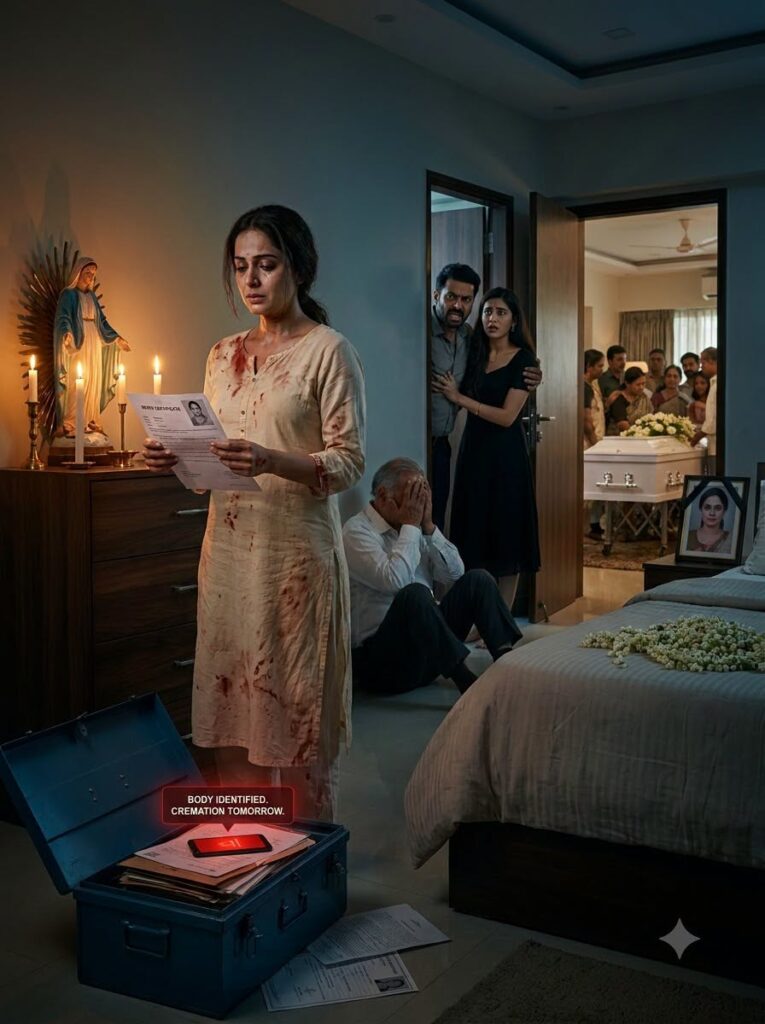
Do not mourn me, she had said.
Be afraid.
I finally understood.
She had not warned me because she wanted fear to control me.
She wanted fear to keep me awake long enough to survive.
“I was afraid, Mumma,” I whispered. “But I came home anyway.”
Rain struck the coffin lid.
For the first time since her death, I allowed myself to cry.
Not quietly.
Not politely.
I cried until my knees failed and Mrs. Fernandes held me above the mud. I cried for the mother who had protected me too late, the father who had loved me too weakly, the brother who had watched in silence, and the sister who had mistaken possession for love.
When I returned home that evening, I removed Rhea’s clothes from my mother’s room.
I placed the blue box beneath the altar again.
Then I opened Mumma’s Bible.
A final envelope waited behind my graduation photograph.
Inside was one line in her handwriting:
**The house is yours, but do not let it become another place where frightened women are told to remain silent.**
One year later, the D’Souza house reopened as the Leena Home for Women.
Mira managed its legal records.
Mrs. Fernandes supervised the kitchen and complained that nobody chopped onions correctly.
Neil, after serving his sentence, began repaying every rupee he had taken. I did not welcome him back as a brother, but I allowed him the chance to become a better man.
My father wrote to me from prison every Sunday.
I read the letters.
I never answered.
Not yet.
On the first anniversary of Mumma’s death, I lit a candle beneath the statue of Mother Mary.
Outside, women filled the rooms that had once echoed with secrets. Some were escaping violent husbands. Some had been cheated by relatives. Some had arrived with nothing except the clothes they wore and the terror in their eyes.
I told every one of them the same thing:
“Fear is not proof that you are weak. Sometimes fear is the hand of someone who loves you, holding on even after they are gone.”
That night, as I locked the blue box, the hidden phone lit up one final time.
A scheduled message from my mother appeared.
**You survived, my child. Now teach others to survive without becoming cruel.**
I pressed the phone against my heart.
Then I switched it off.
My mother had died crushing my hand, but in the end, she had not left me with fear.
She had left me with a purpose.
And perhaps that is the most painful kind of love—the kind that breaks your heart, saves your life, and forces you to decide what sort of person will rise from the ruins.
Tell me honestly: could you forgive a father like Dominic, and did Leena’s final sacrifice make you cry? Share what you felt below and follow the page, because some families bury their secrets—but survivors always find a way to make the truth rise again.





