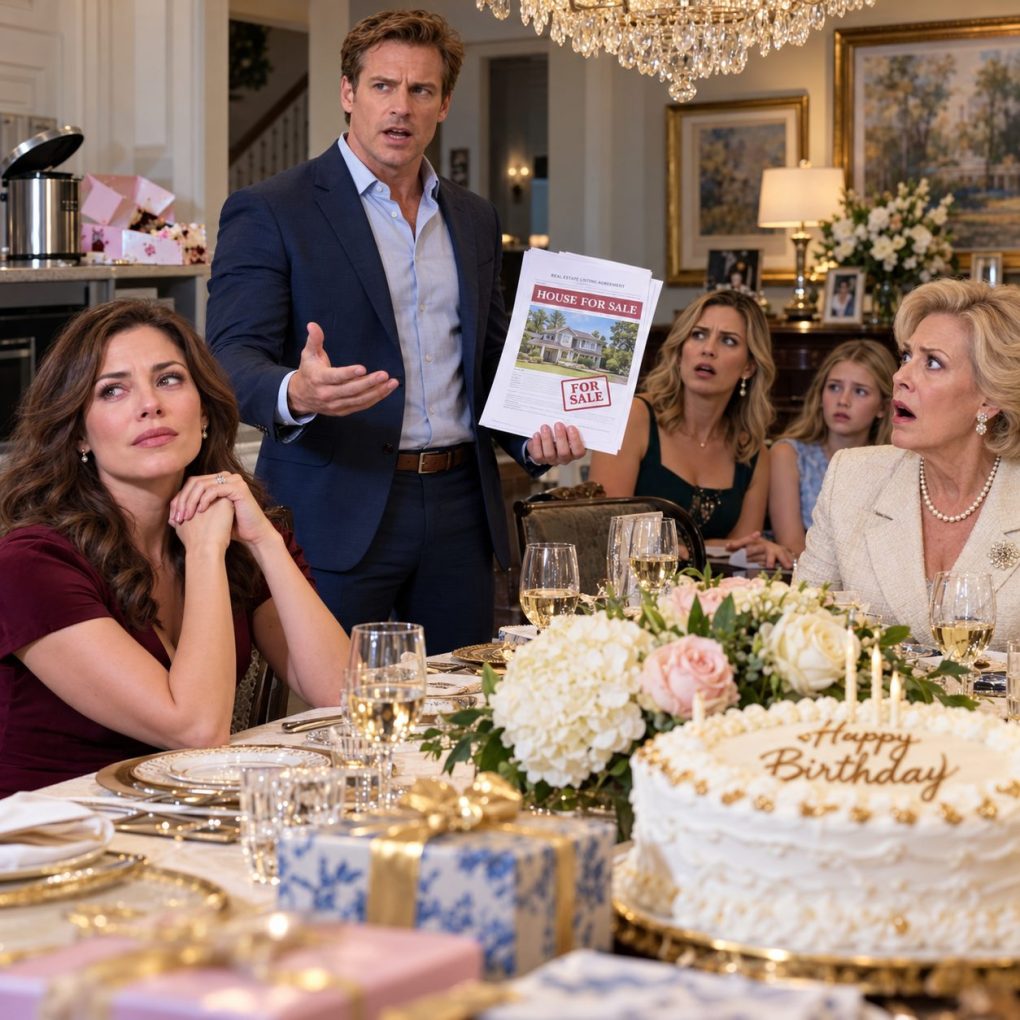
The cake hit the bottom of the trash can before I fully understood what my mother-in-law had done.
My fourteen-year-old daughter, Ava, made a sound between a gasp and a sob. She had spent three days making that cake for my sister-in-law Claire’s thirty-fifth birthday. She baked the layers twice, practiced buttercream roses on wax paper, and piped “Favorite Aunt” across the top in pale blue frosting.
Linda, my mother-in-law, looked at the ruined cake as if she had tossed away a paper plate.
“No one is going to eat it, sweetie,” she said. “We have a real cake coming.”
The dining room went silent.
Twenty relatives were gathered at Linda’s house outside Columbus, Ohio. Claire stood near the kitchen doorway with one hand over her mouth. My husband, Mark, was beside me, completely still.
Ava’s face turned scarlet. “But Aunt Claire asked me to make it.”
“I know,” Linda said with that thin smile she used when she wanted to hurt someone without sounding angry. “But this is an adult birthday party. People expect something presentable.”
I moved toward the trash can.
Mark caught my wrist gently. “Jenna.”
His voice was calm, but his jaw was tight.
Less than a minute later, a delivery driver arrived carrying a glossy white box from an expensive downtown bakery. Linda opened it proudly, revealing a three-tier cake covered in gold leaf and sugar flowers.
“There,” she announced. “That’s what a proper birthday cake looks like.”
Claire didn’t even look at it. She crossed the room, wrapped Ava in both arms, and whispered something that made my daughter cry harder.
I wanted to take Ava home immediately. Linda had made cutting remarks before, but she had never deliberately destroyed something Ava had worked on for days. I was reaching for my purse when Mark pulled out a dining chair and stood behind it.
“Everybody, I need to say something.”
Linda laughed nervously. “Mark, not now. We haven’t even done candles.”
“Now is exactly the time.”
The room changed. Even Linda seemed to hear something in his voice.
Mark looked at Ava, then Claire, and finally his mother.
“What Mom just did was cruel,” he said. “And before anyone tells Jenna or Ava to let it go because ‘that’s just how Mom is,’ everyone here needs to understand something.”
Linda’s smile vanished.
Mark reached into his jacket and placed a folded document on the table.
I recognized it immediately. We had signed it two days earlier.
Linda stared at the paper.
“Mark,” she said quietly, “what is that?”
He looked around the room at every relative who had spent years treating Linda like the unquestioned owner of that house.
Then he said, “Mom, since you enjoy deciding what belongs in this house, everyone should probably know the truth.”
He slid the document toward her.
“You don’t own this house. Jenna and I do. And as of this morning, it’s officially for sale.”
Linda’s face went white.
But Claire was the one who whispered the words that made Mark stop cold.
“What do you mean she doesn’t own it? I’ve been paying her mortgage for three years.”
That was the moment I realized the cake was only the smallest thing Linda had thrown away that night. Claire’s question exposed a secret none of us had expected, and Mark suddenly looked as shocked as everyone else.
Mark stared at his sister. “You’ve been paying Mom what?”
Claire looked from him to me, confused. “Eleven hundred dollars a month. She said Dad left a balance on the mortgage and that if I helped pay it down, the house would eventually be mine.”
I felt my stomach drop.
There was no mortgage.
Mark and I had bought the house five years earlier after Linda nearly lost her previous home to unpaid property taxes. We paid cash using part of an inheritance Mark received from his grandfather, then put the deed in both our names. Linda was allowed to live there rent-free as long as she covered utilities and upkeep.
She knew that. She had signed the occupancy agreement herself.
Mark turned toward Linda. “Thirty-six months?”
Claire nodded. “Sometimes more. She said taxes went up.”
Linda’s eyes hardened. “This is not the place for this conversation.”
Claire laughed without humor. “You took nearly forty thousand dollars from me.”
Several relatives began murmuring. Linda snapped that Claire was being dramatic, then accused Mark of humiliating her over “a childish cake.”
That was when I saw something change in Mark’s face.
He pulled out his phone.
“Fine,” he said. “Then let’s talk about the other thing.”
Linda went still.
Two weeks earlier, Mark had received a call from our bank’s fraud department. Someone had submitted a home-equity application against the house for seventy-five thousand dollars. It included copies of our tax records, a scanned version of Mark’s signature, and Linda’s phone number as the primary contact.





