My brother pushed me off a cliff with both hands. I fell thirty feet, struck a shelf of rock, and heard my bones break before I could scream.
Above me, Owen leaned over the edge.
“Dad should’ve left the company to me,” he said.
Then he walked away.
The Saturday sun burned through the pines outside Bend, Oregon. Below the ledge, the Deschutes River churned against black volcanic rock. I couldn’t stand. I couldn’t draw a full breath. My phone was somewhere in the brush above me.
My name is Morgan Mercer. At thirty-six, I owned sixty percent of Mercer Timberworks, the mill our father built from a two-man shop into a business employing eighty-four people. Owen owned the other forty percent and served as chief financial officer.
Dad had been dead eleven months. Owen hadn’t forgiven him for the split.
“She’s better at keeping people employed,” Dad had told us. “You’re better at keeping score.”
Owen remembered every word.
That morning, he’d called about erosion near a logging road on our property. A damaged slope could shut down our haul route. I drove out because people depended on that road—and because, despite everything, Owen was still my little brother.
At the overlook, I noticed fresh orange survey tape tied to a fir. Our field crew had been checking the slope all week.
Owen pointed toward the drop. “See where the ground’s pulling away?”
I took two steps closer.
His palms hit the middle of my back.
Now, wedged against the rock, I tasted blood and tried not to panic. My left ankle pointed the wrong way. Each breath stabbed. I reached across my chest for the satellite messenger clipped inside my vest.
My fingers kept slipping.
“Please,” I whispered to nobody. “Please work.”
The SOS light finally blinked.
A rescue helicopter arrived nearly two hours later. By then, I had three broken ribs, a fractured collarbone, wrist, pelvis, and ankle. Seven broken bones. One question burned hotter than the pain: Would anyone believe me?
At St. Charles Medical Center, a deputy took my statement between procedures. Owen told investigators we’d gotten separated and I’d slipped. He claimed his phone battery had died before he could call for help.
My mother was gone. Dad was gone. The only person who could confirm the shove was the man who’d done it.
On Monday, my lawyer, Elena Brooks, visited. I told her about the suspicious machinery invoices I’d found the week before—and the independent audit scheduled for Wednesday.
Elena’s expression changed. “Don’t sign anything. And don’t tell Owen what we’ve preserved.”
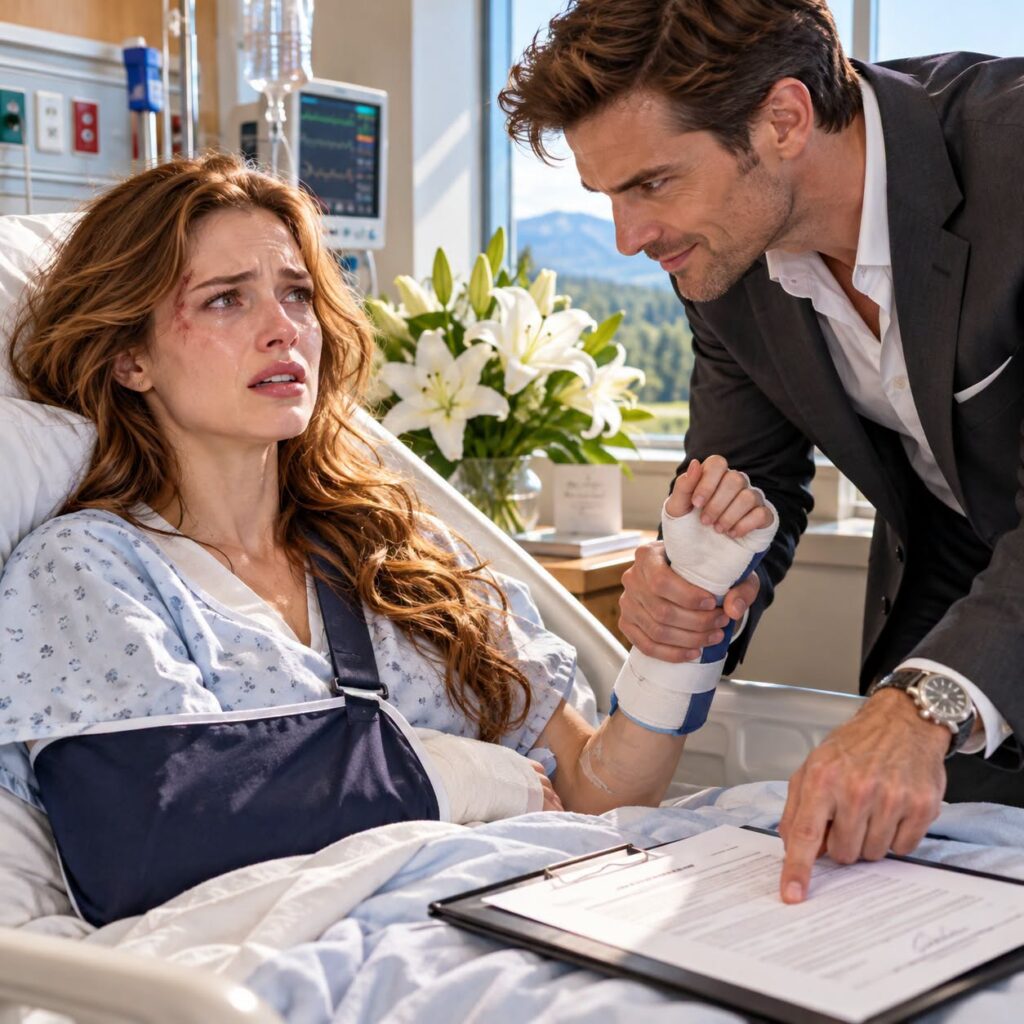
Tuesday afternoon, exactly three days after the fall, Owen entered my hospital room carrying white lilies.
He looked at the monitors before he looked at me.
“Terrible accident,” he murmured. “But you can’t run a mill from a hospital bed.”
He placed a document on my blanket: a ninety-day voting proxy transferring control of my shares to him, supposedly signed by me during surgery.
I hadn’t held a pen since Saturday.
Below my forged signature was a witness’s name.
Ruth Calder.
My best friend of twenty-two years. Our company’s accountant.
And the woman I’d trusted with every financial secret I had.
For one terrible second, I wanted to believe Ruth’s name had been copied without her knowledge. But Owen was smiling, and the ink on that page was only the beginning. Somewhere outside my room, someone was already moving to make the forgery real.
I reached for the nurse’s call button. Owen caught my wrist—the one held together with a metal plate.
Pain flashed white behind my eyes.
“Easy,” he whispered. “You could hurt yourself.”
I stared at his hand until he let go.
“You can’t use a proxy I never signed.”
“Then prove it.” He straightened his jacket. “The buyer expects an answer Friday.”
When he left, I called Elena. She sent hospital security to keep him out and requested my medical records, including the medication log proving I was under anesthesia when the proxy was supposedly executed.
Ruth arrived that evening, twisting her wedding ring.
“Owen said you wanted me to witness paperwork,” she whispered.
“You know my signature.”
She looked at the floor. “I was trying to protect the company.”
“From what?”
She didn’t answer. Instead, she asked if I’d told the deputy about the invoices.
There it was. Not concern for my injuries. Concern about what I knew.
After she left, Elena opened the encrypted folder I’d emailed her before the hike. Inside were invoices for machinery we’d never received, all paid to a supplier called Cascade Industrial Services.
I’d flagged $1.7 million. Elena’s forensic accountant traced the supplier to an LLC registered to Ruth’s husband. Owen approved every payment.
Then came the twist that made me physically sick.





