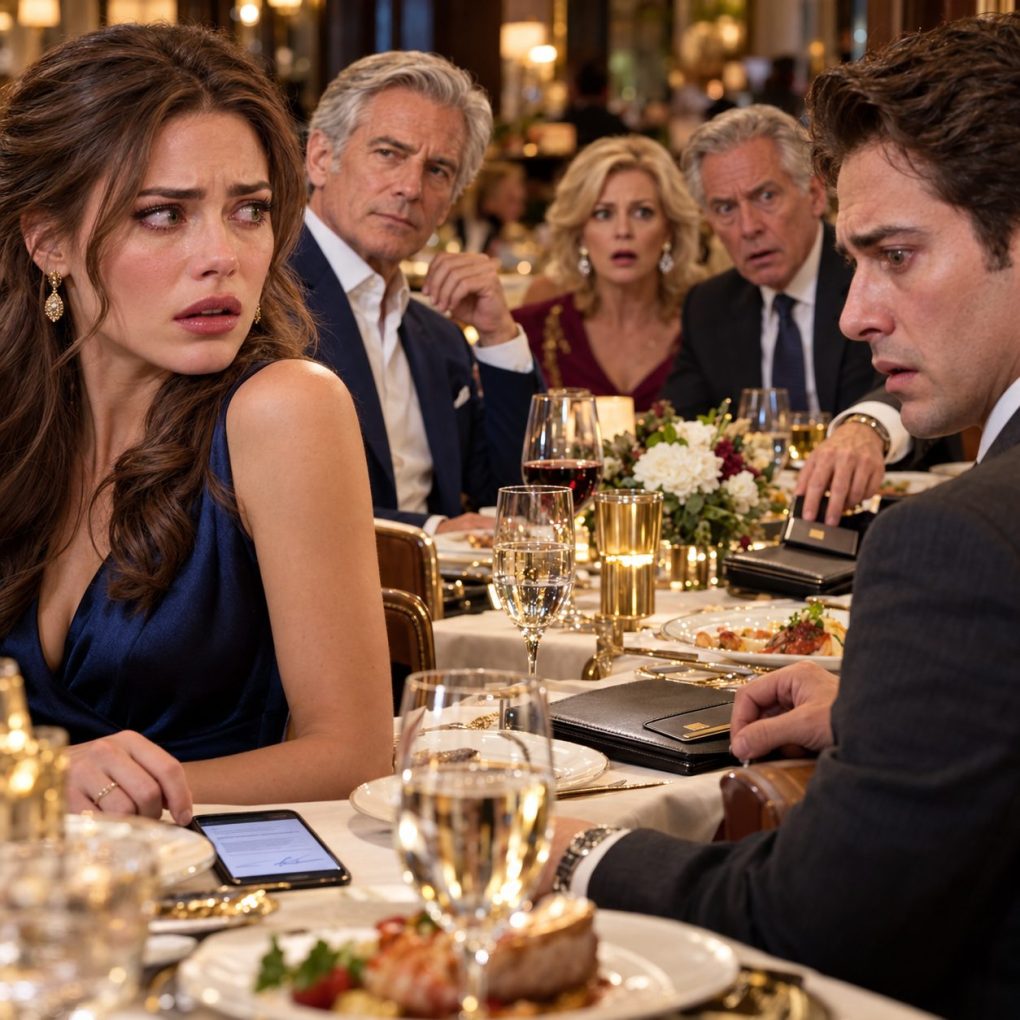
The server’s pen stopped in midair.
“Separate his check,” my mother-in-law said, pointing across the table at my father as if he were a stranger who had wandered into our private dining room. “We’re not covering his meal.”
For one second, I honestly thought I had misunderstood her.
We were at Hawthorne House, one of the most expensive restaurants in Charlotte, celebrating my father-in-law Robert Whitmore’s company landing what he kept calling “the deal that saves the year.” There were nine of us around the table, three bottles of wine open, and a seafood tower that probably cost more than my first car payment.
My dad, Daniel Carter, had ordered grilled salmon and iced tea.
That was apparently where Diane Whitmore decided to draw the line.
I turned to my husband, Mark, expecting him to say something. Anything.
He had heard her. I knew because his jaw tightened.
Then he nodded at the server.
“Yeah,” he said quietly. “That’s probably easiest.”
Something inside me went cold.
My father looked at me before I could speak. He gave the smallest shake of his head and motioned toward my plate.
Keep eating.
So I did.
Or at least I pretended to.
Diane spent the next twenty minutes talking about their new lake house renovation. Robert bragged about expanding Whitmore Hospitality into three more states. Mark’s sister, Lauren, complained that the restaurant’s wine list had “gone downhill.”
Meanwhile, my father sat beside me in a plain navy blazer, listening politely.
The Whitmores had never understood him.
Dad drove a seven-year-old Lexus, hated designer labels, and still trimmed his own hedges. Because he rarely discussed money, Diane had decided years ago that he was “comfortable, but simple.”
After my mother died, Dad became even quieter.
I never corrected their assumptions. Neither did he.
But that night, something felt different.
Every few minutes, Dad’s phone lit up face-down beside his plate. Once, I saw the name Martin Hale flash across the screen.
I knew Martin.
He was Dad’s attorney.
When dessert arrived, Robert raised his glass and smiled at Mark.
“To family loyalty,” he said.
The irony nearly made me laugh.
Then the bill came.
The server placed the leather folder near Robert. Diane immediately reminded her, “His is separate.”
My father slowly set down his coffee.
Robert reached for his credit card.
Dad leaned back in his chair and looked directly at him.
His voice was calm enough that the table went silent before he finished the sentence.
“Before you split the check, Robert, you should call your CFO, because I withdrew the four-point-two-million-dollar bridge commitment to Whitmore Hospitality at four seventeen this afternoon.”
Robert’s hand froze.
Diane’s smile disappeared.
Lauren stared at my father.
And Mark went so pale I could see it even in the low restaurant light.
I looked at my husband, suddenly more frightened by his reaction than anyone else’s.
Because Robert looked shocked.
Diane looked confused.
But Mark looked like a man who already knew exactly what my father was talking about.
I thought my father had just embarrassed them over a business deal. Then Mark whispered one name I had never heard before, and Dad slid his phone toward me. What I saw on the screen made the dinner bill feel like the smallest problem at that table.
Mark’s lips barely moved.
“Carter Ridge.”
Dad looked at him. “So you do recognize the name.”
I did not.
Robert did.
His face changed first.
Carter Ridge Capital, he explained in a rush, was the private investment firm backing the emergency financing his company needed to close a hotel acquisition and refinance debt coming due that Friday. Without the bridge money, Whitmore Hospitality would miss a lender deadline and could lose the acquisition deposit.
Then I looked at Dad.
He had named the firm after the mountain road where my mother grew up.
It was his family office.
Diane stared at him as if he had suddenly become a different person.
But Dad wasn’t watching her. He was watching Mark.
“Tell Emma how you knew,” he said.
My stomach tightened.
Mark reached for my hand. I pulled mine away.
He started saying it was complicated, that he had been trying to protect me from “business stress,” that Robert’s company had temporary cash-flow problems and he only wanted to help his family.
Dad unlocked his phone and slid it across the table.
On the screen was an email Mark had sent three weeks earlier to Carter Ridge’s outside counsel.
Attached was a document titled SPOUSAL CONSENT AND LIQUIDITY SUPPORT.
My name was at the bottom.
Emma Louise Whitmore.
Electronic signature.
I had never seen it before.
The document stated that I had agreed to make up to $650,000 of my separate assets available if Whitmore Hospitality failed to meet certain obligations.





