My daughter, Layla, is nine years old, with freckles across her nose and a habit of mispronouncing cinnamon no matter how many times I correct her. She still believes the tooth fairy keeps children’s teeth in a museum somewhere, but give her a recipe and she’ll measure every ingredient with the concentration of a laboratory technician. For her birthday last spring, I bought her a cupcake cookbook from Barnes & Noble, and since then, our kitchen has become her favorite place in the world.
When I mentioned we were having dinner at my parents’ house for my father’s birthday, she looked up from her book. “Mom, could I make dessert? Like, all by myself?” I asked whether she understood how much work that would take, and she nodded with the solemn determination only a child can manage. “Grandpa always says I make him happy,” she explained. “I want to make something that makes him happy back.”
I should have recognized the danger in that innocent little plan. My mother, Patricia, had never been particularly generous with praise, especially when it came to anything I accomplished. Growing up, I learned that a good report card meant I should try harder next semester, a compliment from a teacher meant I was showing off, and any achievement of my younger sister, Kim, deserved a celebration. My father, Robert, was kinder, but he had perfected the art of pretending not to hear things that might upset his wife.
Still, Layla adored her grandfather, and I refused to let my childhood interfere with her excitement. That Sunday, she spent nearly six hours making lemon cupcakes with blueberry filling and cream cheese frosting, carefully piping little yellow sunflowers onto each one. She washed her hands so often her knuckles turned pink, and when one cupcake collapsed, she insisted on making another rather than serving something imperfect. By late afternoon, twenty-four cupcakes rested inside a covered tray, and Layla was practicing her presentation in the hallway mirror.
“I hope you like them, Grandpa,” she whispered, holding an imaginary plate. Then she turned toward me. “Does that sound too fancy?”
“It sounds perfect, sweetheart.”
My mother opened her front door that evening wearing the pearl necklace she reserved for family celebrations. Her eyes went directly to the tray in Layla’s hands. “You brought dessert?” she asked, glancing toward the dining room. “Rachel, I already ordered a cake.”
Layla stepped forward before I could answer. “I made cupcakes for Grandpa! They’re lemon with blueberry inside.”
“Well, we’ll see where to put them,” my mother replied.
The dining room was crowded with relatives. Kim sat beside her husband, Mark, while their teenage sons stared at their phones, and Aunt Denise and Uncle Paul had driven in from Pennsylvania. My cousin Sarah had brought her new boyfriend, whose nose ring had already attracted several disapproving glances from my mother. Dad seemed pleased to see Layla and kissed the top of her head, but when she mentioned her surprise, he merely smiled and told her to save it until after dinner.
The meal unfolded exactly as our family gatherings always did. My mother corrected the way Kim’s husband carved the roast, complained that the potatoes were getting cold, and interrupted Dad’s birthday toast to announce that she’d accidentally overcooked the meat. Whenever someone tried to compliment her cooking, she found a reason to dismiss it. Layla sat beside me, occasionally touching the covered cupcake tray on the sideboard as though reassuring herself it was still there.
When the dinner plates were cleared, my mother brought out an expensive chocolate cake decorated with elaborate fondant roses. Before she could cut it, Layla carefully lifted her tray and carried it to the center of the table. “Grandpa, I made these for you,” she said, looking directly at him. “I made extra so everybody could have one.”
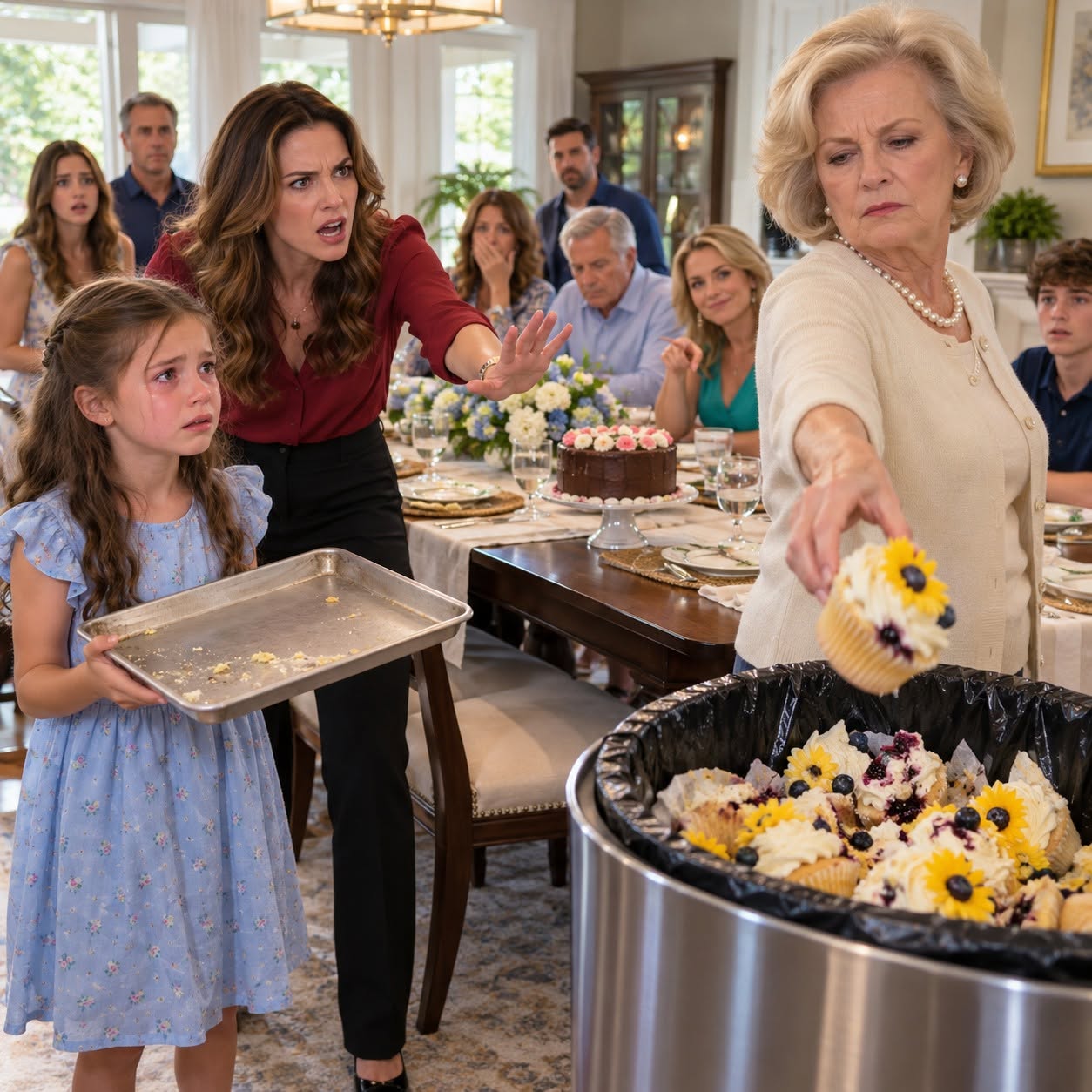
Dad opened his mouth, but my mother reached for a cupcake first. She examined the sunflower frosting, turned it slightly between her fingers, and said, “That’s a lot of sugar.” Then, without tasting it, she dropped it into the trash can beside the kitchen doorway.
Layla’s smile disappeared. My mother reached for another cupcake, then another, moving them from the tray into the garbage with the brisk efficiency of someone clearing away unwanted leftovers. “We have a perfectly good cake,” she said when I asked what she was doing. “Nobody needs two desserts.”
“Mom, stop.”
She didn’t.
By the time I reached the other side of the table, the tray was empty. Twenty-four cupcakes, six hours of work, and every little sunflower Layla had shaped with her own hands were sitting among coffee grounds and dinner scraps.
Kim leaned back in her chair and gave my daughter a thin smile. “Try again when you’re older, honey.”





