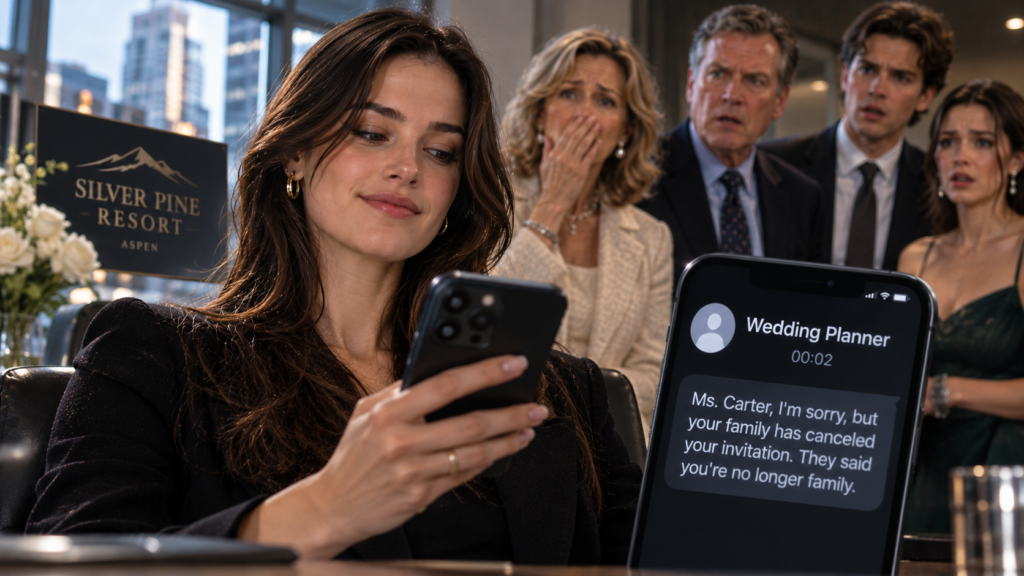
“Ms. Carter,” she said carefully, “I’m sorry, but your family has canceled your invitation.”
I stared through the glass wall of my office at the Denver skyline.
“Canceled?”
There was a pause.
“They said you’re no longer family.”
For three seconds, I heard nothing but the hum of the air conditioner.
Then I smiled.
“That’s fine.”
Her voice dropped. “I’m really sorry. I know this is awkward.”
“It’s not your fault.”
What she didn’t know was that the wedding venue—Silver Pine Resort in Aspen—belonged to Northstar Hospitality.
And Northstar Hospitality belonged to me.
Not publicly. Not in a way my family had ever bothered to understand.
For years, my parents had introduced me as “the one who works in hotels.” My younger brother, Jason, joked that I spent my days choosing towels and checking minibar prices.
I let them believe it.
Three years earlier, after our father’s construction company nearly failed, I quietly paid off a $620,000 business loan through a private family trust. Jason never knew. Neither did my mother.
Yet six months before his wedding, Jason stopped returning my calls.
His fiancée, Melissa, removed me from the bridal party group chat.
Then my mother told me, “Maybe it’s better if you keep your distance. Melissa wants a drama-free wedding.”
Drama-free.
I had not argued with anyone.
My only crime was refusing to hand Jason $85,000 for a new house because he had already borrowed money from me twice and never repaid a dollar.
By noon, I had three emails waiting from Silver Pine’s regional director.
One was the wedding contract.
One was the payment schedule.
And one was a request for executive approval on a special exception Jason had demanded: exclusive use of the west lawn, ballroom, and lakeside terrace for less than half the standard rate.
I read the contract twice.
Then I noticed something that made me sit back.
The discounted booking required direct approval from the ownership office.
My office.
And the approval had never been granted.
At 5:42 p.m., I called Silver Pine’s general manager.
“Refund every dollar of the deposit,” I said. “Then release the dates.”
He went quiet.
“All of it?”
“All of it.”
At 6:03, my phone rang.
Jason.
I watched his name flash across the screen.
Then my mother called.
Then Melissa.
Then Jason again.
By 6:11, I had fourteen missed calls.
And one voicemail.
I pressed play.
My brother wasn’t laughing anymore.
Jason’s voicemail began with shouting in the background.
“What did you do?”
No hello. No explanation.
Just accusation.
I listened to the whole message before calling him back.
He answered on the first ring.
“You canceled my wedding.”
“No,” I said. “The resort canceled an unapproved discount and returned your deposit.”
“That’s the same thing!”
“It isn’t.”
Behind him, I could hear Melissa crying.
My mother took the phone.
“Emily, this is cruel.”
Cruel.
That word stayed with me.
Cruel was sitting alone at Thanksgiving while my brother told everyone I had “chosen money over family.”
Cruel was finding out through Facebook that Melissa’s bridesmaids had gone dress shopping after telling me the appointment was postponed.
Cruel was paying my father’s debt and hearing him tell relatives Jason was “the one who always shows up.”
But I said none of that.
Instead, I asked, “Did you tell the planner I wasn’t family anymore?”
Silence.
Then my mother said, “You’re twisting this.”
“I asked a yes-or-no question.”
Jason grabbed the phone back.
“We didn’t want tension at the wedding.”
“You mean you didn’t want me there.”
Another silence.
Then he snapped, “Fine. Yes. We didn’t.”
The words should have hurt more than they did.
Maybe because I had already heard them in softer forms for years.
I looked down at the wedding contract on my desk.
“You still have your money,” I said. “Book somewhere else.”
“In Aspen? Three months before the date?”
“That’s not my problem.”
“You own the place!”
There it was.
The first time he had ever said it out loud.
Not “you work there.”
Not “your hotel job.”
You own the place.
My mother gasped in the background. “What?”
Jason went silent.
I could almost see him realizing what he had revealed.
He had known.
That explained the discounted rate, the special requests, the pressure on the resort staff.
“Jason,” I said quietly, “how long have you known?”
Finally he said, “Melissa’s father looked you up.”
Something colder than anger moved through me.
They had mocked my work for years, but the moment they discovered what it was worth, they used my name.
Then they erased me from the guest list.
Before I ended the call, Jason said, “Dad will never forgive you.”
I looked at the city lights below my office.
“Maybe the question is why I’m always the one expected to earn forgiveness for what other people do.”





