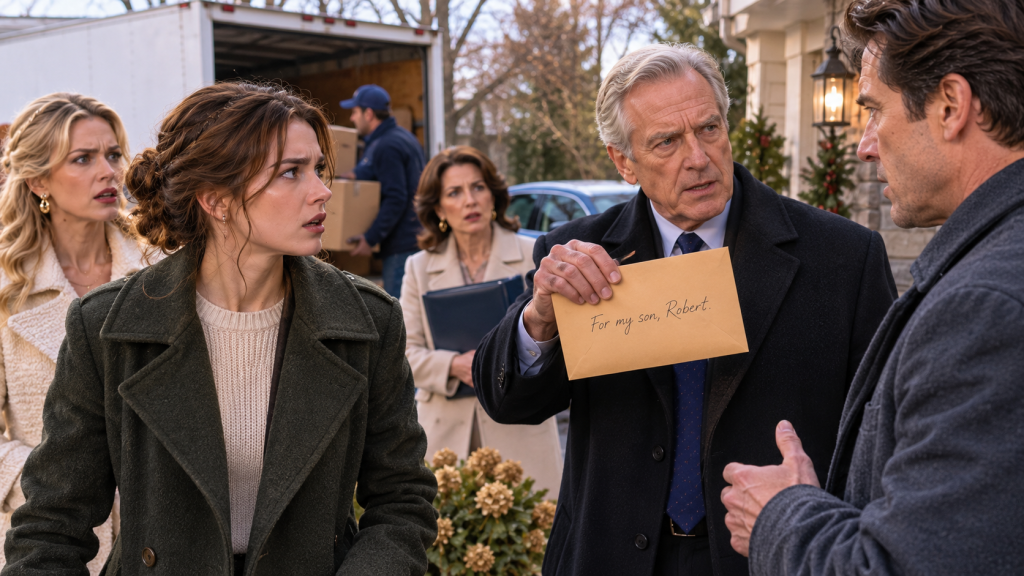
I was kneeling beside Grandpa’s rosebushes when the white truck backed across his driveway. Its tires crushed the little stone border he and I had laid one spring, back when his hands were still steady.
My sister Vanessa climbed out of a silver SUV, followed by a woman carrying a real-estate folder.
“We found our dream house,” Vanessa announced. “The seller needs proof of funds by Monday. So please don’t make this difficult.”
I stood, still holding the watering can. “Grandpa left this house to me.”
Dad stepped between us. “And your sister has two children. You have no husband, no kids, and four bedrooms you don’t need.”
Three days earlier, at Sunday dinner, he had pushed a listing agreement across Grandpa’s oak table and told me to sell. I’d said no. He hadn’t spoken to me since—until a text arrived that morning: BE READY BY TEN.
Now two movers waited beside the truck, uncertain whether to unload boxes or carry furniture out.
Grandpa had been dead eleven weeks. His wool sweater still hung behind the kitchen door. I couldn’t bring myself to move it; sometimes, coming home after work, I’d catch sight of its sleeve and almost call out that I’d bought his favorite peach yogurt.
For the last four years of his life, I had driven him to dialysis, cut his food when his fingers cramped, and slept in the recliner after his hospital stays. When I was seventeen and Dad told me to leave after an argument with Vanessa, Grandpa had opened this same door, taken my wet suitcase, and said, “You can stay as long as you need, Ellie.”
He never asked me to earn my place.
The realtor cleared her throat. “Mr. Whitaker told me he represented the estate.”
“He doesn’t,” I said. “The recorded transfer-on-death deed names me.”
Dad’s face reddened. “Don’t talk to her like you know better.”
Vanessa opened the gate. “We’ve already spent the deposit. We’re counting on this.”
“Then you shouldn’t have counted on my house.”
Dad caught my arm as I turned toward the porch. “Your grandfather would be ashamed of you.”
A familiar blue sedan pulled up behind the truck. Mr. Bennett, Grandpa’s attorney, stepped out with a file and one sealed envelope.
He looked directly at Dad.
“Robert,” he said, “your father asked me to deliver this if you ever tried to take Ellie’s home.”
Dad loosened his grip.
On the envelope, in Grandpa’s shaky handwriting, were four words:
For my son, Robert.
The movers stood beside their truck, watching a man in a suit hand my father an envelope.
“What’s that supposed to prove?” Vanessa demanded.
Mr. Bennett didn’t answer her. He gave the realtor a certified copy of the recorded transfer-on-death designation and my identification, which I’d sent him after Dad announced his plans. Grandpa had signed the designation two years before his death, while he was still able to manage his affairs.
The realtor read the first page. “Mr. Whitaker, you told me probate hadn’t finished and that you were authorized to sell.”
“I am his son.”
“That isn’t authorization,” she said. She closed her folder and asked the movers to stop.
Dad ignored her. He held the envelope against his chest without opening it.
“You arranged this,” he told me. “You called a lawyer just to humiliate us.”
“I called because you told strangers to empty my house.”
Vanessa marched onto the porch and took down the brass wind chime Grandpa had made from old teaspoons. “Fine. We’ll at least take the things that belong to the family.”
I reached for it. “Put that back.”
“It’s a stupid wind chime.”
Grandpa had made it the summer after Grandma died. He’d sat at the workbench for an hour filing the rough edges, because I kept cutting my fingers when I helped him. I remembered Vanessa laughing beside him years earlier as he tested it, each teaspoon ringing a different note.
“Vanessa,” I said, “please.”
She shook it hard. One spoon broke loose and struck the steps.
The sound was tiny. I felt it all the way into my jaw.
Dad finally tore open his envelope. His eyes moved across the first page. He didn’t finish. He folded it in half and shoved it into his coat.
Mr. Bennett spoke carefully. “Robert, the letter is yours. The documents attached to my copy are relevant to what you’ve been telling your family. Your father authorized me to explain them here if you attempted to dispose of the property.”
“Don’t you dare,” Dad said.
“Then tell Vanessa why he recorded the transfer two years ago.”
Dad looked toward the truck. “Because Ellie worked on him when he was sick.”





