PART 2
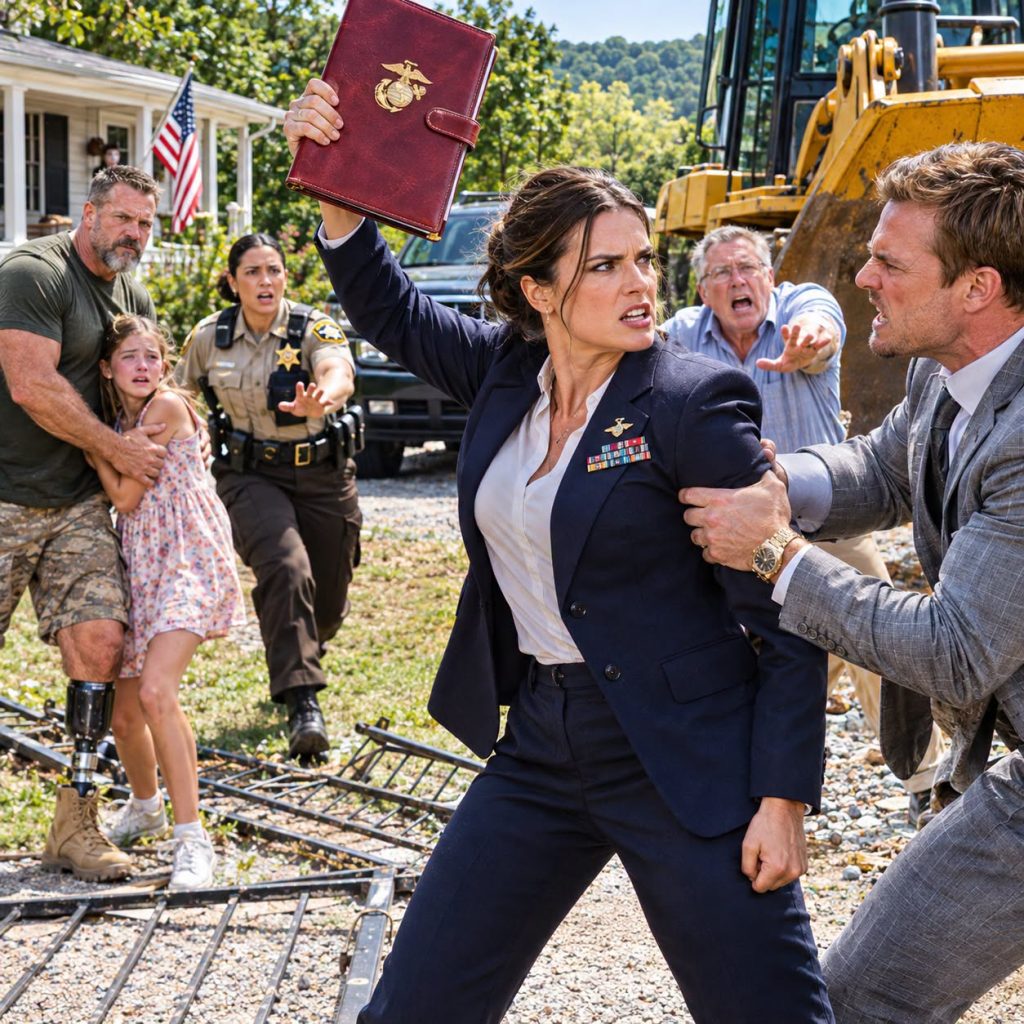
I threw myself sideways as the bulldozer blade chewed into the gate. Gravel sprayed across my face. “Kill the engine!” The operator slammed the controls back, stopping less than six feet from me. Grant stormed forward and grabbed the red binder. I caught his forearm, twisted, and drove him against his SUV. “You’re trespassing,” he snarled. “On the trust I administer?” I tore the binder free. The cottage door opened, and Sergeant First Class Sam Briggs stepped out on a prosthetic leg, his twelve-year-old daughter behind him. “Major, what’s happening?” My father looked at Sam and went white. Two county deputies arrived. Grant produced a recorded deed. “We own this property. She’s interfering with lawful construction.” I handed Deputy Marisol Vega the original trust certificate. “The deed depends on a revocation signed by a man whose writing hand was paralyzed.”
Vega ordered everyone to stay put. My father pulled me behind his truck. “Claire, stop.” “Why are you afraid of that cottage?” He glanced toward Sam’s porch. “Your grandfather kept original corporate ledgers there. Loan records. Things that could destroy Mercer Marine.” I stared at him. “So this was never just Grant’s marina.” He swallowed. “No.” Grant charged over. “Dad, shut up.” My father stepped between us. “She deserves the truth.” Grant shoved him into the truck door. I caught my father before he fell. Vega shouted, “Back up!” Grant snapped, “The old man was going to expose everything.” I looked at my father. “Everything what?” He closed his eyes. “For six years, we shifted pension liabilities off the books to keep the company borrowing. I signed the first false statements.
Grant expanded it.” The land sale was not just a rescue. It was meant to cover a financial hole that could bring federal investigators. Grant noticed my phone recording. He knocked it from my hand and stomped it until the screen shattered. “Now we talk like family.” Eleanor’s sedan pulled up. She stepped out holding a sealed bank envelope. “Actually, we talk with evidence.” Inside were vault logs showing Grant entered Grandpa’s safe-deposit area three days before the false revocation appeared, plus a hospice note stating right-side paralysis and inability to sign his name. Grant gave a cold laugh. “A bank log proves I visited a bank. A nurse’s note proves an old man was sick.” Then my father said, “I witnessed the revocation.” I turned on him. “What?” Grant froze too.
“My signature is on the witness line,” Dad said. “Grant told me if I refused, he would give investigators the pension files and say I acted alone.” Grant’s face changed. Vega separated them and called her supervisor. Before I could speak, Sam shouted from the cottage, “Major! You need to see this.” Inside, floorboards beneath Grandpa’s old desk had been pried up. A steel document box sat open—and empty. On the lid was a fresh smear of blood. The back door swung in its frame, tire tracks cutting toward the service road. Eleanor whispered, “Those were the original pension ledgers.” My father checked his pocket, went rigid, and said, “Grant’s gone.”
PART 3
I ran out the back door and saw Grant’s SUV fishtailing down the service road. Deputy Vega sprinted for her cruiser.
I climbed in beside her. “The ledgers are evidence. If he reaches the highway, they disappear.” Vega radioed the plate and accelerated. Two miles later, we found the SUV nose-down beside a ditch. Grant was limping toward another vehicle behind an abandoned feed store, a steel document box in his hands. He dropped it and reached for the driver’s door. Vega drew her weapon. “Stop!” Grant turned toward me instead. “You think Grandpa chose you because you’re better than us?” Then he rushed me. I caught his first swing on my forearm, but the second drove me into the hood. He clawed for the box. I hooked his ankle, sent him to the gravel, and pinned his wrist while Vega closed the distance. “Enough,” I said. “This is over.” Grant laughed through a split lip. “Dad’s signature makes the revocation legal.” Eleanor arrived with my father and another deputy. She opened the steel box with a bank key Grandpa had left in box 217. Inside were the pension ledgers—and a notarized affidavit signed by Grandpa six days after the supposed revocation. He stated that he had never revoked the Sentinel Ridge Trust, had discovered attempts to transfer the property, and had ordered Eleanor to preserve evidence. Attached was a sealed flash drive and a letter warning the county clerk that any cancellation bearing his signature should be treated as fraudulent. The last mystery was the two-dollar bill. Its serial number matched box 217, but Grandpa had chosen it for another reason. The bill had been given to him by a Marine named Joseph Alvarez after Vietnam, when Grandpa helped him return home and rebuild his life. Alvarez later became the first donor to the veteran-housing project. Grandpa wrote, “Two dollars can be worthless in the wrong hands and priceless in the right ones. Character works the same way.” I had to read that twice. A Tennessee judge issued an emergency order stopping all work at Sentinel Ridge. A forensic document examiner concluded Grandpa’s signature on the revocation had been traced. Bank records connected the $3.2 million payment to Grant’s marina debt, and the pension ledgers triggered a federal investigation. Grant eventually pleaded guilty to forgery, fraud, and obstruction-related charges. My father cooperated, resigned from Mercer Marine, accepted civil penalties, and spent months answering investigators’ questions. He was not innocent, and I never pretended he was. But he finally stopped lying. A year later, Sam Briggs unlocked the door to a permanent home at Sentinel Ridge with his daughter beside him. Twenty-four cottages were complete, and a rehabilitation center was under construction. My father came alone. “I don’t expect forgiveness,” he said. “Good,” I replied. “Earn trust first.” He nodded and handed me the two-dollar bill in a plastic sleeve. I looked at Grandpa’s handwriting and finally smiled without anger. My family had laughed because they thought I inherited almost nothing. They were wrong. Grandpa left me 412 acres, a mission, the truth, and one final lesson: the value of what we inherit is measured by what we are willing to protect.





