At thirty-seven weeks pregnant, I watched my husband slide a birth-certificate worksheet across our kitchen table like a contract I had already lost. At the top, in his mother’s handwriting, was a name I had never agreed to: Margaret Louise.
Caleb didn’t even sit down.
“Whatever name my parents want the baby to have, that will be her name,” he said, looking directly into my eyes. “Your only job is to give birth to her. You have no right to decide anything else.”
Our daughter kicked hard beneath my ribs.
For eight months, I’d let his mother, Diane, call twice a day, criticize my doctor, and rearrange the nursery whenever she visited. I’d swallowed her comments about my job, my weight, and my “unfortunate” family background. But this was different.
I’d wanted to name our daughter Sophie Grace, after the mother who raised me alone and died the previous spring.
Caleb knew that.
I looked at the worksheet. Then at the man I’d married four years earlier.
I smiled.
“Okay,” I said.
His shoulders relaxed. He thought he’d won.
That evening, I blocked Diane and my father-in-law, Richard, on my phone. I removed them from my pregnancy updates and told the hospital, in writing, that neither had permission to visit me or receive information about my care.
The next morning, Diane pounded on our front door.
“How dare you shut me out of my granddaughter’s life?” she screamed through the wood.
Caleb stood behind me in his work clothes. “Just apologize. She’ll calm down.”
“No.”
His expression changed. “You’re making yourself look unstable.”
I felt cold despite the August heat. He’d never used that word about me before.
Three days later, I found a folder in his desk while looking for our insurance cards. On the cover, Diane had written BABY MARGARET: FIRST SIX WEEKS. Inside were schedules for feedings, lists of visitors, and a typed instruction that the baby would stay at his parents’ house after discharge.
My name appeared once, beside the words BIRTH MOTHER. The final page listed a pediatrician forty miles away. Caleb had even crossed my name off the emergency contact line and replaced it with Diane’s.
I photographed every page. I didn’t confront him. Instead, I called a family-law attorney and explained what I’d found. She told me to preserve messages, keep my prenatal records, and call her immediately if anyone tried to make decisions for me.
A week later, contractions doubled me over beside the refrigerator.
“Take me to the hospital,” I gasped.
Caleb picked up his keys but didn’t move. “First, unblock Mom. She’s coming to the delivery room.”
Another contraction stole my breath. I called our neighbor, Marisol. She drove me herself.
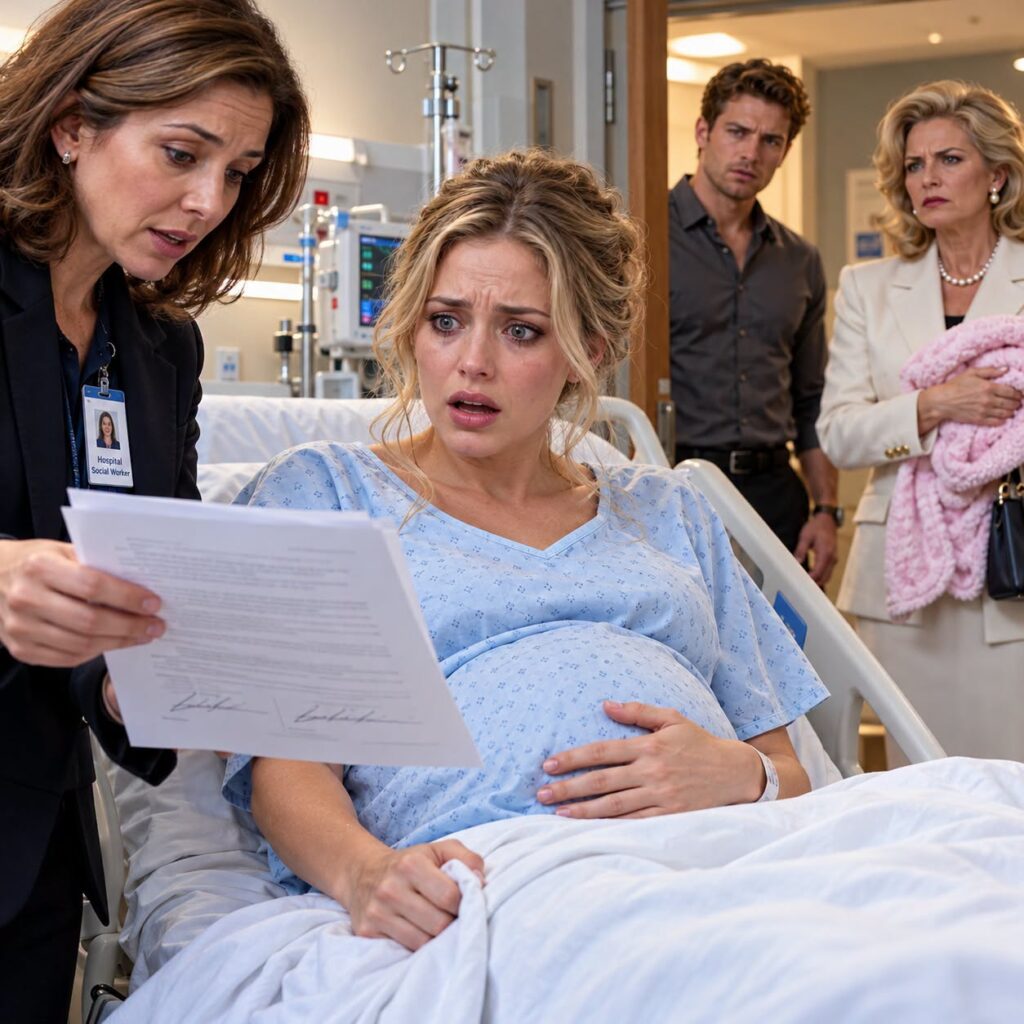
By midnight, I was in a hospital bed, gripping the rails, when a social worker entered with a nurse. The social worker held a document bearing a notary seal.
“Mrs. Bennett,” she said carefully, “your husband gave us paperwork authorizing his parents to take your baby home after delivery.”
“That isn’t possible.”
She turned the final page toward me.
At the bottom was my signature.
And I had never signed it.
Before I could ask who had forged my name, another contraction ripped through me. Outside my door, I heard Diane demanding to see “her baby.” Someone had planned this moment for weeks. What terrified me most was how confidently they believed the hospital would obey.
I stared at the looping letters beneath the notary stamp. Whoever had copied my signature had even reproduced the little flourish I put under the last letter.
“Do not let them take her,” I whispered.
The social worker, Ms. Patel, pulled up a chair. “This document does not replace your consent. We haven’t agreed to any discharge arrangement. Our security team knows your visitor restrictions.”
For the first time that night, I breathed.
Then she pointed to a paragraph I had missed.
It claimed I had a history of psychiatric episodes and had voluntarily requested “temporary placement” because I was incapable of caring for an infant.
I’d never been hospitalized for anything except a broken ankle.
“Who wrote that?” I asked.
Caleb appeared in the doorway before she could answer. Diane stood behind him, clutching a pink blanket embroidered MARGARET.
“It’s just for the first few weeks,” Caleb said. “You’re emotional. Mom will handle everything.”
“You forged my signature.”
Diane lifted her chin. “We’re protecting our grandchild.”
I demanded they leave. Ms. Patel called security. Caleb’s smile vanished when two officers walked him back into the hall.
During the next hour, while nurses checked the baby’s heartbeat, I forwarded the photos from Caleb’s desk to my attorney. She asked for the new document too. Ms. Patel arranged a copy for me.
Then my phone buzzed.





