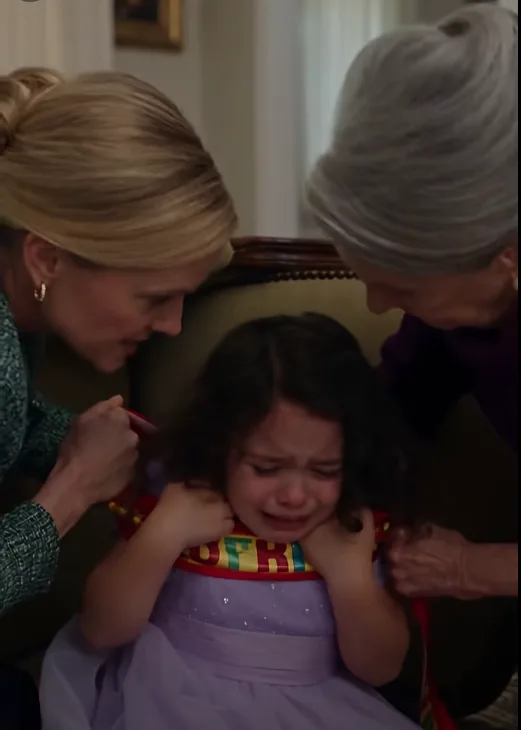
“Laurel tipped the armchair while her six-year-old stepdaughter was sitting in it, then forced Wren against the overturned upholstery as Laurel’s mother held a party sash across the child’s arms.
Wren cried and tried to pull away, but the two women kept the ribbon tight.
The nanny, Iris, rushed through the archway and freed her.
When Julian reached the room, he saw his daughter sobbing, the chair overturned and both women still holding parts of the sash.
Laurel claimed the girl was trying to ruin the party.
Iris answered plainly that both women had held Wren down.
Julian took his daughter into the hallway and confronted the adults who had decided she did not belong in their picture of a proper family.
Then Wren spoke from the bench beside Iris.
Grandma had told her she must wear the sash for the visitors.
As Julian looked toward Laurel’s mother, Vivienne tried to conceal a sealed envelope she had drawn from the table drawer.
Who were the visitors, and why was an invitation important enough that two adults would restrain a frightened child to force her cooperation?
The sharp click of the hallway door latch echoed like a pistol shot through the high-ceilinged drawing room, but the sound was instantly swallowed by the heavy velvet drapes that Vivienne had insisted upon hanging to keep the common glare of the afternoon out of her daughter’s reception.
Julian stood frozen in the threshold, his gaze shifting from the overturned armchair where the velvet upholstery bore the distinct indentations of scuffed shoes, down to the trembling frame of his six-year-old daughter, Wren. The child was buried against Iris’s apron, her dark curls damp with sweat and tears, her small shoulders hitching with silent, exhausted sobs.
Across the room, Laurel’s posture had snapped from casual dismissal into rigid, defensive fury. Her hand, which had only a second ago been resting casually on the mahogany arm of the side table, snatched back as if burned. But it was Vivienne—the matriarch whose silver-pinned chignon never seemed to suffer a single stray hair regardless of domestic chaos—whose movements betrayed the real panic in the room. Her knuckles were stark white as she shoved a thick, cream-colored envelope deeper into the mahogany drawer, sliding it shut with a muffled thud that resonated far too loudly in the sudden stillness.
“Julian,” Laurel began, her voice sliding up an octave into that practiced, breathless cadence she used whenever she needed to rewrite an event before his eyes. “You have to understand how difficult it’s been all morning. The caterers are arriving in two hours, the garden terrace is half-set, and Wren simply refused to cooperate. She was throwing a tantrum, stomping her feet right on the heirloom runner, and we were merely trying to steady her before she hurt herself on the antique furniture.”
Iris did not release her hold on Wren. The nanny’s posture remained a solid, immovable barrier between the child and the two women who had pinned her. Iris’s gray eyes, steady and sharp, locked onto Julian’s face with a quiet challenge that bypassed years of domestic conditioning in a single look.
“She wasn’t throwing a tantrum, Mr. Vance,” Iris said, her voice completely level, devoid of the trembling deference Vivienne usually demanded from household staff. “The child was crying because they tried to strap her into a decorative silk sash she hates, and when she tried to step away, Mrs. Laurel tipped the chair. When Wren fell against the fabric, your mother-in-law held the ribbon across her wrists so she couldn’t stand up.”
“That is an absolute lie!” Vivienne hissed, stepping forward, her silk skirt whispering sharply against the parquet floor. “A disgruntled, overpaid nursemaid inventing dramatics to secure her position! Julian, you cannot possibly listen to this—this hired help over your own family. We were preparing her for the guests. Proper families present a unified, polished image when important visitors arrive. If our household looks fractured or undisciplined to the foundation board members, the entire philanthropic grant for the community library annex is jeopardized!”
Julian didn’t answer immediately. He looked at Vivienne, then down at Laurel, whose eyes flicked nervously toward the closed drawer where the cream-colored envelope lay hidden. Then, slowly, his gaze dropped to Wren.
The little girl lifted her head from Iris’s shoulder. Her hazel eyes, so like his own when he was trapped in his father’s relentless expectations, looked up at him with a heartbreaking question: Are you going to believe them, or are you going to look at me?
“Wren,” Julian said softly, his voice cutting through the rising tide of Vivienne’s excuses. He knelt down on the rug, ignoring the dust motes dancing in the failing light, bringing himself down to his daughter’s eye level. “Did Grandma tell you to wear the sash?”
Wren sniffled, wiping her cheek with the back of her small hand. She looked back at Vivienne with visible terror before whispering, “Grandma said if I didn’t sit still and wear the itchy ribbon for the visiting lady and gentleman, they wouldn’t sign the papers. She said… she said if the visitors saw me crying, they would take away Daddy’s big building project and give it to someone else. She said I was ruining everything.”
Julian’s blood ran cold. The words hung in the air, heavy and poisonous. For months, Vivienne and Laurel had been pressing him to secure the regional philanthropic endowment—a massive capital injection for the community trade and library expansion he had dedicated his life to building after breaking away from the toxic corporate structures of his past. He had thought their anxiety was born of civic pride. Now, looking at the hidden envelope and the terror in his daughter’s eyes, he realized the grant was tied to something far more insidious.





