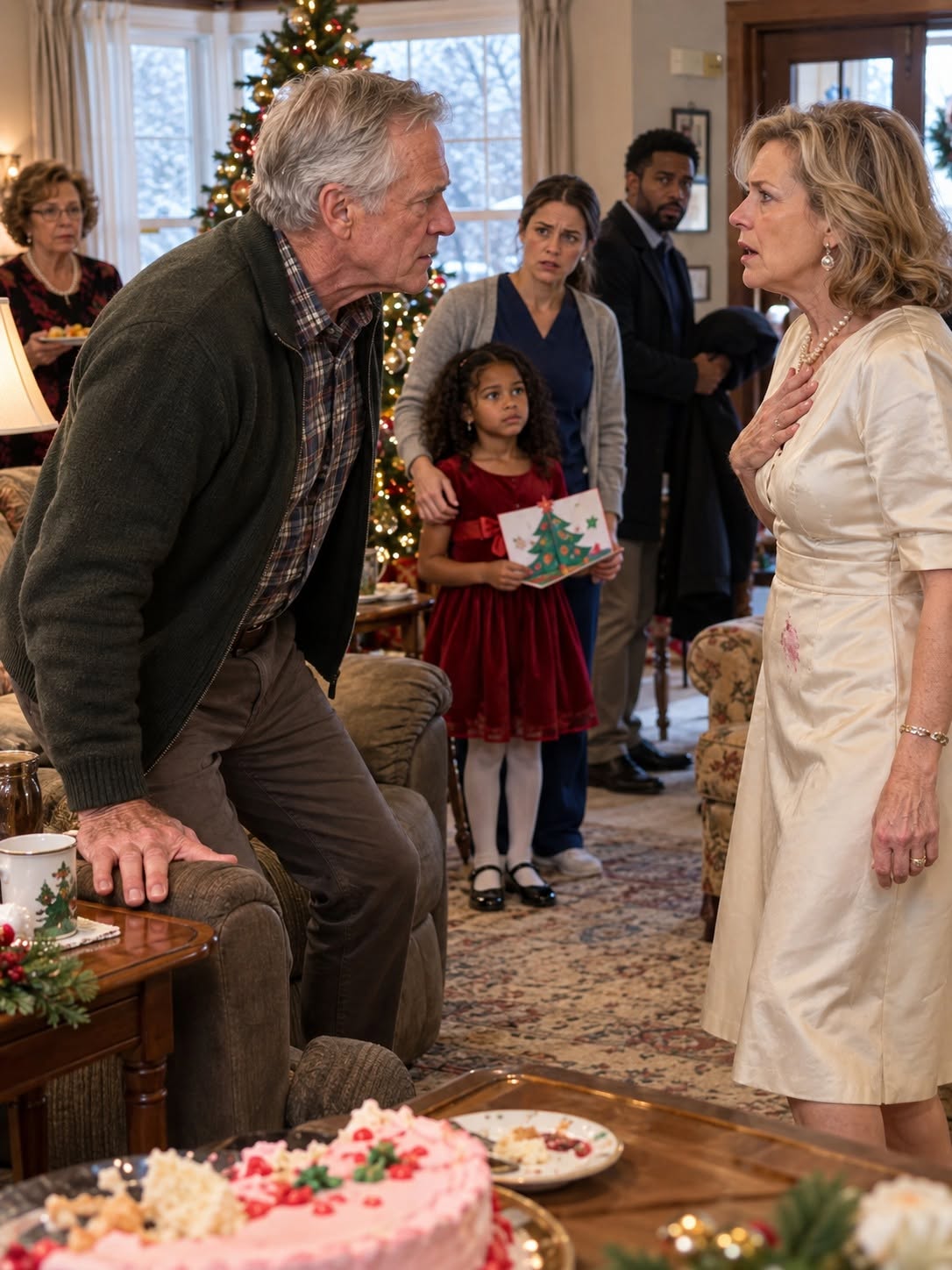
My mother refused my eight-year-old daughter’s Christmas hug because she might “mess up” her silk dress—then embraced my sister’s children with frosting on their hands. Nora asked if it was because of her daddy. Before we could leave, Grandpa set down his coffee and said, “Yes, sweetheart. And it’s the same reason your grandma never held her own son.” My sister immediately begged him to stop…
When I was eight, I ran toward my mother after our church Christmas pageant with my arms open. I had played a shepherd, delivered my one line, and managed to get candy cane stuck to my bathrobe sleeve.
Mom held up a hand.
“Not in front of everyone, Trisha. You’re sticky.”
Then she turned to straighten my older sister’s angel halo. Amber had a real white dress, carefully hemmed by Mom, while I stood there trying to remember what to do with my arms.
My father noticed. Gene Hollister, a printer with ink that never quite washed from his fingers, lifted me onto his shoulders and carried me to the car.
He comforted me, but he didn’t challenge her. That distinction took years to understand.
I’m Trisha Davis, thirty-five, and I grew up learning how to ask for very little. Amber’s pictures filled the staircase; mine occupied the spaces left over.
Every September fourteenth, Mom stayed in bed with the curtains closed. Dad called it her hard day and said it wasn’t about me.
When I was twelve, I found a newborn’s hospital bracelet at the bottom of her jewelry box. It read “Baby boy Sorenson,” using her maiden name.
She took it from me and said it belonged to a cousin’s baby who had died. Dad later told me I could ask him anything when I was grown.
I didn’t ask for twenty-three years. By then, I had become a labor-and-delivery nurse, married Owen, and had a daughter of my own.
Owen and I met when the break-room air conditioner failed during a heat wave. He fixed it while a parade of hot, tired nurses offered opinions he had not requested.
Before leaving, he put a note on the thermostat: “Please don’t touch. The guy who will have to come back.”
He came back anyway, then eventually without needing a repair call. I kept that note in our wedding album.
He listened carefully and answered the question you actually asked. On our first date, he said he could fix almost anything with patience and a screwdriver.
I told him I could deliver a baby in a parking garage. We were both telling the truth.
Mom cared enormously about family background and appearances. Owen’s mother had supervised a post office, his father drove a bus, and he repaired heating and cooling systems; to her, that made them the wrong sort of family.
When she met him, she asked what his people did, then turned away after his answer to discuss Amber’s kitchen.
In the restroom afterward, she told me, “I know how these things end.”
I didn’t know what experience she meant. Dad shook Owen’s hand again before we left and told him I was lucky.
At Thanksgiving, Mom forgot Owen’s place card. Dad brought in a paint-stained folding chair, gave Owen his own seat, and sat on the folding chair himself.
Amber said he was making it weird. Dad said he was comfortable.
Owen’s mother, Evelyn, helped me shop for a wedding dress when mine said she wasn’t comfortable with the marriage. Evelyn sewed the edging on my veil at her kitchen table.
Mom wore black to our wedding, avoided the photograph of both families, and left before our first dance. Dad stayed and welcomed Owen with a toast.
Afterward, the church bulletin carried no announcement of our marriage, although Amber’s wedding had received a photograph. I bought a manila folder and began saving things I still tried to explain away.
When Nora was born, Mom declined to hold her because of a scratchy throat. Dad held her for a long time and whispered, “We’re not doing it that way again.”
I thought he meant something about raising us. I assumed a lot.
That Christmas, Amber’s children had needlepoint stockings with names in gold thread. Nora got red felt with her name in glitter glue.
“Temporary,” Mom said.
It remained temporary for eight Christmases. When Amber had another baby, his embroidered stocking arrived promptly.
Mom held Nora when someone wanted a photograph, then handed her back. With the other grandchildren, she settled into the rocking chair until they fell asleep.
One night, Owen told me he had counted eleven seconds.
“That’s how long she held Nora.”
I didn’t know what to say. He had been polite for my sake, and I had confused his patience with an absence of hurt.





