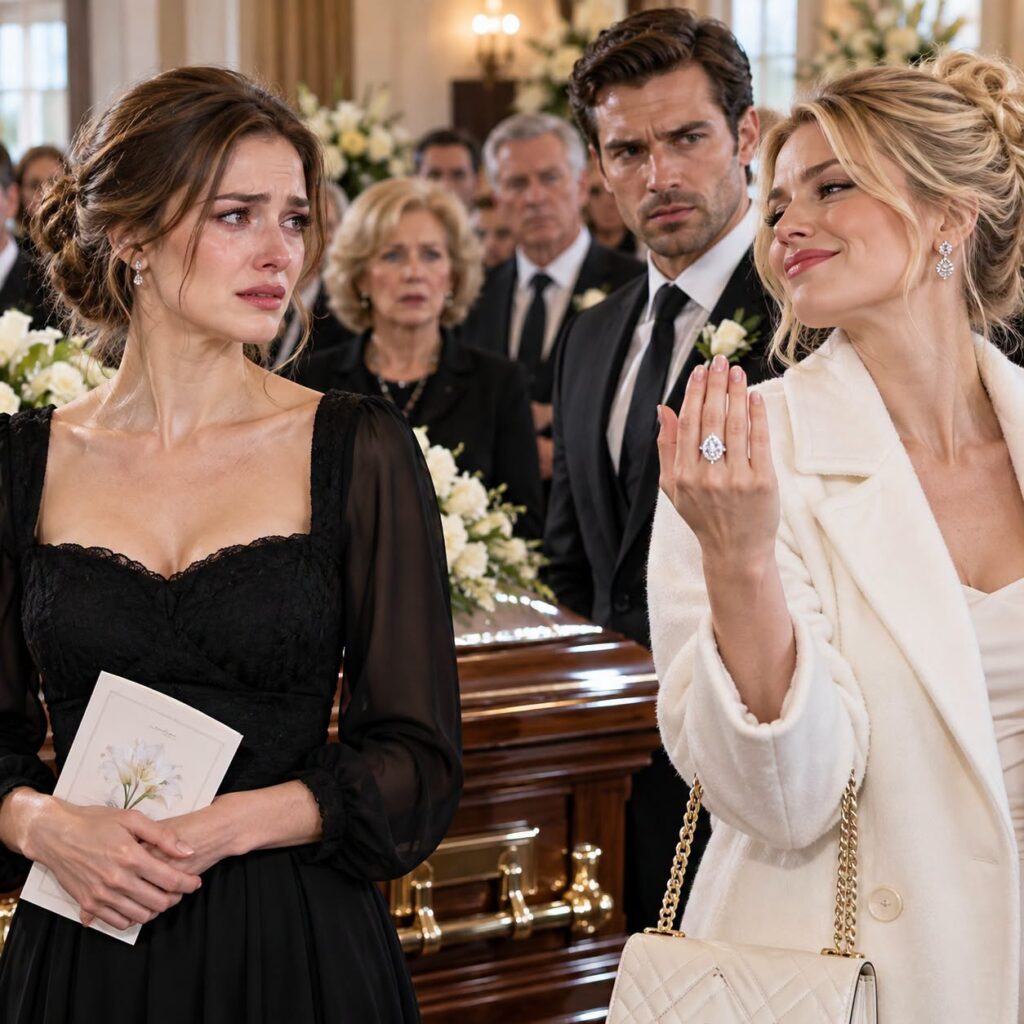
The first thing my sister did at our mother’s funeral was hold her diamond over the guest book so everyone could see it.
“Still beautiful, isn’t it?” Brooke whispered. “Grant says it looks better on me.”
It was the same pear-shaped ring my millionaire fiancé had given me six years earlier, before I found him kissing my sister in the kitchen of the house where we were supposed to live.
I was standing beside Mom’s casket in a small funeral home outside Wilmington, North Carolina. My hands were shaking around a folded program. Brooke wore a white designer coat to a funeral. Grant waited behind her in a suit worth more than my first car.
“Not today,” I said.
Brooke glanced at the empty chair beside me. “Still alone, Nora? That’s actually pathetic.”
Our aunt Linda heard her. So did the funeral director. Brooke didn’t lower her voice.
Six years ago, Grant Wilder had owned two apartment buildings and driven a silver Porsche. I thought we were building a life together. Instead, he canceled our wedding eleven days before it happened, and Brooke moved into his penthouse before I finished returning the gifts.
Mom begged me not to let one man destroy our family. I tried. Brooke made sure reconciliation never lasted longer than a holiday dinner.
Then Mom got sick.
I spent eight months driving her to appointments, helping her reopen her beloved corner bakery after treatments, and sitting beside her through nights when she couldn’t sleep. Brooke sent flowers. Grant sent a business proposal.
He wanted an access road across the bakery’s parking lot for a luxury condominium project behind it.
Mom tore his offer in half.
Now, at her funeral, Brooke tilted her head. “Grant’s project is finally moving forward. Mom would’ve wanted us to be practical.”
“She wanted you to leave her property alone.”
Grant stepped between us. “Don’t make a scene.”
I almost laughed. My sister had just called me pathetic beside our mother’s casket, and I was the problem.
A hand settled gently against my back.
“Nora,” a warm voice said, “the pastor’s ready when you are.”
I turned to my husband, Eli, in his dark charcoal suit. He had spent the morning arranging chairs, carrying flowers, and finding Mom’s favorite recording of “Blue Skies” for the service. Mom had been our only witness when we married at the courthouse two years earlier.
Brooke stared at his wedding band.
“Who is this?”
I took his hand. “Brooke, meet my husband, Eli Navarro.”
Her smile faltered. Grant’s face changed completely.
“Navarro?” he asked.
Eli looked straight at him. “We’ve met. You asked my engineering firm to approve a drainage plan that would flood this property. I refused.”
Grant’s jaw tightened. “That was confidential.”
“Your request was. My refusal wasn’t.”
Brooke grabbed Grant’s sleeve. “What is he talking about?”
Grant ignored her. He leaned close enough that I smelled his expensive cologne.
“Your mother signed the access agreement before she died,” he said. “It’s recorded. And Monday morning, the bank releases my construction money.”
He slid a folded document into my palm.
Across its bottom was my mother’s signature.
Dated three days before her death.
Brooke thought the worst thing she could do was wear my old ring beside our mother’s casket. She hadn’t realized the folded paper Grant put in my hand was more dangerous than any insult—and that Mom had prepared for it.
I didn’t unfold the paper until the last mourner had gone.
The signature looked almost perfect. Mom’s looping D. The tiny dash she always put beneath her last name.
But the notary acknowledgment said she had appeared in person at a downtown office at 2:15 p.m. on September 9.
At 2:15 that afternoon, I had been holding her hand in the intensive care unit.
Eli read the page once. “This isn’t just a bad drainage proposal.”
“No,” I said. “It’s a forged easement.”
The recorded document purported to give Grant’s company permanent vehicle access across the bakery lot. Without that driveway, his proposed condominium complex had no approved entrance for delivery trucks.
I opened my phone and called Mom’s estate attorney, Rebecca Sloan.
“Don’t confront them again,” Rebecca said. “Email me every page. I’m ordering the hospital records and certified land records tonight.”
Then she told me something that stopped me cold.
“Your mother changed her living trust in July. She named you successor trustee and left you the bakery property, which she transferred into the trust years ago. She also left you a sealed envelope. She insisted I give it to you after the service.”
Rebecca brought it to Mom’s empty bakery, where Eli and I were sitting beneath the humming display lights.
Inside were a USB drive, a wire-transfer receipt, pages from Grant’s loan application, and a note in Mom’s unsteady handwriting.





