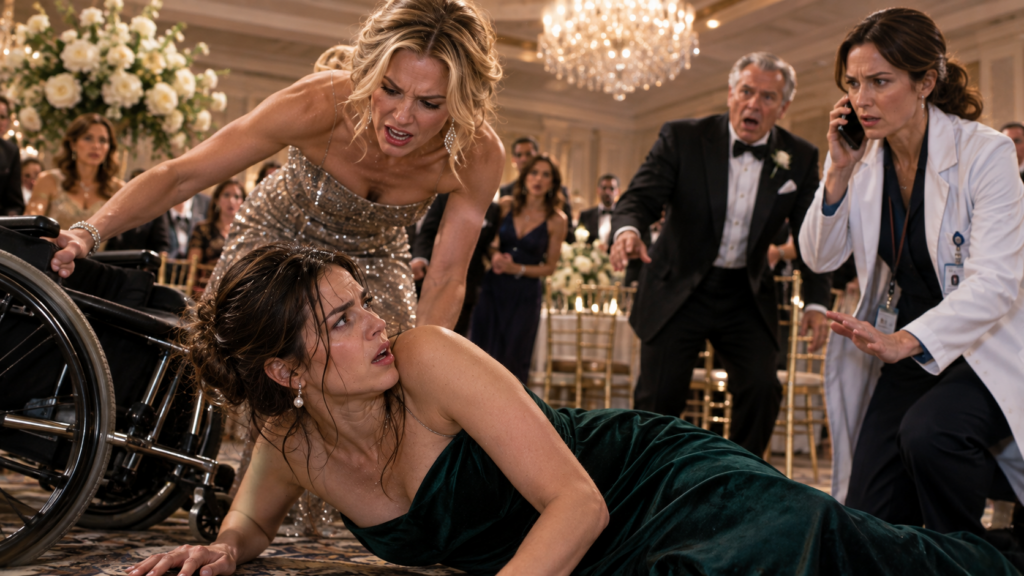
My sister stood in front of more than a hundred guests at our father’s retirement dinner in Cleveland and announced that I had been faking my paralysis for attention. Then she grabbed the handles of my wheelchair and jerked backward so hard that I hit the ballroom floor before anyone could stop her. The impact knocked the air from my lungs. My cheek struck the carpet. Somewhere behind me, glass shattered. Vanessa looked down at me and said, “See? If she was really paralyzed, she would have protected herself.”
Nobody laughed.
Fourteen months earlier, a truck had hit my car on Interstate 71. The crash damaged my spinal cord at T11. I could move parts of my legs on good days, but I could not stand safely or walk without extensive support. My doctors called it an incomplete spinal cord injury. Vanessa called it convenient. She had been saying that privately for months. She said I enjoyed the attention. She said Dad treated me differently now. She said my insurance settlement had turned me into “the family celebrity.”
I had ignored her because Dad begged me to. “She’s jealous,” he said. “Give her time.” So I did. Even when Vanessa mocked my accessible apartment. Even when she asked why I needed a wheelchair if my toes could still move. Even when she told relatives she had seen me “stand up when nobody was watching.” That part was technically true. In physical therapy, with braces, parallel bars, and two therapists beside me, I could sometimes bear weight for seconds. Vanessa turned those seconds into a lie.
That night, I had come to celebrate Dad. Nothing else. I wore a dark green dress, low black boots over my braces, and the pearl earrings Mom had left me before she died. Dad cried when he saw me. He knelt beside my chair and whispered, “Your mother would have loved this.” For the first hour, everything felt almost normal. Then Vanessa drank too much wine and started telling people I was planning to buy a new house with my settlement.
I asked her to stop.
She smiled. “Why? Embarrassed?”
“Not tonight, Vanessa.”
That should have ended it.
Instead, she took the microphone.
She told the room I had manipulated Dad, exaggerated my condition, and used the accident to collect sympathy and money. Dad stood up so quickly his chair fell backward. I reached for his hand and told him not to engage. Vanessa laughed at that too. “Look at her. Calm as ever. Because she knows exactly what she’s doing.”
Then she walked behind me.
I felt her hands close around my wheelchair.
“Vanessa,” I said.
She pulled.
The chair tipped.
My shoulder hit first. Then my face. Pain shot through my back so sharply that I couldn’t speak. Dad shouted my name. Vanessa froze.
But someone else was already moving.
A woman standing directly behind Vanessa stepped away from the table with her phone pressed to her ear. I recognized her immediately. Dr. Rebecca Collins, the rehabilitation physician who had treated me after the crash.
Her voice was calm.
“We need EMS at the Lakeshore Grand Ballroom. Adult female with a spinal cord injury has been forcibly thrown from a wheelchair.”
Vanessa’s face changed.
Rebecca looked straight at her.
Then she added, “And tell police the assault was witnessed by more than a hundred people.”
I thought Vanessa’s public accusation was the worst thing she had planned that night. I was wrong. Before the ambulance arrived, Rebecca quietly told me Vanessa had contacted her two weeks earlier asking for something no doctor should ever have been asked to provide.
Rebecca knelt beside me without moving my spine. “Don’t try to sit up,” she said. My right shoulder burned. My lower back felt wrong. Dad crouched nearby, pale and shaking, while two guests kept Vanessa from approaching me again. She kept saying the same thing. “I barely touched her. She threw herself down.” Rebecca did not argue. She simply asked one of the banquet staff to preserve the security footage and told another guest to keep recording until police arrived.
The paramedics immobilized me and took me to University Hospitals. X-rays showed no new spinal fracture, but I had a separated shoulder, bruised ribs, and a deep contusion along my hip. I was lucky. The emergency physician said a slightly different angle could have caused far more damage. Dad sat beside my bed holding my hand. For the first time since the accident, he cried in front of me. “I kept telling you to give her time,” he whispered. “I made you keep absorbing it.”
Rebecca arrived just after midnight. She was not there as my doctor anymore. She had come because of Vanessa. Two weeks earlier, Vanessa had called her office pretending she needed “family documentation.” She asked whether Rebecca would write a statement saying my paralysis was largely psychological and that I was physically capable of walking. Rebecca refused. Vanessa pushed harder. She said there was “a legal reason” the family needed proof that I was exaggerating my disability.
I stared at her. “What legal reason?”





