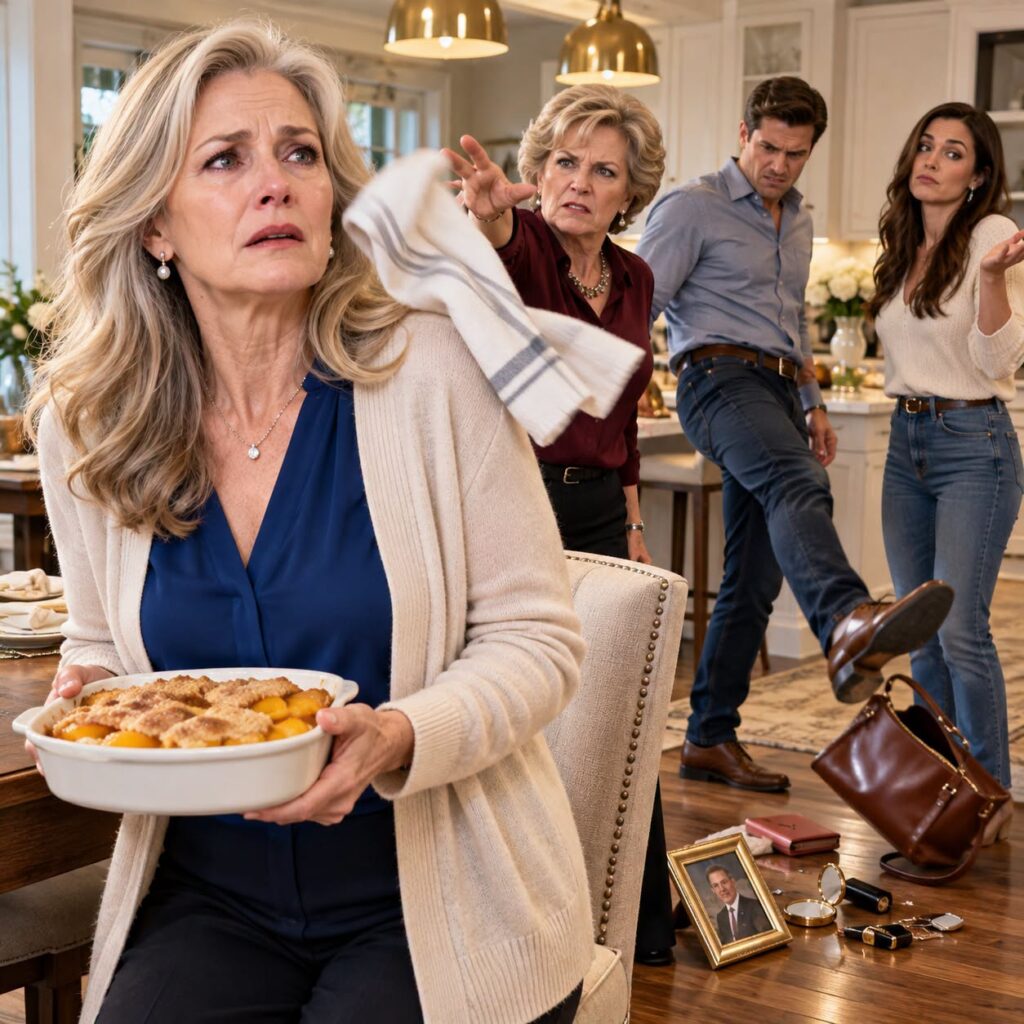
The dish towel hit my face while I was still holding the plate of peach cobbler I’d baked for my daughter.
“Get out of my chair,” Brenda snapped. “You know perfectly well that’s my place.”
I stood in the kitchen of a Columbus, Ohio, house I’d purchased for $398,000, listening to my son-in-law’s mother order me around like an intruder.
My name is Elaine Mercer. I’m sixty-three. Three years earlier, after my husband died, I’d bought that house so my daughter, Hannah, could build a life without mortgage payments. The deed remained in my name. Hannah and her husband, Tyler, had a written month-to-month rental agreement and paid a modest amount toward expenses.
Brenda wasn’t on a single document.
She’d moved into the guest room six months earlier, supposedly until repairs on her condo were finished. Since then, she’d rearranged my daughter’s kitchen, thrown away photographs of my late husband, and started calling the place “our family home.”
I set down the cobbler. “Brenda, you could have asked me to move.”
“Don’t lecture my mother,” Tyler said.
He hooked his shoe under my purse and kicked it across the tile. My keys scattered beneath the table. A small framed photograph of her father, which I’d brought for Hannah, slid out onto the floor.
“Always playing the victim,” he muttered.
I turned to Hannah. At thirty-four, she still had her father’s dark eyes. For one desperate second, I expected to see his kindness in them.
Instead, she shrugged. “Mom, stop being so sensitive.”
Something in my chest went perfectly still.
I’d paid the property taxes. I’d replaced the furnace. When Tyler lost his job last winter, I’d covered their overdue utility bills without telling a soul. And there stood my daughter, watching him grind his heel beside her father’s photograph.
Brenda folded her arms. “Maybe you should go home before you embarrass yourself again.”
“This is my home too,” I said quietly.
Tyler laughed. “Not for much longer.”
His phone lit up on the counter. I saw a message preview before he snatched it away: CAPACITY MATERIALS READY. NEED FAMILY VIDEO.
Brenda shot him a look so sharp it silenced him.
I bent to collect my purse. Beside the kitchen trash can lay an opened envelope addressed to Tyler. The return address belonged to a private lending company. Across the top, in red, someone had written: OWNER AUTHORIZATION REQUIRED.
“Why are you trying to borrow against my house?” I asked.
Hannah went pale.
Tyler stepped between us. “You need to leave.”
I didn’t argue. Outside, in the cold November air, I called my attorney, Michelle Park, then the real estate agent who’d helped me buy the property. I told them both I wanted to discuss selling. I also asked Michelle to check whether anyone had filed paperwork concerning me.
At 8:15 the next morning, a FOR SALE sign stood in the front yard. I hadn’t canceled anyone’s tenancy. I was simply putting my property on the market.
Tyler stormed onto the porch, shouting. Hannah followed with a thick court envelope clutched to her chest.
“You can’t do this,” she whispered. “I told the judge you’re no longer capable of making your own decisions.”
And then she held up the petition bearing her signature.
I had expected a fight over the house. I hadn’t expected my own daughter to question my sanity in court. But the papers in her hands were only part of it. What Michelle uncovered next made that cruel dinner look like a carefully rehearsed trap.
“Give me that envelope,” I said.
Hannah held it against her coat. “Tyler says you’ll only make things worse.”
“Then Tyler can explain himself to my lawyer.”
Michelle arrived twenty minutes later. She’d downloaded the actual filing from the county probate court: an application asking for an emergency guardian over my finances. No judge had approved it. No one had taken away my right to sell, sign contracts, or speak for myself.
But the allegations made my hands shake.
According to Hannah’s sworn statement, I wandered into the house uninvited, confused relatives with strangers, and became aggressive when asked to leave. Attached was a short video of me confronting Brenda, edited to omit the towel she’d thrown. It ended before Tyler kicked my purse.
“Who filmed this?” Michelle asked.
“Tyler,” Hannah said, barely audible.
I remembered his phone standing upright against the coffee maker. He’d told us he was recording a recipe for his mother.
Then Michelle turned another page.
A medical assessment supposedly written by a nurse practitioner declared that I showed signs of serious cognitive decline. The office address looked familiar. It was the clinic where I’d had my annual physical—but I hadn’t seen that practitioner, ever.





