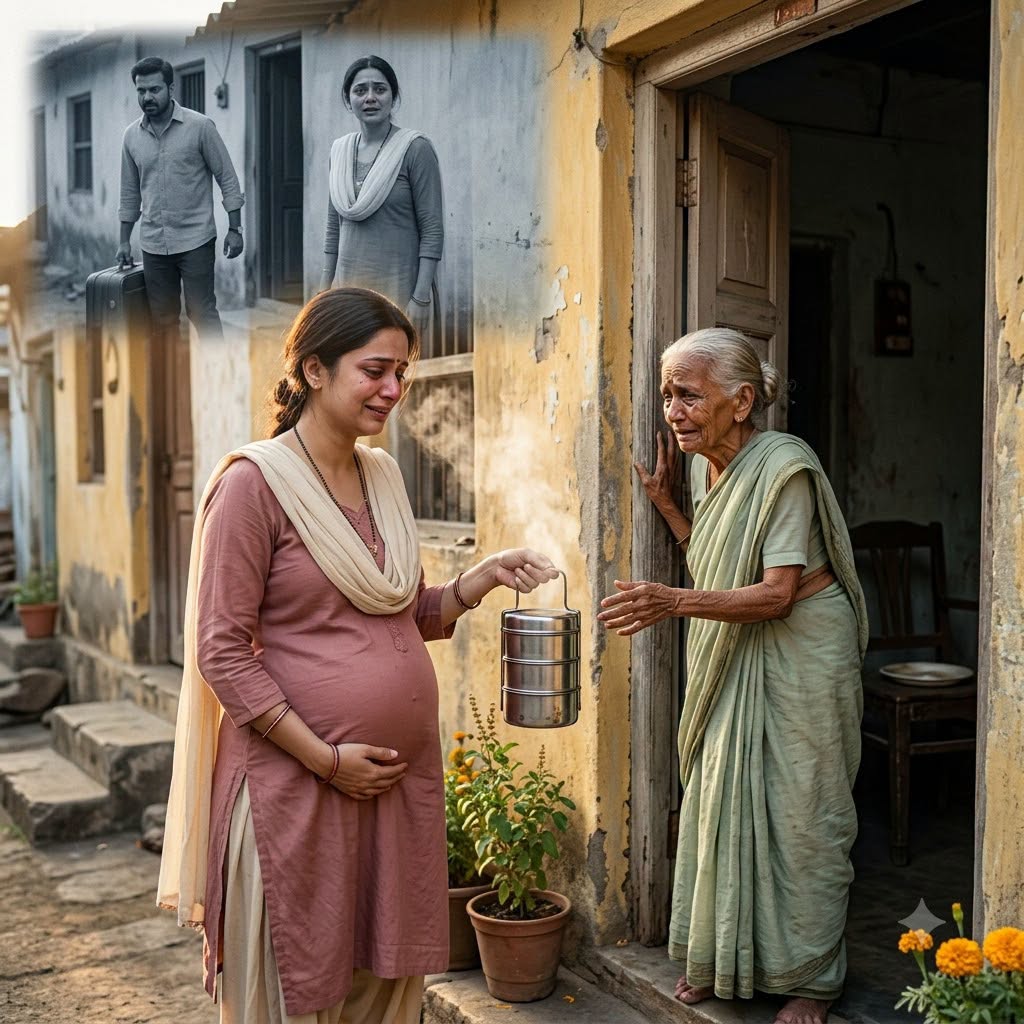
Now I understood what he had truly given me.
A name.
A home.
A childhood without shame.
And love that had never depended on biology.
Three weeks later, Avinash returned.
This time, he came alone.
I met him in the courtyard.
He looked thinner.
“Vedika, I’ve made mistakes.”
I said nothing.
“I was frightened about money.”
I looked at him.
“You were not frightened when you called our child a burden.”
His eyes filled.
“I didn’t mean that.”
“But you said it.”
He lowered his head.
“I want another chance.”
For one terrible moment, I remembered our wedding day.
The marigolds.
My mother’s red saree.
The hope I had felt when he tied the mangalsutra around my neck.
Then the baby kicked.
I placed my hand over my stomach.
“Avinash, if I had no inheritance, would you have come back?”
He looked away.
My heart hurt.
But I already knew.
I whispered, “That’s what I needed to hear.”
He began crying.
I did not embrace him.
I told him that any decisions about our marriage and the baby’s future would have to be handled responsibly and with legal advice.
Then I went inside.
For the first time since he left, I did not cry after closing the door.
Two months later, my daughter was born.
I named her Anagha.
When the nurse placed her in my arms, I stared at her tiny face.
Her fingers curled around mine.
I began sobbing.
“Your grandmother loved you before she knew you,” I whispered.
Then I corrected myself.
“Both your grandmothers did.”
Mrinalini arrived at the hospital carrying a small yellow blanket.
She was crying before she even reached my bed.
“May I hold her?”
I nodded.
She took the baby carefully.
For a moment, she looked twenty years younger.
“Anagha,” she whispered.
My heart broke when I saw her tears.
She was not only holding her great-granddaughter.
She was remembering the daughter she had buried.
I reached for her hand.
“Aaji, she’s not here to replace anyone.”
Mrinalini nodded through her tears.
“I know, beta.”
Then she smiled.
“But perhaps love has found another way to visit me.”
Over the following year, the independent financial review uncovered improper payments and missing disclosures involving Raghavendra’s firm.
Legal proceedings began.
Some disputed funds were recovered, and the trust’s administration was transferred to independent professionals.
The process was exhausting.
But I was no longer facing it alone.
Mrinalini helped care for Anagha.
Bhairavi visited regularly.
Devyani guided me through the legal complications.
And I returned to my accounting work when I was ready.
Avinash and I separated.
Through our lawyers, we arranged financial support and a framework for his involvement in our daughter’s life.
I did not teach Anagha to hate her father.
But I would never teach her that love required accepting cruelty.
On Anagha’s first birthday, we celebrated in our courtyard.
The jasmine creeper was blooming.
There were paper decorations, homemade sweets, and a small cake.
Mrinalini sat beside me, holding the same steel tiffin I had brought her that rainy afternoon.
She had filled it with khichdi.
I laughed.
“Aaji, today we have so much food. Why did you bring khichdi?”
She smiled.
“Because this is what brought my granddaughter back to me.”
I looked at her.
Then at the little girl playing near the tulsi plant.
And finally at the house I had once been ashamed not to own.
My father had left it as a place of safety.
My mother had filled it with love.
My biological mother had given her life bringing me into the world.
And my grandmother had waited next door, carrying a truth too painful to speak.
I took her hand.
“Aaji, I thought I was helping you that day.”
She squeezed my fingers.
“You did help me.”
I smiled.
“But you gave me so much more.”
She shook her head.
“No, beta. You gave me something money could never buy.”
“What?”
She looked toward Anagha.
“You gave me my family back.”
That evening, after everyone left, I sat beside my daughter’s cot.
She was sleeping peacefully, her tiny hands resting near her cheeks.
I thought about Avinash.
About the door he had slammed.
About the words that had once convinced me I was worthless.
Then I looked around the room.
The old furniture.
The faded walls.
My parents’ photographs.
And the little yellow socks I had bought when I first discovered I was pregnant.
I had spent months believing that losing my husband meant losing my future.
But now I understood.
A house does not become a home because your name appears on its ownership documents.
And marriage does not become love because someone ties a mangalsutra around your neck.
A home is where you are safe.
Love is where you are respected.





