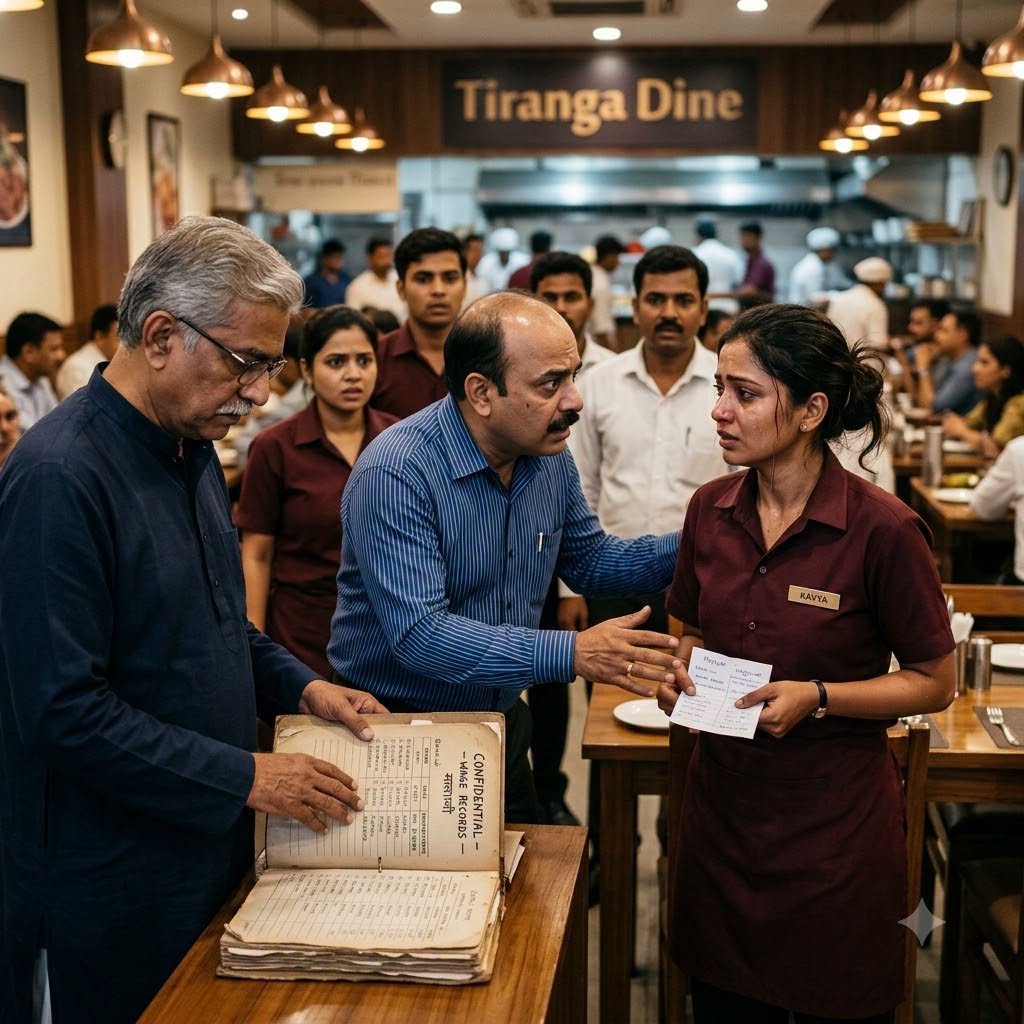
For the first time, fear returned.
Not the old fear.
Not the fear that made me silent.
This was different.
Now I knew exactly what Mahesh could lose.
And men like him became dangerous when they realized frightened people had stopped obeying.
I took out my phone.
I photographed the car.
Mahesh’s smile disappeared.
Then I called the officer who had taken my statement.
Within minutes, Mahesh drove away.
I did not sleep in that apartment again.
Prakash helped Nikhil and me stay with his family.
The next morning, something happened that Mahesh had never expected.
The workers spoke.
Arjun spoke.
Prakash spoke.
Two former cooks spoke.
A dishwasher who had moved away came back.
A woman who had worked there four years earlier brought old pay stubs.
Another worker had saved text messages.
Another had photographs.
One had recorded Mahesh threatening him.
For years, each person had carried one small piece of the truth.
Mahesh’s power came from making every one of us believe our piece was useless.
Together, they formed the entire picture.
The investigation widened.
Bank fraud.
Identity theft.
Wage theft.
Falsified payroll records.
Housing fraud.
Threats.
The restaurant closed temporarily.
Mr. Mehta cooperated.
His cooperation did not erase what he had done.
He had known workers were being mistreated.
He had chosen his business over us.
That mattered.
When investigators asked whether I considered him another victim, I said no.
He had been deceived about the financial fraud.
But he had ignored complaints because confronting Mahesh was inconvenient.
There is a difference between being fooled and choosing not to look.
Nikhil struggled the most.
For months, he apologized every day.
Finally, I told him to stop.
Not because I had forgiven everything.
But because apologies without change become another burden for the person who was hurt.
“Tell the truth,” I said. “That’s what you can do for me.”
So he did.
He admitted withdrawing money.
He admitted signing as a witness.
He admitted introducing two workers to Mahesh because Mahesh had promised him referral money.
That confession nearly broke him.
“I helped him.”
“You were manipulated.”
“That doesn’t mean I did nothing wrong.”
For the first time, I saw my little brother as an adult.
Not innocent.
Not evil.
Responsible.
And responsibility was where healing began.
The case lasted nearly two years.
I won’t pretend every stolen dollar returned.
It didn’t.
Some money disappeared.
Some records were impossible to reconstruct.
Some former workers were too afraid to participate.
But enough evidence remained.
Mahesh could no longer hide behind our silence.
The fraudulent debt in my name was eventually removed.
The day I received the letter confirming I was no longer responsible, I sat at my kitchen table and cried.
Not dramatically.
Quietly.
I placed the letter beside my tea and touched my own name printed across the top.
For three years, my name had belonged to other people.
Mahesh used it for loans.
My landlord used it for housing records.
The restaurant used it to hide wages.
My brother had written beneath it because he was afraid.
That letter gave something back to me that money couldn’t measure.
My name was mine again.
Prakash and I later helped several former employees organize their records for wage claims.
Arjun found another job.
Nikhil began working at a small repair shop.
And me?
I never returned to that restaurant.
For months, I couldn’t even smell frying onions without remembering Mahesh shouting in the kitchen.
Then one afternoon, Prakash called.
A small café near his neighborhood needed someone to manage the front counter.
The owner had heard what happened.
I almost refused.
I was tired of restaurants.
Tired of managers.
Tired of feeling that employment meant handing someone power over my survival.
But I went to the interview.
The owner placed the contract in front of me.
My hands froze.
She noticed.
“Take it home,” she said.
I looked at her.
“What?”
“Read it. Ask someone else to read it. Bring it back tomorrow if you want the job.”
I nearly cried.
Such a small thing.
A person giving me time to read my own contract.
I took it home.
I read every word.
Twice.
Then Nikhil read it.
Then I signed.
A year later, I became assistant manager.
The first employee I hired was a nineteen-year-old girl who had recently moved to the city.
When I gave her the paperwork, she immediately reached for a pen.
I stopped her.
“Read first.”
She smiled nervously.
“It’s okay. I trust you.”
Those words hurt.
I pushed the papers gently back toward her.
“No.”
She looked confused.
“Never sign because you trust someone.”
I thought of Mahesh.
Mr. Mehta.
My landlord.
Nikhil.
And the woman I had been three years earlier, standing inside a noisy restaurant while a manager pointed at pages I didn’t understand.





