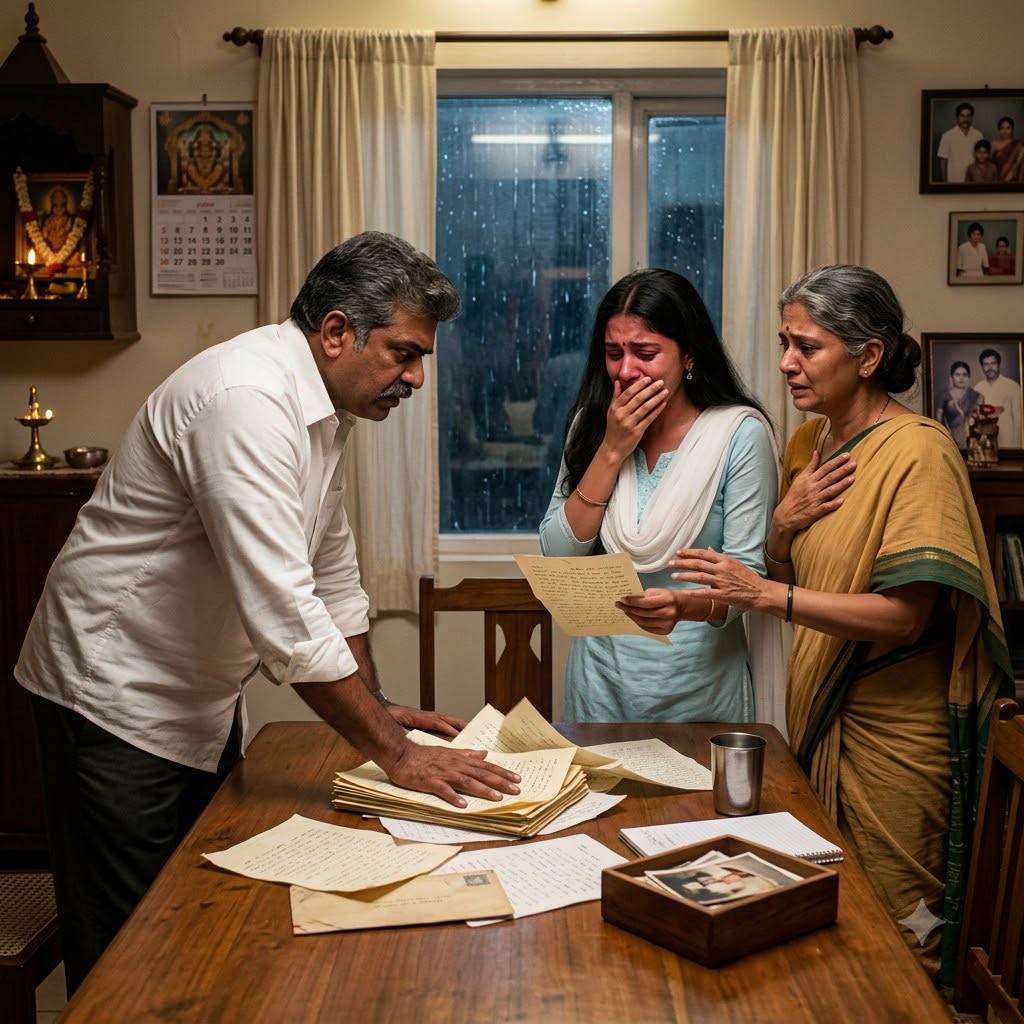
“…that Raghavendra Mehra was the man who arranged for you to be accused of stealing the examination papers from your university.”
I read the sentence three times.
My daughter stood beside me, waiting.
Raghavendra slowly lowered himself into the armchair.
“That is a lie,” he whispered.
But I remembered.
I remembered the university office in Lucknow, the professor who refused to meet my eyes, and the scholarship letter I had held in my hands only six days before everything collapsed.
I remembered being told that confidential examination papers had been discovered in my hostel cupboard.
I remembered begging the principal to believe me.
And I remembered Raghavendra arriving at our house two days later, offering to marry the disgraced daughter nobody else would accept.
I had spent twenty-nine years believing he rescued me.
Now my father’s letter suggested he had created the danger himself.
“Amma?” Vaidehi whispered.
I looked at her.
“Your father knew me before our marriage. He had approached my family once, but I refused because I wanted to study.”
Raghavendra stood abruptly.
“Charulata, enough.”
“No,” I said.
The word surprised even me.
I turned the page.
My father had written that shortly before his death, he received a confession from a former university clerk named Mahendra Sethi.
Mahendra admitted that he had placed the examination papers in my cupboard after receiving money from a businessman connected to Raghavendra’s family.
There were copies of bank records, an old written statement, and correspondence concerning my disciplinary proceedings.
My father had spent years trying to uncover the truth.
He had finally found evidence.
But he died before he could tell me.
I looked at my husband.
“Did you do this?”
He stared at the floor.
“Your father never liked me.”
“Did you do it?”
His jaw tightened.
“I wanted to marry you.”
I felt something inside me turn cold.
“So you destroyed my future?”
“I didn’t think it would go so far.”
Vaidehi stepped backward.
“Papa…”
Raghavendra reached toward her.
“Beta, you don’t understand. Things were different then.”
She pulled away.
“You made Amma believe nobody else would marry her?”
He said nothing.
“You watched her give up her scholarship, her studies, her career—and you knew why?”
His face hardened.
“I gave her a good life.”
I looked around the room.
The expensive furniture.
The silk curtains.
The silver photographs of our family.
For years, I had mistaken those things for proof that I should be grateful.
“You gave me a house,” I said quietly. “Then spent twenty-nine years making sure I never felt free inside it.”
He looked away.
Vaidehi began crying.
But there was another question.
The young woman in the photograph.
My closest friend from university.
Her name was Ishwari.
She had been the only person who believed I was innocent.
When the university suspended me, Ishwari had promised to help me appeal.
She arranged a place for me to stay in Delhi.
She bought my train ticket.
She even waited at the station.
But I never went.
Because the night before my departure, my father told me that Ishwari had withdrawn her support.
He said she had written a letter accusing me of dishonesty.
I had believed him.
I had been too ashamed to contact her again.
Now I turned over the photograph.
For Charulata. In case they never allow you to come home.
My hands shook.
I looked at Raghavendra.
“Did Ishwari ever withdraw her support?”
He remained silent.
“Answer me.”
He sighed.
“She was filling your head with foolish ideas.”
I stared at him.
“You intercepted her letters?”
“I was trying to protect our marriage.”
“We weren’t married!”
He flinched.
For the first time in twenty-nine years, I shouted at my husband.
“You weren’t protecting a marriage. You were making sure I had nowhere else to go.”
Vaidehi took my hand.
“Amma, we need to find her.”
I shook my head.
“It’s been nearly thirty years.”
“Then we’ll start looking.”
Raghavendra laughed bitterly.
“And what will you do when you find her? Turn back the clock?”
I looked at him.
“No. But perhaps I’ll finally stop living according to the lies you told me.”
That evening, Vaidehi searched through old university records.
She found references to Ishwari Menon, a former history student who had later become an advocate in Delhi.
There was an office address.
A telephone number.
I stared at the screen for nearly an hour.
Then I asked my daughter to call.
A woman answered.
“Menon Chambers.”
Vaidehi introduced herself.
“I’m looking for Advocate Ishwari Menon. My mother studied with her in Lucknow.”
The receptionist asked for my name.
When Vaidehi said “Charulata,” there was a long silence.
Then another voice came onto the line.
“Charu?”
My throat closed.
Nobody had called me that in decades.
“Ishwari?”
She began crying.





