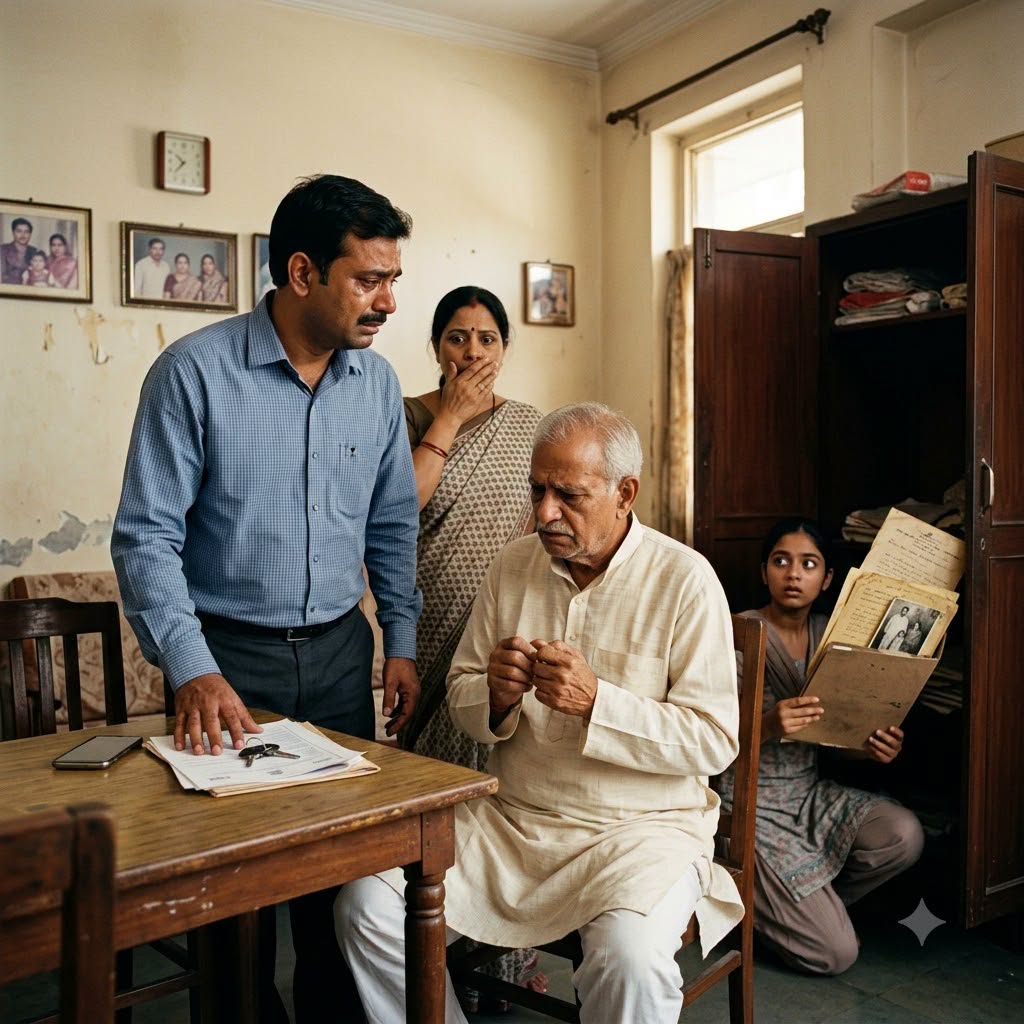
He sold a piece of land.
Reduced his expenses.
Stopped giving money he couldn’t afford to give.
Mahesh slowly rebuilt his life.
Devyani became financially independent.
And my relationship with my father became something I had never thought possible.
Not obedience.
Not fear.
Respect.
There were still difficult conversations.
Sometimes he would say, “But you’re my daughter.”
And I would answer gently:
“Yes, Papa.
That is why you should never be afraid of hearing no from me.”
He eventually learned to accept it.
The house remained mine.
Years passed.
Gaurika grew taller.
The marks on the doorframe moved upward.
The little girl who had watched her grandfather demand her mother’s house eventually became a woman who understood exactly what that house represented.
One evening, when she was seventeen, she sat beside me on the balcony.
“Mama?”
“Yes?”
“Do you regret not giving the house to Maasi?”
I looked at her.
“No.”
“Even though Grandpa was angry?”
“No.”
“Why?”
I thought about the twelve years of payments.
The sleepless nights.
The sacrifices.
My mother’s letter.
My father’s betrayal.
My sister’s fear.
And the woman I had been before that night.
“I regret how long it took me to understand that saying no doesn’t make you a bad daughter.”
Gaurika rested her head on my shoulder.
“Would you give the house to me one day?”
I smiled.
“If you need a place to live, I’ll help you find one.”
She laughed.
“That isn’t what I meant.”
“I know.”
I kissed her forehead.
“One day, this house will belong to whoever I legally choose to leave it to.”
She smiled.
“And if Grandpa asks you to give it to someone else?”
I looked toward the living room.
My father was there, arguing with my husband about cricket.
I laughed.
“I’ll remind him that he already learned the lesson.”
“What lesson?”
“That family comes before ownership only when the people you call family respect the person who owns the property.”
Gaurika smiled.
Then she asked the question that made me realize how much that little girl had understood.
“Mama, do you think Grandma knew all of this would happen?”
I looked at the brass diya sitting beside us.
The one my father had returned.
I lit it.
The flame flickered gently in the evening air.
“Maybe she knew my father would make mistakes.”
“And you?”
I smiled.
“She knew I would eventually learn to stop making mine.”
That night, after everyone went to sleep, I walked through the house alone.
I touched the walls.
The kitchen counter.
The little marks on the doorway.
The framed photograph of my mother.
Then I stood in the middle of the living room where I had cried twelve years earlier after making my final payment.
Back then, I thought the greatest victory was owning the house.
I was wrong.
The greatest victory was standing in that same room years later and realizing that nobody could make me surrender myself just to prove that I loved them.
My father had demanded my house because he believed family gave him the right to take from me.
But the old file my daughter found had revealed something much more important than a financial secret.
It revealed the difference between love and obligation.
Love says:
**I will help you because I want you to stand.**
Obligation says:
**You must fall so I can prove that I love someone else more.**
I had spent half my life believing being a good daughter meant giving until there was nothing left.
My mother had spent the last years of her life trying to teach me otherwise.
And perhaps that was the inheritance she had really left me.
Not money.
Not property.
Not jewelry.
The courage to say:
**This is mine.**
**I love you.**
**And I still have the right to say no.**
If someone you love ever made you feel guilty for protecting what you worked so hard to build, remember this story. Sometimes the hardest door to close is the one opened by your own family—but closing it does not mean you stopped loving them. Sometimes it means you finally started loving yourself too. And if this story touched something inside you, tell me in the comments: **Would you have given up your house for your sister, or would you have chosen to protect the life you spent years building?**





