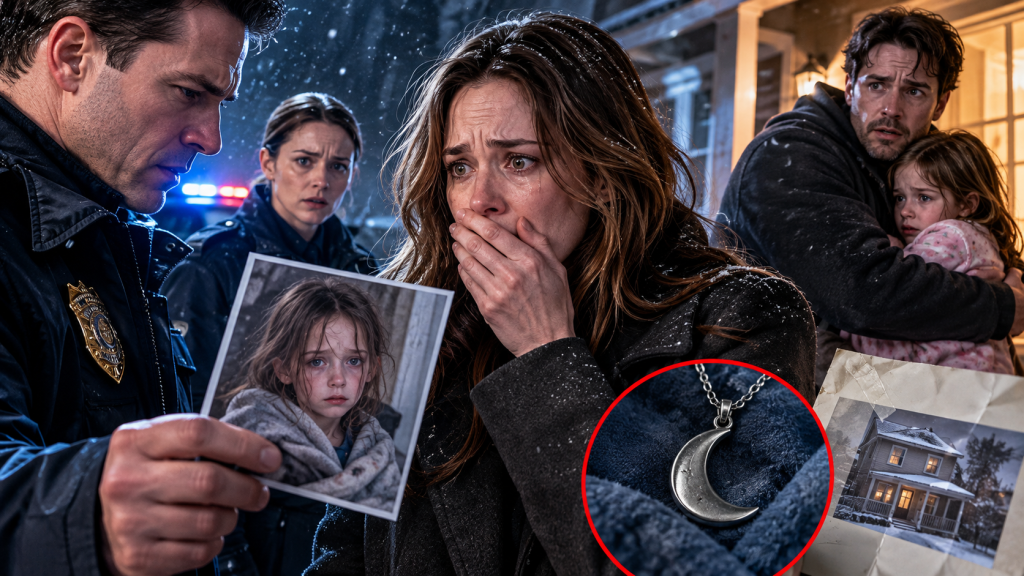
Inside the police station, I repeated that my daughter had slept safely beside me all night. The detective placed a photograph of a painfully thin girl on the desk. She wasn’t my daughter. But the handwritten note tucked into her coat carried an address I hadn’t visited in twelve years.
“Ma’am, we found your daughter outside in eleven-degree weather. She was barefoot, and nobody would let her back inside.”
The officer said it at 2:14 in the morning, standing beneath my porch light with snow melting on his shoulders.
“My daughter is upstairs,” I whispered.
I’d fallen asleep beside seven-year-old Sophie after she woke from a nightmare. Her small hand had been tucked inside my sleeve when the knocking began. My husband, Ben, was still sitting with her.
The second officer turned a phone toward me.
On the screen was a thin girl wrapped in a police blanket, with chapped lips and hair tangled against her cheeks. Around her neck hung a small silver moon.
I gripped the doorframe.
The pendant had a tiny dent on its edge. I knew because I’d made that dent myself, dropping it on the kitchen tiles the Christmas I gave it to my older sister, Natalie.
Natalie later fastened it around her daughter’s neck for her fifth birthday. At the funeral, Emma had fallen asleep against my shoulder, her little fist curled around that moon as if it might keep her mother close.
But my sister had died three years ago.
“Where did you find her?” I asked.
“On the back porch of a house in Westfield. The woman inside said the child was yours and gave us this address.”
The officer watched me carefully.
The girl in the picture was my niece, Emma.
My mother had told me Emma’s father took her to Oregon after Natalie’s funeral. He’d never liked our family, she said, and wanted no contact. My birthday cards came back unopened. When I asked for his phone number, Mom called me controlling.
Our last conversation ended with her saying, “Stop trying to replace your sister.”
I had stopped calling her. I hadn’t stopped keeping a birthday present for Emma in the closet, year after year.
“Is the child all right?” I asked.
“She’s being checked at the hospital. We need to establish who’s responsible for her.”
I pulled on my coat. My fingers missed the zipper twice.
Ben appeared behind me. “I’ve got Sophie. Go.”
Before we left, the officer showed me the incident address.
My mother’s name was listed beside it.
She’d told me she sold her house and moved south last spring.
Then he added something that made the hallway seem suddenly airless.
“When officers asked why the girl was outside, she said, ‘Grandma said I could come back when I stopped asking for dinner.’”
At the hospital, Emma sat beneath two blankets, turning a paper cup between her hands. The nurse had given her warm socks. She kept looking toward the door whenever footsteps passed.
“Emma?” I said.
Her eyes rose to mine. For a moment she stared, then touched the silver moon at her throat.
“Aunt Claire?”
I nodded. She didn’t run to me. She just asked, “Are you going to send me back?”
The nurse waited while I sat beside her. I wanted to promise everything, but the social worker had explained that child protection workers would decide where she could safely stay.
“Not tonight,” I said. “And I’m going to do everything I can to help.”
I remembered teaching her to tie her shoes on Natalie’s kitchen floor, making two clumsy loops while she insisted that rabbits had four ears. Now she flinched whenever anyone moved a chair.
Emma stared at the cup. “Grandma said you didn’t want me.”
I swallowed so hard it hurt.
Three years earlier, Mom told me Emma was living with her father in Oregon. Now a county caseworker explained that my mother had actually become Emma’s legal guardian after Natalie died. Emma’s father, who had been largely absent, had agreed to the arrangement. Mom had filed paperwork with the court while telling me the exact opposite.
I asked why Emma had never attended school in my district, why nobody had noticed.
“She was enrolled,” the caseworker said. “We’re reviewing attendance and prior concerns. We can’t give you everything today.”
My phone buzzed before I could ask more.
Mom.
Don’t speak to the police. I’ll handle the misunderstanding.
I called her.
“You left Emma outside in the cold.”
“She’s exaggerating,” Mom replied. “She refused to eat what I made.”
“An officer found her barefoot.”
“You have no idea what I’ve sacrificed for that girl. Now you want to play hero?”
I looked through the glass at Emma, who was carefully folding the empty paper wrapper from a cracker.
“I want her safe.”
Mom’s voice sharpened. “Then stay away. I’m her guardian.”
I ended the call and forwarded the message to the caseworker.





