“…the same man. Pradyumna Mehta. But the name he used when he entered our lives was not the name on his birth certificate.”
I stared at the hospital bracelet.
The name printed beneath the identification number was Mahendra Sethi.
I had never heard it before.
But the photograph beside the letter showed a familiar face.
Pradyumna.
Younger, clean-shaven, wearing a white shirt instead of the expensive suits I remembered.
My hands began shaking.
“Charulata ji,” I whispered, “please look at this.”
The child protection worker examined the documents without touching the bracelet.
“Bhairavi ji, we need to preserve these carefully. They may be evidence.”
Outside, the shouting grew louder.
“I am the boy’s father! Bring him down immediately!”
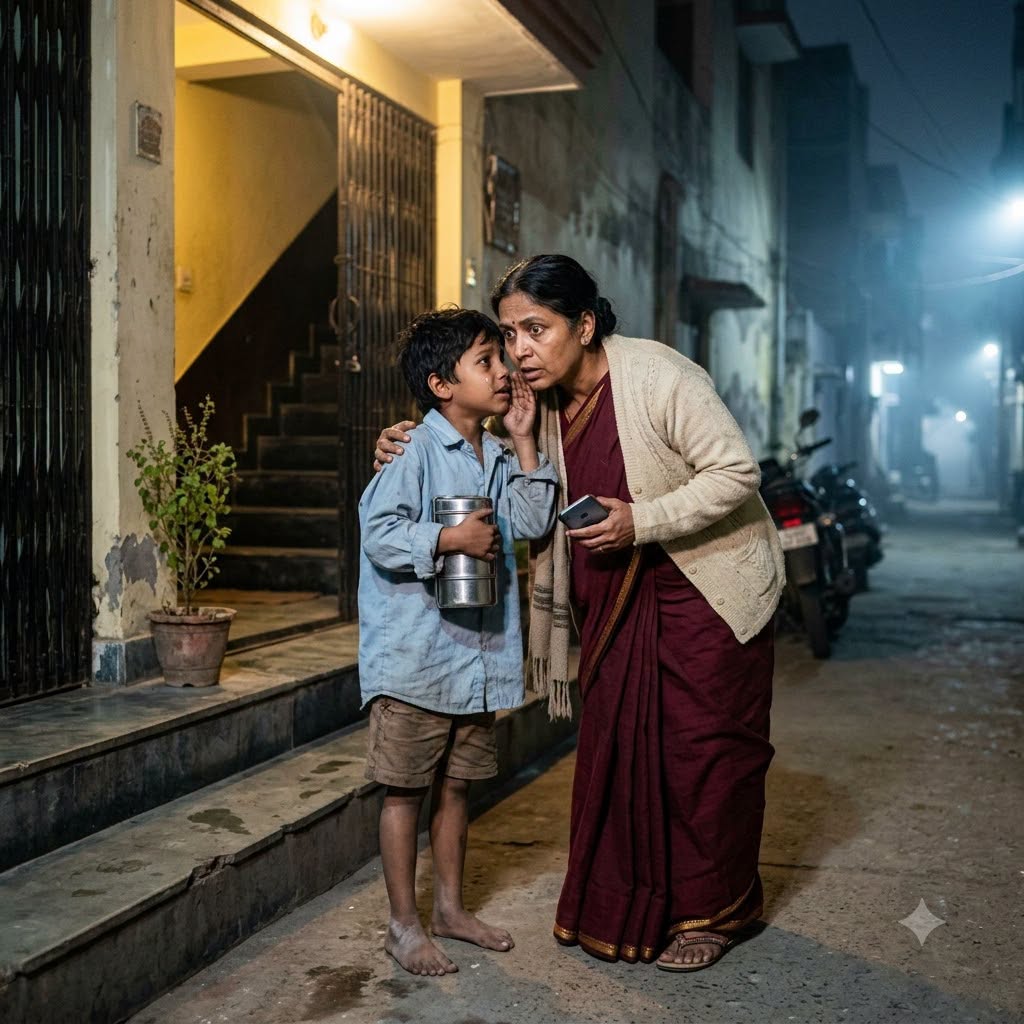
Chirag pressed himself against my side.
“Aunty, please don’t let him see me.”
I knelt beside him.
“Chirag, look at me.”
His frightened eyes met mine.
“You are not going downstairs. The police are here, and we are going to make sure you are safe.”
He swallowed.
“Will they find Mumma?”
I felt tears gathering.
“They are looking for her right now.”
He studied my face.
Then whispered, “You look like her.”
My heart broke.
I wanted to tell him that I was his grandmother.
I wanted to pull him into my arms and make up for seven lost years.
But he had already experienced too much fear that night.
So I simply said, “Your mother and I belong to the same family.”
He nodded.
“That is why she sent me.”
Before I could answer, Charulata’s phone rang.
She stepped aside.
I watched her expression change.
Then she turned toward the police officer.
“They’ve located a woman at the industrial property.”
I stood so quickly that my chair scraped against the floor.
“Is it Ishwari?”
Charulata hesitated.
“She has been taken to a hospital. She’s alive, but her condition is serious.”
My knees weakened.
Alive.
My daughter was alive.
I gripped the edge of the table.
“Please take me to her.”
“We will arrange that,” Charulata said. “But first, the officers need to speak with the man downstairs.”
I looked toward the entrance.
For eight years, I had imagined what I would say if I ever saw Pradyumna again.
I had rehearsed accusations.
Questions.
Threats.
But now, with my grandson trembling beside me, I wanted only one thing.
To keep him away from us.
The police brought Pradyumna into a separate room near the security office.
I could see him through the glass partition.
He was heavier than I remembered.
His hair had begun thinning.
But his expression was unchanged.
Impatient.
Entitled.
Certain that raising his voice would make everyone obey.
He pointed toward the lobby.
“That woman has taken my child!”
The officer asked him to provide identification and explain the circumstances.
Pradyumna produced a driver’s licence.
The name on it was Pradyumna Mehta.
Then he produced a birth certificate listing himself as Chirag’s father.
I felt a terrible chill.
Charulata examined the documents.
“Sir, the child has expressed fear of returning with you. There are concerns about his mother’s safety. We cannot simply hand him over without appropriate checks.”
Pradyumna’s face darkened.
“My wife is mentally unstable. She fills the boy’s head with nonsense.”
I stepped forward.
“Where is Ishwari?”
He turned.
For one brief second, genuine fear crossed his face.
Then he smiled.
“Bhairavi Aunty. After all these years.”
I felt sick hearing him use that familiar name.
“Where is my daughter?”
“She left home.”
“She’s in a hospital.”
His smile disappeared.
The police officer looked sharply at him.
Pradyumna recovered quickly.
“She has been ill. I was trying to arrange treatment.”
I held up the letter.
“Then why did she send her son barefoot into the December cold to escape you?”
He said nothing.
I continued.
“Why did she tell him not to reveal where they lived?”
His jaw tightened.
“She’s confused.”
I looked at him.
“No. She was frightened.”
The officer asked us to stop arguing.
Pradyumna was taken aside for further questioning.
Chirag remained with the child protection team.
And I was escorted to the hospital where my daughter had been admitted.
During the drive, I opened the remaining document.
It was a copy of a complaint written by Ishwari several months earlier.
The pages were filled with dates, addresses, and descriptions of incidents.
She had documented threats.
Financial restrictions.
Repeated attempts to prevent her from contacting relatives.
She described being moved between rented houses whenever she tried to seek help.
Then came the paragraph that made my blood run cold.
I believe the man living with me as Pradyumna Mehta is actually Mahendra Sethi, formerly employed as an administrative coordinator at the private hospital where my father died.
I stopped reading.
The hospital.
Shashidhar’s final weeks.
I remembered a young administrative employee who had helped us with billing.





