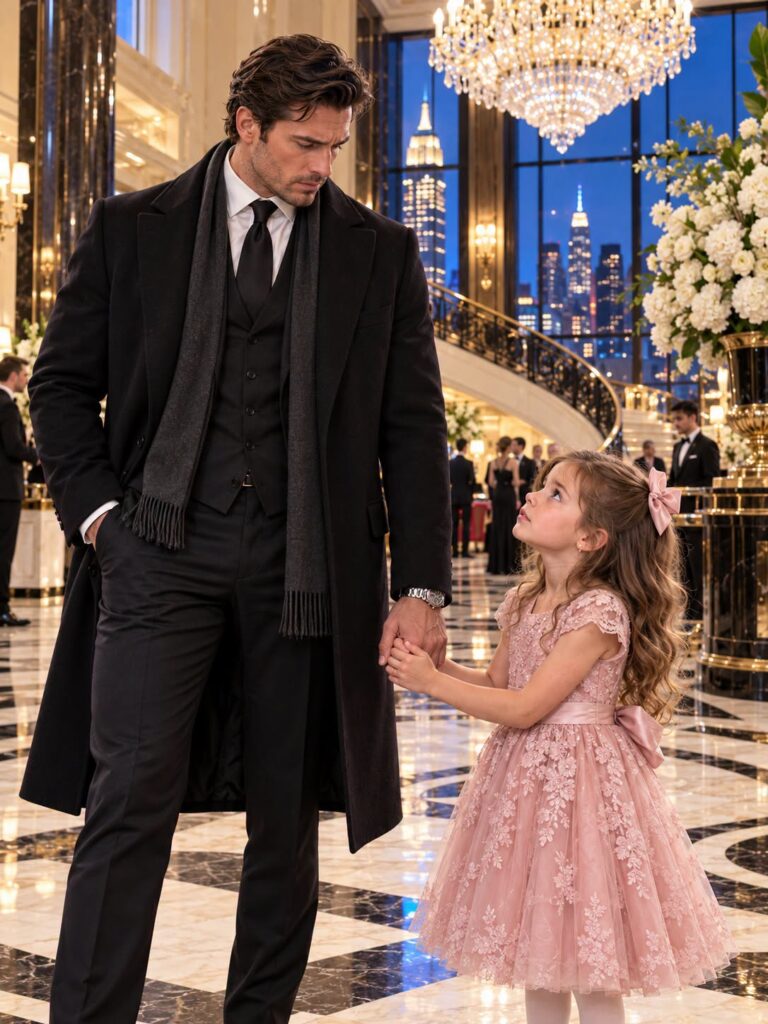
He had missed this.
The child.
The buttons.
The way the entire house had emptied when he came through the door.
Damon looked down.
The little girl was still holding his hand.
Three fingers remained half curled.
She worked them open one by one.
Patiently.
Then she rubbed her thumb over his knuckles again.
Small circles.
Exactly three.
Pause.
Exactly three more.
Damon stopped breathing.
“Who taught you that?”
The girl looked up.
Her eyes were dark brown and solemn.
“Baba.”
“What’s your name?”
“Millie.”
He knew that much after she said it.
Millie Reed.
Three years old.
Her mother, Elena Reed, had joined the household staff six months earlier as an assistant seamstress and general housekeeper.
Damon had approved the employment file.
He remembered the numbers.
Not the woman.
That realization landed unpleasantly.
“Your grandmother taught you?”
Millie nodded.
“What is her name?”
“Marta.”
The corridor seemed to narrow.
Damon crouched slowly.
“Marta what?”
The child considered this important question.
Then:
“Petrov.”
His hand went completely still.
Marta Petrov.
For thirty years, Damon had refused to say that name.
Not because he had forgotten it.
Because he had remembered too much.
A kitchen with yellow curtains.
Flour on a woman’s cheek.
A boy of fourteen standing beside his father’s study with blood on his lip after answering a question badly.
Marta taking his fist.
“Open.”
He refused.
She opened one finger.
Then another.
Then another.
“You hold anger too tightly, Dima, it thinks it belongs to you.”
Three circles over his knuckles.
Pause.
Three more.
His mother had been dead four years by then.
Marta had been the closest thing remaining.
Then one morning she was gone.
His father told him she had stolen money.
Damon had asked where she went.
His father answered:
“People who betray this family do not get goodbyes.”
Damon never asked again.
At forty-five, he looked at a three-year-old standing beneath his chandelier and heard himself say:
“Is Marta Petrov alive?”
Millie’s face fell.
“Baba went to heaven.”
Something inside him sank.
“When?”
She held up fingers.
That did not help.
A voice came from the back corridor.
“Millie?”
A woman hurried around the corner.
Early thirties.
Dark hair pinned badly.
Gray staff dress.
She stopped when she saw Damon crouched beside her daughter.
Color vanished from her face.
“Mr. Vosilenko.”
Millie turned.
“Mama.”
Elena Reed crossed the marble quickly.
“I’m sorry. Mrs. Halpern let me bring her today because daycare closed. She was supposed to stay in the sewing room.”
Millie held up the buttons.
“I sorted.”
“Yes, baby.”
Elena took her hand.
“We’ll leave.”
Damon stood.
“No.”
She froze.
His tone had done what it always did.
Changed the temperature.
He softened it deliberately.
“Please.”
That word clearly surprised her.
“Your mother was Marta Petrov?”
Elena’s eyes changed.
Not fear now.
Recognition.
“Yes.”
“Why didn’t you tell me?”
She looked at him for several seconds.
“Would it have helped me get the job?”
“No.”
“Could it have prevented me from getting it?”
Damon said nothing.
There was his answer.
Elena nodded.
“I needed work.”
“When did she die?”
“February.”
He looked away.
Nine months.
Marta had been alive nine months ago.
He had been living seventeen miles away.
“How old?”
“Seventy-four.”
“Was she ill?”
“For a while.”
Millie tugged his sleeve.
“Baba had bad lungs.”
Elena closed her eyes.
“Millie.”
“What?”
“Go see Mrs. Halpern.”
“I want my buttons.”
“You can take them.”
Millie gathered the buttons into both hands.
Before leaving, she looked at Damon.
“Your hand is better.”
He stared at her.
“Yes.”
Satisfied, she walked away.
Damon waited until her footsteps disappeared.
Then:
“Did your mother ever talk about this house?”
Elena laughed once.
There was no humor in it.
“All the time.”
“What did she say?”
“That it was beautiful.”
He waited.
“And?”
“That beautiful houses can still teach children to be frightened.”
Damon looked toward the closed doors where his employees had disappeared minutes earlier.
The sentence found its target too easily.
“What else?”
Elena hesitated.
“My mother loved you.”
Damon’s jaw tightened.
“She stole from us.”
“No.”
The word came quickly.
Too quickly to be cautious.
Damon looked at her.
Elena continued.
“She never stole anything.”
“My father found cash in her room.”
“My mother said he put it there.”
Silence.
Thirty years ago, Damon would have called that impossible.
Twenty years ago, disloyal.
Ten years ago, irrelevant.
Today, after watching his entire household flee because he slammed a door, he asked:
“Why?”
Elena looked toward his father’s old study.
“Because she was going to take you away.”
Damon’s face hardened.
“What?”
“She thought you weren’t safe here.”
“I was fourteen.”
“Yes.”
“My father never—”
He stopped.
Memory had entered before the sentence finished.
A split lip.
A cracked bedroom door.





