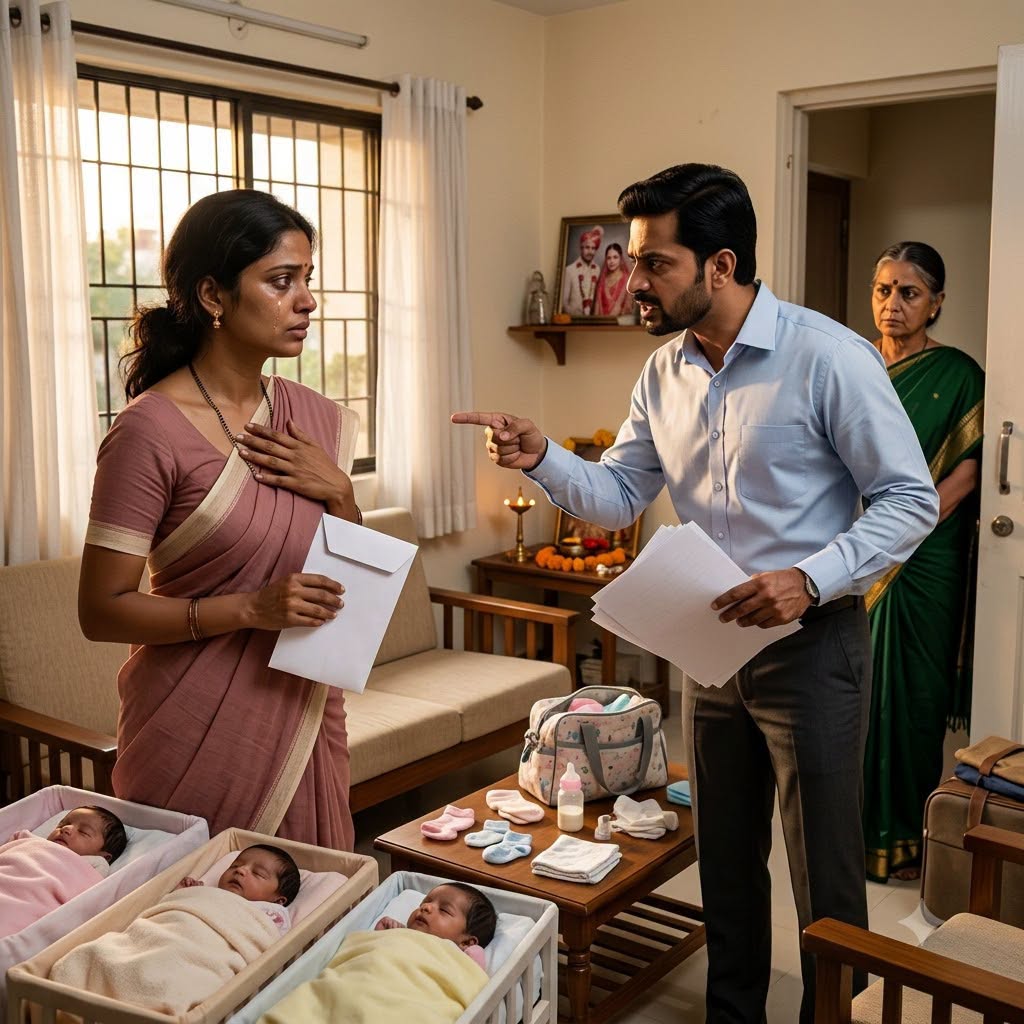
She lowered her head.
I looked toward the bedroom.
“Do you know what Ishani asked me after you left that day?”
Devyani shook her head.
“She asked whether women stop being good mothers when their husbands stop loving them.”
Devyani began crying so hard she could barely breathe.
I continued.
“She is six years old.”
For a long time, nobody spoke.
Then Devyani folded her hands.
“I don’t deserve your forgiveness.”
I answered quietly.
“Then don’t ask for it today. Show your grandchildren that you can tell the truth, even when it makes your own son look bad.”
She nodded.
And she did.
She spoke to relatives who had repeated the accusations.
She corrected the stories.
She apologized to Bhairavi for refusing to listen.
And one evening, she sat beside Shlok and Ishani and told them that their mother had done nothing wrong.
I did not know whether I would ever trust her again.
But I was grateful my children had finally heard the truth from the person who had helped spread the lie.
Over the following year, my life changed slowly.
I returned to teaching part-time.
My mother stayed with us until the girls were stronger.
Bhairavi helped arrange reliable childcare.
The school principal adjusted my schedule so I could work around the babies’ needs.
I began giving mathematics lessons online.
Some evenings, I taught while three tiny girls slept in a row beside my desk.
Other evenings, all three cried together.
There were days when I felt exhausted beyond words.
But whenever I looked at their faces, I remembered something.
They had never been the problem.
They were the reason I discovered how strong I could become.
Through legal advice, Avinash and I arranged financial support for all five children and a structured visitation schedule.
I filed for divorce.
It was not an easy decision.
There were nights when I missed the man I thought I had married.
But I no longer confused missing someone with needing them back.
Yamini eventually left Avinash.
Bhairavi told me she had discovered that a man willing to humiliate one woman could not be trusted to protect another.
I felt no triumph.
I remembered how much pain had been caused by people treating marriage like a competition.
There were no winners in that part of our story.
Only children and adults trying to recover from the damage.
On the triplets’ first birthday, our apartment was filled with balloons.
Shlok insisted on decorating the wall himself.
Ishani made three handmade crowns.
My mother prepared kheer.
Bhairavi arrived with matching pink dresses.
And when the girls sat together in their little chairs, everyone began laughing.
Vaidehi tried to grab the cake.
Ishwari pulled off her crown.
Triveni clapped whenever someone said her name.
I stood watching them.
For a moment, I remembered the hospital corridor where I had cried alone after learning I was carrying triplets.
I remembered wondering how I would feed them.
How I would survive.
Whether anyone would ever love them.
Now the room was overflowing with love.
My mother approached and placed her hand on my shoulder.
“What are you thinking, beta?”
I smiled through my tears.
“About the day the doctor told me there were three.”
She nodded.
“I was so frightened, Maa.”
“I know.”
“I thought my life was over.”
She looked toward the children.
“And now?”
I watched Shlok carefully lift Triveni’s fallen crown.
I watched Ishani kiss Vaidehi’s cheek.
I watched my three little daughters laugh together.
Then I whispered, “Now I know my life was beginning again.”
That night, after the guests left, I found the old pregnancy test in a small box beneath my wardrobe.
The two pink lines had faded.
Beside it lay the first ultrasound photograph.
Three tiny shapes.
Three heartbeats.
Three daughters who had entered a marriage already breaking apart.
I placed the ultrasound beside their first birthday photograph.
Then I wrote one sentence on the back.
You were never evidence of my shame. You were always proof that my life still held beautiful surprises.
I closed the box.
Outside, rain began falling softly.
The same kind of rain that had fallen on the night Avinash walked away.
But this time, I was not standing alone.
Five children were sleeping beneath my roof.
My mother was humming in the kitchen.
And somewhere between the heartbreak and the healing, I had learned that being abandoned does not mean being unworthy.
It means someone else made a choice.
Their choice does not have to become the story of your entire life.
I looked at my daughters one last time before switching off the light.
“Sleep well, my little girls,” I whispered.
“One day, you will hear stories about how you came into this world.”
I kissed each forehead.





