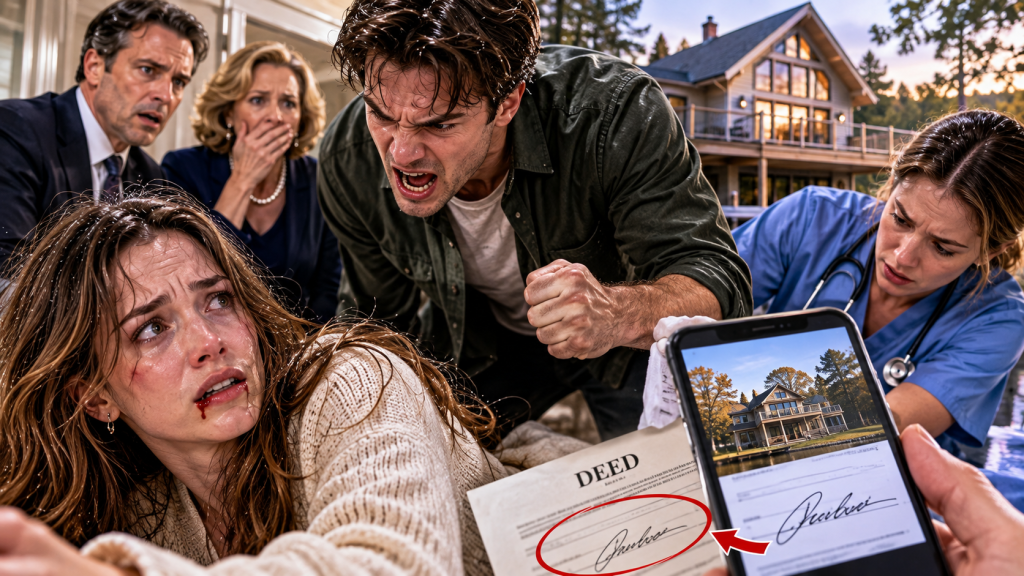
“This should have been mine!”
My stepbrother Ryan’s fist caught my mouth before I could push back my chair. I hit the carpet beside Grandpa’s attorney’s table, tasting blood as a photograph of the lake house slid off my lap.
Dad stood up, but not to help me.
“Ryan, calm down,” he said. Then, to me: “Emily, you knew this would upset him.”
I’d just been told that Grandpa had left me the little cedar house on Lake Wawasee, Indiana. Ryan had expected it for years. He’d already talked about replacing the porch with a deck large enough for vacation renters.
The attorney, Ms. Whitcomb, called 911 while Ryan paced by the windows.
“You stole it from me,” he said.
I pressed a tissue against my lip. “Grandpa signed his own will.”
“You put ideas in his head.”
There was nothing to say to that.
When Mom died, I was eleven. Grandpa picked me up from school every Friday and drove me to the lake, where he taught me to repair fishing reels and make grilled cheese without burning the bread. He kept a yellow raincoat on a hook near the door because I always forgot mine.
Ryan joined our family when Dad remarried. Grandpa welcomed him, too. But when Grandpa’s hands began trembling, Ryan visited to discuss property values. I visited to wash sheets, label his medication, and sit beside him when he couldn’t remember which season it was.
At the hospital, a nurse cleaned my split lip and handed me a paper cup of water. I couldn’t drink without wincing.
Dad texted: Don’t press charges. Ryan’s under pressure.
I turned the phone facedown.
Grandpa’s attorney had given me one thing before the meeting began: a photocopy of a handwritten note he sent her several weeks before his final hospitalization.
If anybody says I signed the lake house away, ask where I was that day.
I hadn’t understood why she’d included it.
My phone vibrated again. This time it was Ms. Whitcomb.
Emily, the county recorder sent the deed Ryan said was destroyed. It transfers the lake house to his company. Look at the date.
I enlarged the attachment.
The deed was supposedly signed and notarized on a Tuesday in October.
On that very Tuesday, I’d been sitting beside Grandpa in the hospital, holding a straw to his lips because he could no longer lift his water glass.
And the signature on the deed was his name, written in a hand I’d never seen.
I called Ms. Whitcomb from the emergency-room hallway.
“The deed doesn’t mean he owns it automatically,” she said. “But it creates a title dispute. We need to establish whether Grandpa actually signed it.”
I asked her not to tell Ryan what we’d found until she’d preserved the county record and spoken with the estate’s representative.
By the time I reached my apartment, Ryan had posted a photograph of my swollen face in the family group chat.
She’s pretending I attacked her because she manipulated Grandpa. He promised me the property.
Dad replied with a thumbs-up.
I stared at the little blue symbol. When I was a child, Dad had taught me to ride a bicycle by running alongside it, one hand under the seat. I couldn’t remember when he’d stopped reaching out to catch me.
I filed a police report and gave the officer Ms. Whitcomb’s name. The attorney and her assistant had witnessed the punch.
Two days later, Ryan appeared at my door carrying a folder.
“Sign this settlement,” he said. “You keep twenty thousand dollars. I keep the house. Everybody moves on.”
His real-estate agency logo was printed across the top. He was already marketing a property whose ownership was disputed.
“Leave, Ryan.”
He laughed. “You can’t afford a lawsuit.”
I closed the door and sent a photograph of the papers to Ms. Whitcomb.
She requested the hospital records through the estate’s authorized representative and arranged for an examiner to compare the questioned signature with Grandpa’s verified signatures. She also found the notary named on the deed.
The notary said Grandpa had appeared in person at her office.
But the hospital’s nursing notes recorded his condition and location throughout that same afternoon. He hadn’t left his room.
Then Aunt June, Grandpa’s younger sister, brought over an old shoebox. Inside were photographs, bait-shop receipts, and a small appointment book.
One October page read: Ryan came. Said papers were just for taxes. Told him no. Call Whitcomb.
“That was his last clear week,” June said. Her thumb rested on the corner of the page. “He was frightened you’d lose the place.”
I sat with the book open until evening.
A week later, Ms. Whitcomb called. Ryan had refused to withdraw the deed, and his brokerage’s compliance officer had asked for an explanation after receiving notice of the dispute.





