“I was planning to give Claire one house,” Daniel said quietly. “Not the development.”
“Does she know that?”
“I tried to tell her. Your mother kept calling it a surprise.”
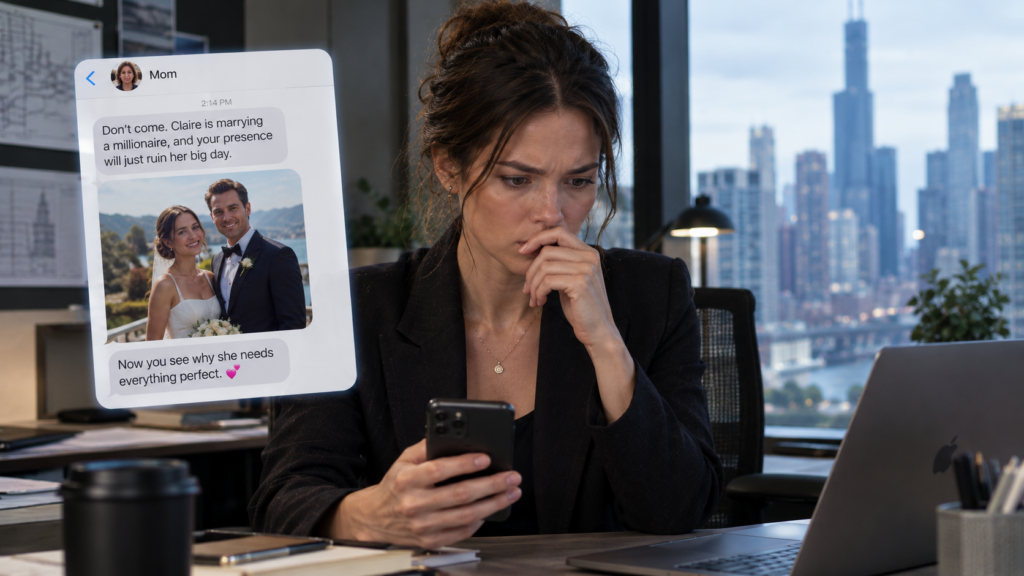
My phone buzzed.
Mom had added me to the family group chat.
“Since Rachel insists on making everything about herself, Daniel will explain tonight exactly who owns what.”
Then another message:
“Maybe this will finally humble her.”
Daniel read it over my shoulder.
His face went still.
Because for the first time, Mom had accidentally demanded the truth in front of everyone.
At 7:30 that night, the family video call began.
Mom had invited everyone.
Claire. Aunt Susan. Two cousins. Richard. Even Daniel’s parents.
Mom appeared first beneath the chandelier in her dining room.
“Well,” she said, smiling tightly, “Daniel can clear up this ridiculous misunderstanding.”
Daniel joined from his apartment.
I stayed muted.
Claire leaned toward her camera. “Please explain to Rachel that the lake property is ours.”
Daniel’s expression changed.
“Claire, it isn’t.”
Her smile vanished.
“What?”
“One house was going to be my wedding gift to you.”
Mom cut in. “You said Mercer Lake Estates was your project.”
“It is my company’s project.”
“Exactly.”
“On land my company partly owns.”
Silence.
Daniel continued.
“The access parcel belongs to Rachel.”
My aunt’s eyebrows lifted.
Claire stared at me through the screen.
Mom laughed, but it sounded thin.
“A strip of dirt?”
“The strip containing the only legal road access to the waterfront section,” Daniel said.
Nobody spoke.
He explained the easement, the restrictions, the signatures, and the fact that my land could not be transferred without my written consent.
Then he added something I hadn’t expected.
“Rachel also designed the original site plan that made the project financially viable. I hired her firm before I knew she was related to Claire.”
Mom’s face lost its color.
Claire whispered, “You knew him before me?”
“Professionally,” I said.
“For how long?”
“About eighteen months before your engagement.”
Mom leaned toward the camera. “Why didn’t you tell us?”
I looked at her.
“You told me to stay away.”
That ended the conversation more effectively than shouting could have.
Claire left the call.
Mom followed seconds later.
The wedding still happened three days later.
I did not attend.
Not because I was still banned.
Claire called the next morning and asked me to come.
Her voice was smaller than I remembered.
“I didn’t know,” she said.
“I know.”
“Mom made it sound like you were jealous.”
“I know that too.”
A long pause.
“Will you come?”
I looked at the dress hanging untouched in my closet.
“No, Claire.”
She inhaled sharply.
“I’m not punishing you. But you told me not to come before you knew what I owned. I don’t want an invitation that exists only because the balance of power changed.”
She cried quietly.
I stayed on the phone.
But I didn’t change my answer.
Three months later, Claire and Daniel were still married.
He gave her the house he had originally planned to give her, after correcting every legal document and advertisement connected to the development.
Mom’s social media posts disappeared.
She never apologized directly.
Instead, she texted one Sunday:
“I suppose I underestimated how involved you were.”
I read it once.
Then locked my phone.
Some people apologize by naming what they did.
Others rewrite the sentence so they can live with themselves.
Claire and I eventually started talking again.
Slowly.
No dramatic reunion. No instant forgiveness.
Just coffee, birthdays, and careful conversations where neither of us pretended the past had vanished.
As for the lake parcel, I kept it.
Not because I wanted leverage over Daniel.
Because Grandpa had left it to me, and I finally stopped feeling guilty for keeping something that was mine.
The following summer, I stood on that narrow strip of shoreline while workers finished the access road.
The land Mom had dismissed as “a strip of dirt” was quiet beneath my shoes.
I remembered her first message.
Stay away.
So I smiled.
Sometimes staying away is exactly how you learn what deserves access to you—and what doesn’t.





